

Section 11: Vehicle Inspection Test
11.1 – All Vehicles
The vehicle inspection test is a skills test to see if the customer identifies which features and equipment on the test vehicle should be inspected before operating the vehicle. Interpreters are prohibited. The entire vehicle inspection test must be conducted in English, pursuant to CFR, Title 49 §§391.11(b)(2) and 383.133(c)(5).
If you communicate in a language other than English, or fail to comprehend instructions given to you in English, during the skills tests (vehicle inspection, basic control skills, and road test), you will receive a verbal warning for the first 2 offenses committed on the same test date. Upon the third offense committed on the same test date, the test will end as an automatic failure.
A vehicle inspection should be done the same way each time so you will learn all the steps and be less likely to forget something during the test.
Vehicle inspection tests are conducted to ensure that a vehicle is safe to operate. During the vehicle inspection test, you will be expected to explain or show your knowledge of the vehicle inspection process.
During the vehicle inspection test, you must show that the vehicle is safe to drive. You will have to walk around the vehicle, name, point to, or touch each item and explain to the examiner what you are checking and why. Any vehicle that has components marked or labeled cannot be used for the vehicle inspection test. The brake lights, emergency flashers, turn signals, and horn must be checked. If any of these items do not work, the skills and road portions of the test will be postponed.
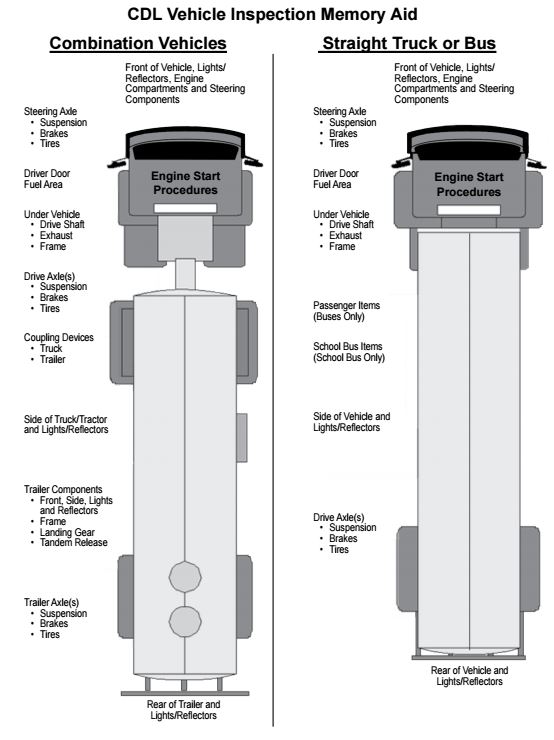
You may use the guides shown on the last page of this section when taking your vehicle inspection test. You cannot write any instructions or notes on the vehicle inspection guide. If you do not pass the vehicle inspection test, the other tests will be postponed.
Remember: You are allowed a total of 3 attempts to pass the vehicle inspection, basic control skills, and road tests.
11.2 Internal Inspection (All Vehicles)
Study the following vehicle parts for the type of vehicle you will be using during the CDL skills tests. You should be able to identify each part and tell the examiner what you are looking for or inspecting.
As you approach the vehicle, notice its general condition. Look for damage or if the vehicle is leaning to one side. Look under the vehicle for fresh oil, coolant, grease, or fuel leaks. Check area around the vehicle for hazards to vehicle movement such as people, other vehicles, objects, low hanging wires, or limbs, etc.
Check that the parking brakes are set and/or wheels chocked. You may have to raise the hood or open the engine compartment door. Check the following:
11.2.1 – Engine Compartment (Engine Off)
Leaks/Hoses
- Look for puddles on the ground.
- Look for dripping fluids on underside of the engine and transmission.
- Inspect hoses for condition and leaks.
- Water Pump.
— Identify the water pump.
— Identify that the water pump is mounted securely and is not leaking. - Alternator.
— Identify the alternator.
— Check that the alternator is securely mounted and that all wires are securely fastened. - Air Compressor.
— Identify the air compressor.
— Check that the air compressor is securely mounted and is not leaking.
Oil Level
- Check the oil level when the engine is off.
- Indicate where the dipstick is located.
- See that the oil level is within safe operating range. the level must be above the refill mark.
Coolant Level
Look at the sight glass on the radiator or coolant reservoir; the adequate level will show in sight glass. If no sight glass is available, you must describe what you would look for after removing radiator cap.
Power Steering Fluid
Check the dipstick and see where the fluid level is relative to the refill mark or check the sight glass. The level must be above refill mark.
Windshield Washer Fluid Level
Check the fluid level and that the cap is secure.
Engine Compartment Belts
- Check the following belts for snugness (1/2 to 3/4 inch play at center of the belt), cracks, frays, loose fibers, or signs of wear:
— Power steering belt.
— Water pump belt.
— Alternator belt.
— Air compressor belt.
Note If any of the components listed above are not belt driven, you must:
- Tell the examiner which component(s) are not belt driven.
- Make sure the component(s) are operating properly, not damaged or leaking, and mounted securely.
Hydraulic Brakes Master Cylinder and Brake Fluid
- Check that the master cylinder is securely attached and not leaking.
- Check the level of brake fluid in the reservoir to ensure it is between the add and full marks.
Safe Start
- Place the gearshift lever in Neutral (or Park, for automatic transmissions).
- Depress the clutch before attempting to start the vehicle.
- Start the vehicle and keep the clutch depressed until the engine reaches idling speed, then release the clutch slowly.
11.2.2 – Cab Check/Engine Start
Oil Pressure Gauge
- Make sure the oil pressure gauge is working.
- Check that the pressure gauge shows increasing or normal oil pressure or that the warning light goes off.
- If equipped, the oil temperature gauge should begin a gradual rise to the normal operating range.
Temperature Gauge
- Make sure the temperature gauge is working.
- The temperature should begin to climb to the normal operating range or the temperature light should be off.
Air Gauge
- Make sure the air gauge is working properly.
- Build air pressure to the governor cut-out, approximately 120–140 psi or as specified by the manufacturer.
Ammeter/Voltmeter
Check that the gauges show that the alternator and/or generator is charging or that the warning light is off.
The Mirrors and the Windshield
- Mirrors should be clean and adjusted properly from the inside.
- Windshield should be clean with no illegal stickers, no obstructions, or damage to the glass.
Emergency Equipment
- Check for spare electrical fuses.
- Check for 3 red reflective triangles, 6 fuses or 3 liquid burning flares.
- Check that the fire extinguisher is properly charged and securely mounted.
Note If the vehicle is not equipped with electrical fuses, you must mention this to the examiner.
Check Optional Emergency Equipment
- Tire chains (where winter conditions require them).
- Tire changing equipment.
- List of emergency phone numbers.
- Accident reporting kit (packet).
Wipers/Washers
- Check that the wiper arms and blades are secure, not damaged, and operate smoothly.
- If equipped, the windshield washers must operate correctly.
Lights/Reflectors/Reflector Tape Condition (Sides and Rear)
- Test that the dash indicators work when the corresponding lights are turned on:
— Left turn signal.
— Right turn signal.
— 4-way emergency flashers.
— High-beam headlight.
— Anti-lock Braking System (ABS) indicator. - Check that all external lights and reflective equipment are clean and functional and not broken or missing. Light and reflector checks include verification of correct color:
— Clearance lights (red on rear, amber elsewhere).
— Headlights (high and low beams).
— Backing lights.
— Turn signals.
— 4-way emergency flashers.
— Brake lights.
— Red reflectors (on rear) and amber reflectors (elsewhere).
— Reflector tape condition.
— License plate light(s).
Note Checks of the brake, turn signals, and 4-way emergency flasher functions must be done separately.
Horn
Check that the air horn and/or electric horn(s) work.
Heater/Defroster
Test that the heater and defroster work.
Parking Brake Check
- Fasten your seat belt.
- With the air pressure built to governor cutout and the parking brake engaged (trailer brakes released on combination vehicles), check that the parking brake will hold the vehicle by gently trying to pull forward with the parking brake on.
- With the air pressure built to governor cutout, and the trailer parking brake engaged (combination vehicles only), check that the trailer parking brake will hold the vehicle by gently trying to pull forward with the trailer parking brake on.
Hydraulic Brake Check
- Pump the brake pedal 3 times, and then hold it down for 5 seconds. The brake pedal should not move (depress) during the 5 seconds.
- If equipped with a hydraulic brake reserve (back up) system, with the key off, depress the brake pedal and listen for the sound of the reserve system electric motor.
- If equipped with a “HydroBoost” brake system, with the engine off, release the parking brake, depress and release the brake pedal several times to deplete all hydraulic pressure. Depress and hold the brake pedal with light pressure (15–25 pounds) and then start the engine and run it at idle speed. If the Hydro-Boost is operating, the pedal will yield slightly to foot pressure and then hold. Less pressure is required to hold the pedal at this position.
- Check that the warning buzzer or light is off.
Note Failure to perform both components of the hydraulic brake check will result in an automatic failure of the vehicle inspection test.
Air Brake Check (Air Brake-Equipped Vehicles Only)
Refer to Section 5, In-Cab Air Brake Check for DMV vehicle inspection testing. All items marked with an asterisk (*) are required during the vehicle inspection test. These items must be demonstrated and the parameters verbalized to receive credit. Failure to perform these air brake tests correctly will result in an automatic failure for the entire vehicle inspection portion of the test.
Service Brake Check
You will be required to check the application of air or hydraulic service brake. This procedure is designed to determine that the brakes are working correctly and that the vehicle does not pull to one side or the other.
Pull forward at 5 mph, apply the service brake, and stop. Check to see that the vehicle does not pull to either side and that it stops when the brake is applied.
Safety Belt
Check that the safety belt is securely mounted, adjusts, and latches properly, and is not ripped or frayed.
11.3 – External Inspection (All Vehicles)
11.3.1 – Steering
Steering Box/Hoses
- Check that the steering box is securely mounted and not leaking. Look for any missing nuts, and/or bolts.
- Check for power steering fluid leaks or damage to the power steering hoses.
Steering Linkage
- See that connecting links, arms, and rods from the steering box to the wheel are not worn or cracked.
- Check that joints and sockets are not worn or loose and that there are no missing nuts, bolts, or cotter keys.
11.3.2 – Suspension
Springs/Air/Torque
- Look for missing, shifted, cracked, or broken leaf springs. If 1/4 or more are missing or broken, it will put the vehicle “out of service.”
- Look for broken or distorted coil springs.
- If the vehicle is equipped with torsion bars, torque arms, or other types of suspension components, check that they are not damaged and are mounted securely.
- Air ride suspension should be checked for damage and leaks.
Mounts
Look for cracked or broken spring hangers, missing or damaged bushings, and broken, loose, or missing bolts, u-bolts, or other axle mounting parts. The mounts should be checked at each point where they are secured to the vehicle frame and axle(s).
Shock Absorbers
See that shock absorbers are secure and that there are no leaks.
Note Be prepared to perform the same suspension components inspection on every axle (power unit and trailer, if equipped).
11.3.3 – Brakes
Slack Adjustors and Pushrods
- Check that the slack adjuster is securely mounted.
- Look for broken, loose, or missing parts.
- For manual slack adjustors, the brake pushrod should not move more than 1 inch (with the brakes released) when pulled by hand.
Brake Chambers
- See that the brake chambers are not leaking, cracked, or dented, and are mounted securely.
- See that there are no loose or missing clamps.
Brake Hoses/Lines
- Check that the hoses or lines can supply air or hydraulic fluid to the brakes.
- Check for cracked, worn or frayed hoses and all couplings and fittings are secured and not leaking.
Drum Brake
- Check for cracks, dents, or holes. Also, check for loose or missing bolts.
- Check for contaminates, such as debris or oil/grease.
Brake Linings
Brake linings (where visible) should not be worn dangerously thin. On some brake drums, there are openings where the brake linings can be seen from outside the drum. For this type of drum, check that a visible amount of brake lining is showing.
Note Be prepared to perform the same brake components inspection on every axle (power unit and trailer, if equipped).
11.3.4 – Wheels
Rims
- Check for damaged or bent rims.
- Rims cannot have welding repairs.
- Check the rims for rust trails that may indicate the rim is loose on the wheel.
Tires
- The following items must be inspected on every tire:
— Tread depth: Check for the minimum tread depth (4/32 on steering axle tires, 2/32 on all other tires).
— Tire condition: Check that the tread is evenly worn and look for cuts or other damage to tread or sidewalls. Also, make sure that valve caps and stems are not missing, broken, or damaged.
— Tires are the same type(not mixed radial and bias). Front tires for buses cannot be recapped, retreaded, or regrooved.
— Tire inflation: Check for proper inflation by using a tire gauge.
Note You will not get credit for simply kicking the tires or striking the tire with a mallet or other similar device to check for proper inflation.
Hub Oil/Axle Seals
See that the hub oil/grease and axle seals are not leaking and, if the wheel has a sight glass, that the oil level is adequate.
Lug Nuts
- Check that all lug nuts are present, free of cracks and distortions, and show no signs of looseness such as rust trails or shiny threads.
- Make sure all bolt holes are not cracked or distorted.
Spacers or Budd Spacing
- If equipped, check that spacers are not bent, damaged, or rusted through.
- The spacers should be evenly centered, with the dual wheels and tires evenly separated.
- Check that no debris and/or foreign objects are between dual tires.
Note Be prepared to perform the same wheel inspection on every axle (power unit and trailer, if equipped).
11.3.5 – Side of Vehicle
Door(s)/Mirror(s)/Window(s)
- Check that the door(s) are not damaged and that they open and close properly from the outside.
- Hinges should be secure with the seals intact.
- Check that the mirror(s) and mirror brackets are not damaged, are mounted securely with no loose fittings, and are free of excessive dirt.
- Windows must be clean and work properly.
Fuel Tank
Check that the tank(s) are secure, cap(s) are tight, and that there are no leaks from tank(s), cap(s), or lines.
Drive Shaft
- See that the drive shaft is not bent or cracked.
- Couplings (U-joints) should be secure and free of foreign objects.
Exhaust System
- Check the system for damage and signs of leaks such as rust or carbon soot.
- The exhaust system should not have cracks, holes, or severe dents.
- The system should be connected tightly and mounted securely.
If equipped with emissions after-treatment equipment:
- Check the diesel exhaust fluid (DEF) tank to ensure the level of DEF in the tank is adequate (more than 1/8 tank).
- Check that the DEF indicator on the dash is working properly.
Frame
Look for cracks, broken welds, holes, or other damage to the longitudinal frame members, cross members, box, and floor.
11.3.6 – Rear of Vehicle
Splash Guards
If equipped, check that the splash guards or mud flaps are not damaged and are mounted securely.
Doors/Ties/Lifts
- Check that the doors and hinges are not damaged and that they open, close, and latch properly from the outside, if equipped.
- Ties, straps, chains, and binders must also be secure.
- If equipped with a cargo lift, look for leaking, damaged, or missing parts, and explain how it should be checked for correct operation.
- The lift must be fully retracted and latched securely.
11.3.7 – Tractor/Coupling
Air/Electric Connectors
Check that:
- The trailer air connectors are sealed and in good condition.
- The fittings out of the truck and trailer are secured.
- All connections from the truck to trailer are secured.
- The trailer electrical plug is firmly sealed and locked in place on both the truck and trailer.
Air/Electric Lines
- Listen for air leaks. Check that air hoses and electrical lines are not cut, chafed, spliced, or worn (steel braid should not show through).
- Make sure the air and electrical lines are not tangled, pinched, or dragging against tractor parts.
Catwalk/Steps
Check that the:
- Catwalk is solid, clear of objects, and securely bolted to tractor frame.
- Steps leading to the cab entry and catwalk (if equipped) are solid, clear of objects, and securely bolted to the tractor frame.
- Storage area is solid to the tongue and the cargo in the storage area is secured.
Mounting Bolts
- Look for loose or missing mounting brackets, clamps, bolts, or nuts. Both the fifth-wheel and slide mounting must be solidly attached.
- On other types of coupling systems (for example, ball hitch, pintle hook, etc.), inspect all coupling components and mounting brackets for missing or broken parts.
- Check for loose or missing mounting bolts. Look for broken welds on the pintle hook or other hitch mount, and tongue/drawbar assembly to ensure they are solidly attached in place.
Hitch Release Lever
Check to see that the hitch release lever is in place and secure.
Locking Jaws
- Look into the fifth-wheel gap and check that the locking jaws are fully closed around the kingpin.
- On other types of coupling systems (ball hitch, pintle hook, etc.), inspect the locking mechanism for missing or broken parts and make sure it is locked securely. If present, safety cables or chains must be secure and free of kinks and excessive slack.
Fifth-Wheel Skid Plate
Check for proper lubrication, that fifth-wheel skid plate is securely mounted to the platform, and that all bolts and pins are secure and not missing.
Platform (Fifth-Wheel) (Pintle Hook)
- Check for cracks or breaks in the platform structure which supports the fifth-wheel skid plate.
- Check the pintle hook for cracks, breaks, or excessive wear.
Release Arm (Fifth-Wheel)
If equipped, make sure the release arm is in the engaged position and the safety latch is in place.
Kingpin/Apron/Gap
- Explain that the locking jaws holds the kingpin in place and the kingpin is not bent or damaged.
- Make sure the visible part of the apron is not bent, cracked, or broken.
- Check that the trailer is lying flat on the fifth-wheel skid plate (no gap).
- Check for the kingpin lock.
Locking Pins (Fifth-Wheel)
- If equipped, look for loose or missing pins in the slide mechanism of the sliding fifth-wheel. If air powered, check for leaks.
- Make sure the locking pins are fully engaged.
- Check that the fifth-wheel is positioned properly so that the tractor frame will clear the landing gear during turns.
Sliding Pintle
Check the sliding pintle hook for excessive wear and to ensure it is secure with no loose or missing nuts or bolts and the cotter pin is in place.
Tongue or Draw-Bar
- Check that the tongue/draw-bar is not bent or twisted and check for broken welds and stress cracks.
- Check that the tongue/draw-bar eye is not worn excessively.
Tongue Storage Area
- Check that the storage area is solid and secured to the tongue.
- Check that cargo in the storage area (chains, binders, etc.) are secure.
11.4 – School Bus Only
Emergency Equipment
- In addition to checking for spare electrical fuses (if equipped), 3 red reflective triangles, 6 fuses or 3 liquid burning flares, and a properly charged and rated fire extinguisher; school bus drivers must also inspect the following emergency equipment:
— Emergency kit
— Body fluid cleanup kit
Lighting Indicators
- In addition to checking the lighting indicators listed in Section 10.2 of this handbook, school bus drivers must also check the following lighting indicators (internal panel lights):
— Alternately flashing amber lights indicator, if equipped.
— Alternately flashing red lights indicator.
— Strobe light indicator, if equipped.
Lights/Reflectors
- In addition to checking the lights and reflective devices listed in Section 10.2 of this handbook, school bus drivers must also check the following (external) lights and reflectors:
— Strobe light, if equipped, is operational and not broken.
— Stop arm light, if equipped.
— Alternately flashing amber lights, if equipped, are operational and not broken.
— Alternately flashing red lights, on the front and back of the vehicle are operational and not broken.
Student Mirrors
- In addition to checking the external mirrors, school bus drivers must also check the internal and external mirrors used for observing students:
— Check for proper adjustment.
— Check that all internal and external mirrors and mirror brackets are not damaged and are mounted securely with no loose fittings.
— Check that visibility is not impaired due to dirty mirrors.
Stop Arm/Safety Arm
If equipped, check the stop arm to see that it is mounted securely to the frame of the vehicle. Also, check for loose fittings and damage. Checks that the stop arm extends fully when operated.
Passenger Entry/Lift
- Check that the entry door is not damaged, operates smoothly, and closes securely from the inside.
- Check that the hand rails are secure and the step light is working, if equipped.
- Check that the entry steps are clear with the treads not loose or worn excessively.
- If equipped with a handicap lift, look for leaking, damaged, or missing parts, and explain how lift should be checked for correct operation.
- The lift must be fully retracted and latched securely.
- Make sure the lift control interlock(s) functions properly.
Emergency Exit
- Demonstrate that at least 1 emergency exit is not damaged, operates smoothly, and closes securely from the inside.
- Check that the release handle can be operated properly from both inside and outside the vehicle.
- Point out and describe how all other emergency exits operate.
- Check that any emergency exit warning devices are working properly.
Passenger Seating
- Look for broken seat frames and check that seat frames are firmly attached to the floor.
- Check that the seat cushions are attached securely to the seat frames.
11.5 – Trailer
11.5.1 – Trailer Front
Air/Electrical Connections
- Check that the trailer air connectors are sealed and in good condition.
- Make sure the glad hands are locked in place, and free of damage or air leaks.
- Make sure the trailer electrical plug is firmly seated and locked in place.
Header Board
- If equipped, check the header board to see that it is secure, free of damage, and strong enough to contain cargo.
- If equipped, the canvas or tarp carrier must be mounted and fastened securely.
- On enclosed trailers, check the front area for signs of damage such as cracks, bulges, holes, or missing rivets.
11.5.2 – Side of Trailer
Landing Gear
- Check that the landing gear is fully raised, has no missing parts, crank handle is secure, and support frame and landing pads are not damaged.
- If power operated, check for air or hydraulic leaks.
Doors/Ties/Lifts
- If equipped, check that the doors are not damaged. Check that the doors open, close, and latch properly from the outside.
- Check that ties, straps, chains, and binders are secure.
- If equipped with a cargo lift, look for leaking, damaged, or missing parts, and explain how it should be checked for correct operation.
- Lift should be fully retracted and latched securely.
Frame
Look for cracks, broken welds, holes, or other damage to the frame, cross members, box, and floor.
Tandem Release Arm/Locking Pins
If equipped, make sure the locking pins are locked in place and the release arm is secured.
11.5.3 – Remainder of Trailer
Remainder of Trailer
- Please refer to Section 11.3, External Inspection (All Vehicles) of this handbook for detailed inspection procedures regarding the following components:
— Wheels.
— Suspension system.
— Brakes.
— Doors/ties/lift.
— Splash guards.
11.6 – Coach/Transit Bus
11.6.1 – Passenger items
Passenger Entry/Lift
- Check that the entry doors operate smoothly and close securely from the inside.
- Check that the hand rails are secure and, if equipped, that the step light(s) are working.
- Check that the entry steps are clear, and the treads are not loose or worn excessively.
- If equipped with a handicap lift, look for any leaking, damaged, or missing part, and explain how it should be checked for correct operation.
- Lift should be fully retracted and latched securely.
- Make sure the lift control interlock(s) functions properly.
Emergency Exits
- Demonstrate that at least 1 emergency exit is not damaged, operates smoothly, and closes securely from inside.
- The release handle can be operated properly both from inside and outside of the vehicle.
- Points out and describes how all other emergency exits operate.
- Checks that any emergency exit warning devices are working properly.
Passenger Seating
- Look for broken seat frames and check that the seat frames are firmly attached to the floor.
- Check that the seat cushions are attached securely to the seat frames.
11.6.2 – Entry/Exit
Doors/Mirrors
- Check that the entry/exit doors are not damaged and operate smoothly from the outside. The hinges should be secure with seals intact.
- Make sure that the passenger exit mirrors, all external mirrors, and mirror brackets are not damaged and are mounted securely with no loose fittings.
11.6.3 – External Inspection of Coach/Transit Bus
Level/Air Leaks
See that the vehicle is sitting level (front and rear) and, if air-equipped, check for audible air leaks from the suspension system.
Fuel Tank(s)
See that fuel tank(s) are secure with no leaks from tank(s) or lines.
Baggage Compartments
Check that the baggage and all other exterior compartment doors are not damaged, operate properly, and latch securely.
Battery/Box
- Wherever located, see that the battery(ies) are secure, connections are tight, and cell caps are present.
- Battery connections should not show signs of excessive corrosion.
- Check that the battery box and cover, or door is not damaged and is secure.
11.6.4 – Remainder of Coach/Transit Bus
Remainder of Vehicle
Refer to Section 11.3, External Inspection (All Vehicles) of this handbook for detailed inspection procedures for the remainder of the vehicle.
Remember: The vehicle inspection test must be passed before you can proceed to the basic control skills test.
11.7 – Taking the CDL Vehicle Inspection Test
11.7.1 – Class A Vehicle Inspection Test
If you are applying for a Class A CDL, you will be required to perform 1 of 4 versions of a vehicle inspection in the vehicle you brought for testing. Each of the 4 tests are equivalent and you will not know which test you take until just before testing begins. Tests include an engine start, in-cab-inspection, and inspection of the coupling system. Your test may require an inspection of the entire vehicle or only a portion of the vehicle, which your CDL examiner will explain to you.
11.7.2 – Class B and C Vehicle Inspection Test
If you are applying for a Class B or Class C CDL, you will be required to perform 1 of 3 versions of a vehicle inspection in the vehicle you brought for testing. Each of 3 tests are equivalent and you will not know which test you take until just before testing begins. Tests include an engine start and in-cab inspection. Your test may require an inspection of the entire vehicle or only a portion of the vehicle, which your CDL examiner will explain to you. You will also have to inspect any special features of your vehicle (for example, school or transit bus).
Section 10: School Buses
You should be thoroughly familiar with California and your local school district laws and regulations.
A CLP holder with a “P” and/or an “S” endorsement is prohibited from operating a CMV with passengers, other than federal/state auditors and inspectors, test examiners, other trainees, and the accompanying CDL holder (CFR, Title 49 §383.25).
Note As of July 1, 2018, it is required that a passenger in a bus equipped with seat belts to be properly restrained by a safety belt. Parents, legal guardians, or chartering parties are prohibited from transporting on a bus that is equipped with safety belts, or permitting to be transported on a bus that is equipped with safety belts, a child, ward, or passenger who is under 8 years of age and under 4 feet 9 inches in height, but under 16 years old, unless they are properly restrained by a safety belt.
10.1 – Danger Zones and Use of Mirrors
10.1.1 – Danger Zones
The danger zone is the area on all sides of the bus where children are in the most danger of being hit, either by another vehicle or their own bus. The danger zones may extend as much as 30 feet from the front bumper (with the first 12 feet being the most dangerous), 12 feet from the left and right sides, and 12 feet behind the rear bumper of the school bus. In addition, the area to the left of the bus is always considered dangerous because of passing cars. Figure 10.1 illustrates these danger zones.
10.1.2 – Correct Mirror Adjustment
Proper adjustment and use of all mirrors is vital to the safe operation of the school bus in order to observe the danger zone around the bus and look for students, traffic, and other objects in this area. You should always check each mirror before operating the school bus to obtain maximum viewing area. If necessary, have the mirrors adjusted.

Figure 10.1
10.1.3 – Outside Left and Right Side Flat Mirrors
These mirrors are mounted at the left and right front corners of the bus at the side or front of the windshield. They are used to monitor traffic, check clearances, and check for students on the sides and to the rear of the bus. There is a blind spot immediately below and in front of each mirror and directly in back of the rear bumper. The blind spot behind the bus extends 50 to 150 feet and could extend up to 400 feet depending on the length and width of the bus.
Ensure that the mirrors are properly adjusted so you can see:
- 200 feet or 4 bus lengths behind the bus.
- Along the sides of the bus.
- The rear tires touching the ground.
Figure 10.2 shows how both the outside left and right side flat mirrors should be adjusted.

10.1.4 – Outside Left and Right Side Convex Mirrors
The convex mirrors are located below the outside flat mirrors. They are used to monitor the left and right sides at a wide angle. They provide a view of traffic, clearances, and students at the side of the bus. These mirrors present a view of people and objects that does not accurately reflect their size and distance from the bus.
You should position these mirrors to see:
- The entire side of the bus up to the mirror mounts.
- The front of the rear tires touching the ground.
- At least 1 traffic lane on either side of the bus.
Figure 10.3 shows how both the outside left and right side convex mirrors should be adjusted.

10.1.5 – Outside Left and Right Side Crossview Mirrors
These mirrors are mounted on both the left and right front corners of the bus. They are used to see the front bumper “danger zone” area directly in front of the bus that is not visible by direct vision, and the “danger zone” area to the left and right side of the bus, including the service door and front wheel area. The mirror presents a view of people and objects that does not accurately reflect their size and distance from the bus. The driver must ensure that these mirrors are properly adjusted. Every school bus shall be equipped with a crossview mirror mounted on the front exterior of the bus to provide the seated driver with a clear view of the area directly in front of the bus (CCR, Title 13 §1258).
Ensure that the mirrors are properly adjusted so you can see:
- The entire area in front of the bus from the front bumper at ground level to a point where direct vision is possible. Direct and mirror view vision should overlap.
- The right and left front tires touching the ground.
- The area from the front of the bus to the service door.
- These mirrors, along with the convex and flat mirrors, should be viewed in a logical sequence to ensure that a child or object is not in any of the danger zones.
Figure 10.4 illustrates how the left and right side crossview mirrors should be adjusted.

Figure 10.4
10.1.6 – Overhead Inside Rearview Mirror
This mirror is mounted directly above the windshield on the driver’s side area of the bus. This mirror is used to monitor passenger activity inside the bus. It may provide limited visibility directly behind the bus if the bus is equipped with a glass-bottomed rear emergency door. There is a blind spot area directly behind the driver’s seat, as well as a large blind spot area that begins at the rear bumper and could extend up to 400 feet or more behind the bus. You must use the exterior side mirrors to monitor traffic that approaches and enters this area.
You should position the mirror to see:
- The top of the rear window in the top of the mirror.
- All of the students, including the heads of the students right behind you.
10.2 – Loading and Unloading
More students are killed while getting on or off a school bus each year than are killed as passengers inside of a school bus. As a result, knowing what to do before, during, and after loading or unloading students is critical. This section will give you specific procedures to help you avoid unsafe conditions that could result in injuries and fatalities during and after loading and unloading students.
The information in this section is intended to provide a broad overview, but is not a definitive set of actions. It is imperative that you learn and obey California’s laws and regulations governing loading/unloading operations.
10.2.1 – Approaching the Stop
Each school district establishes official routes and school bus stops. All stops should be approved by the school district prior to making the stop. You should never change the location of a bus stop without written approval from the appropriate school district official.
You must use extreme caution when approaching a school bus stop. You are in a very demanding situation when entering these areas. It is critical that you understand and follow all state and local laws and regulations regarding approaching a school bus stop. This would involve the proper use of mirrors, alternating flashing lights, and, when equipped, the moveable stop signal arm, and crossing control arm.
When approaching the stop, you should:
- Approach cautiously at a slow rate of speed.
- Look for pedestrians, traffic, or other objects before, during, and after coming to a stop.
- Continuously check all mirrors.
- If the school bus is so equipped, activate alternating flashing amber warning lights at least 200 feet or approximately 5–10 seconds before the school bus stop or in accordance with state law.
- Turn on the right turn signal indicator about 100–300 feet or approximately 3–5 seconds before pulling over.
- Continuously check mirrors to monitor the danger zones for students, traffic, and other objects.
- Move as far as possible to the right on the traveled portion of the roadway.
When stopping, you should:
- Bring the school bus to a full stop with the front bumper at least 10 feet away from students at the designated stop. This forces the students to walk to the bus so you have a better view of their movements.
- Place the transmission in Park or, if there is no Park shift point, in Neutral, and set the parking brake at each stop.
- Activate the alternating red lights when traffic is a safe distance from the school bus and ensure the stop arm is extended.
- Make a final check to see that all traffic has stopped before completely opening the door and signaling students to approach.
10.2.2 – Loading Procedures
Perform a safe stop as described in Section 10.
- Students should wait in a designated location for the school bus, facing the bus as it approaches.
- Students should board the bus only when signaled by the driver.
- Monitor all mirrors continuously.
- Count the number of students at the bus stop and be sure all board the bus. If possible, know the names of students at each stop. If there is a student missing, ask the other students where the student is.
- Have the students board the school bus slowly, in single file, and use the handrail. The dome light should be on while loading in the dark.
- Wait until students are seated and facing forward before moving the bus.
- Check all mirrors. Make certain no one is running to catch the bus.
- If you cannot account for a student, secure the bus, take the key, and check around and underneath the bus.
- When all students are accounted for, prepare to leave by:
— Closing the door.
— Engaging the transmission.
— Releasing the parking brake.
— Turning off the alternating flashing red lights.
— Turning on the left turn signal.
— Checking all mirrors again.
— Allowing congested traffic to disperse. - When it is safe, move the bus, enter the traffic flow, and continue the route.
The loading procedure is essentially the same wherever you load students, but there are slight differences. When students are loading at the school campus, you should:
- Turn off the ignition switch.
- Remove the key if leaving the driver’s compartment.
- Position yourself to supervise loading.
10.2.3 – Unloading Procedures on the Route
Perform a safe stop at designated unloading areas as described in Section 10.
- Have the students remain seated until told to exit.
- Check all mirrors.
- Count the number of students while unloading to confirm the location of all students before pulling away from the stop.
- Tell students to exit the bus and walk at least 10 feet away from the side of the bus to a position where the driver can plainly see all students.
- Check all mirrors again. Make sure no students are around or returning to the bus.
- If you cannot account for a student, secure the bus, take the key, and check around and underneath the bus.
- When all students are accounted for, prepare to leave by:
— Closing the door.
— Engaging the transmission.
— Releasing the parking brake.
— Turning off the alternating flashing red lights.
— Turning on the left turn signal.
— Checking all mirrors again.
— Allowing congested traffic to disperse. - When it is safe, move the bus, enter the traffic flow, and continue the route.
Note If you miss a student’s unloading stop, do not back up. Be sure to follow local procedures.
Additional Procedures for Students who Must Cross the Roadway
When a school bus is stopped on a highway or private road for the purpose of loading or unloading pupils, at a location where traffic is not controlled by a traffic officer or official traffic control signal, the school bus driver shall do all of the following:
- Escort all students in prekindergarten, kindergarten, or any grades 1 through eighth, who need to cross the highway or private road where the school bus stopped. The driver shall use an approved, hand-held “STOP” sign while escorting all students.
- Require all students who cross the highway or private road where the school bus stopped to walk in front of the bus as they cross.
- Ensure that all students who cross the highway or private road where the school bus stopped have crossed safely, and that all other students and pedestrians are at a safe distance from the school bus before setting the school bus in motion.
Note The school bus driver should enforce any state or local regulations or recommendations concerning student actions outside the school bus.
10.2.4 – Unloading Procedures at School
State and local laws and regulations regarding unloading students at schools, particularly in situations where activities take place in the school parking lot or other location off the traveled roadway, are often different than unloading along the school bus route. It is important that the school bus driver understands and obeys state and local laws and regulations. The following procedures are meant to be general guidelines.
When unloading at the school, you should follow these procedures:
- Perform a safe stop at designated unloading areas as described in Section 10.
- Secure the bus by:
— Turning off the ignition switch.
— Removing the key if leaving driver’s compartment. - Have the students remain seated until told to exit.
- Position yourself to supervise unloading.
- Escort all students in prekindergarten, kindergarten, or any grades 1 through 8, inclusive, who need to cross the highway or private road where the school bus stopped. The driver shall use an approved, hand-held “STOP” sign while escorting all students.
- Have the students exit in orderly fashion.
- Observe the students as they step from the bus to see that they all move promptly away from the unloading area.
- Walk through the bus to check for hiding/sleeping students and items left by students.
- Check all mirrors. Make certain no students are returning to the bus.
- If the bus is secure and you cannot account for a student outside the bus, check around and underneath the bus.
- When all students are accounted for, prepare to leave by:
— Closing the door.
— Fastening the safety belt.
— Starting the engine.
— Engaging the transmission.
— Releasing the parking brake.
— Turning off the alternating flashing red lights.
— Turning on the left turn signal.
— Checking all mirrors again.
— Allowing congested traffic to disperse. - When it is safe to do so, pull away from the unloading area.
10.2.5 – Special Dangers of Loading and Unloading
Dropped or Forgotten Objects. Always focus on students as they approach the bus and watch for any who disappear from sight. Students may drop an object near the bus during loading and unloading. Stopping to pick up the object or returning to pick up the object may cause the student to disappear from the driver’s sight at a very dangerous moment. Students should be told to leave any dropped object and move to a point of safety out of the danger zones and attempt to get the driver’s attention to retrieve the object.
Handrail Hang-Ups. Students have been injured or killed when clothing, accessories, or even parts of their body are caught in the handrail or door as they exited the bus. You should closely observe all students exiting the bus to confirm that they are in a safe location prior to moving the bus.
10.2.6 – Post-Trip Inspection
When your route or school activity trip is finished, you should conduct a post-trip inspection of the bus.
You should walk through the bus and around the bus to look for the following:
- Articles left on the bus.
- Sleeping students.
- Open windows and doors.
- Mechanical/operational problems with the bus, with special attention to items that are unique to school buses–mirror systems, flashing warning lamps, and stop signal arms.
- Damage or vandalism.
Any problems or special situations should be reported immediately to your supervisor or school authorities.
10.3 – Emergency Exit and Evacuation
An emergency situation can happen to anyone, anytime, anywhere. It could be an accident, a stalled school bus on a railroad-highway crossing or in a high-speed intersection, an electrical fire in the engine compartment, or medical emergency to a student on the school bus, etc. Knowing what to do in an emergency–before, during, and after an evacuation–can mean the difference between life and death.
10.3.1 – Planning for Emergencies
Determine the Need to Evacuate the Bus. The first and most important consideration is for you to recognize the hazard. If time permits, school bus drivers should contact their dispatcher to explain the situation before making a decision to evacuate the school bus.
As a general rule, student safety and control is best maintained by keeping students on the bus during an emergency and/or impending crisis situation, if it does not expose them to unnecessary risk or injury. Remember, the decision to evacuate the bus must be a timely one.
A decision to evacuate should include consideration of the following conditions:
- Is there a fire or danger of fire?
- Is there a smell of raw or leaking fuel?
- Is there a chance the bus could be hit by other vehicles?
- Is the bus in the path of a sighted tornado or rising waters?
- Are there downed power lines?
- Would removing students expose them to speeding traffic, severe weather, or a dangerous environment such as downed power lines?
- Would moving students complicate injuries such as neck and back injuries and fractures?
- Is there a hazardous spill involved? Sometimes, it may be safer to remain on the bus and not come in contact with the material.
Mandatory Evacuations. The driver must evacuate the bus when:
- The bus is on fire or there is a threat of a fire.
- The bus is stalled on or adjacent to a railroad-highway crossing.
- The position of the bus may change and increase the danger.
- There is an imminent danger of an accident.
- There is a need to quickly evacuate because of a HazMat spill.
10.3.2 – Evacuation Procedures
Be Prepared and Plan Ahead. When possible, assign 2 older, responsible student assistants to each emergency exit. Teach them how to assist the other students off the bus. Assign another student assistant to lead the students to a “safe place” after evacuation. However, you must recognize there may not be older, responsible students on the bus at the time of the emergency. Therefore, emergency evacuation procedures must be explained to all students. This includes knowing how to operate the various emergency exits and the importance of listening to and following all instructions given by you.
Some tips to determine a safe place:
- A safe place will be at least 100 feet off the road in the direction of oncoming traffic. This will keep the students from being hit by debris if another vehicle collides with the bus.
- Lead students upwind (into the wind) of the bus if fire is present.
- Lead students as far away from railroad tracks as possible and in the direction of any oncoming train.
- Lead students upwind of the bus at least 300 feet if there is a risk from spilled HazMat.
- If the bus is in the direct path of a sighted tornado and evacuation is ordered, escort students to a nearby ditch or culvert if shelter in a building is not readily available, and direct them to lie face down, hands covering their head. They should be far enough away so the bus cannot topple on them. Avoid areas that are subject to flash floods.
General Procedures. Determine if evacuation is in the best interest of safety.
- Determine the best type of evacuation:
— Front, rear, side door, or some combination of doors evacuation.
— Roof or window evacuation. - Secure the bus by:
— Placing transmission in Park or, if there is no shift point, in Neutral.
— Setting the parking brakes.
— Shutting off the engine.
— Removing the ignition key.
— Activating the hazard-warning lights.
— If time allows, notifying your dispatch office of the evacuation location, conditions, and type of assistance needed. - Dangle the radio microphone or telephone out of the driver’s window and take your cell phone for later use, if operable.
- If there is no radio or cell phone or they are inoperable, dispatch a passing motorist or area resident to call for help. As a last resort, dispatch 2 older, responsible students to go for help.
- Order the evacuation.
- Evacuate the students from the bus.
— Do not move a student you believe may have suffered a neck or spinal injury unless his or her life is in immediate danger.
— Special procedures must be used to move neck spinal injury victims to prevent further injury. - Direct a student assistant to lead students to the nearest safe place.
- Walk through the bus to ensure no students remain on the bus. Retrieve emergency equipment.
- Join waiting students. Account for all students and check for their safety.
- Protect the scene. Set out emergency warning devices as necessary and appropriate.
- Prepare information for emergency responders.
10.4 – Railroad-Highway Crossings
10.4.1 – Types of Crossings
Passive Crossings. This type of crossing does not have any type of traffic control device. You must stop at these crossings and follow proper procedures. However, the decision to proceed rests entirely in your hands. Passive crossings require you to recognize the crossing, search for any train(s) using the tracks, and decide if there is sufficient clear space to cross safely. Passive crossings have yellow circular advance warning signs, pavement markings, and crossbucks to assist you in recognizing a crossing.
Active Crossings. This type of crossing has a traffic control device installed at the crossing to regulate traffic at the crossing. These active devices include flashing red lights with or without bells, and flashing red lights with bells and gates.
10.4.2 – Warning Signs and Devices
Advance Warning Signs. This round, black-on-yellow warning sign is placed ahead of a public railroad-highway crossing. The advance warning sign tells you to slow down, look and listen for the train, and be prepared to stop at the tracks if a train is coming. See Figure 10.5.

Figure 10.5
Pavement Markings. Pavement markings mean the same as the advance warning sign. They consist of an “X” with the letters “RR” and a no-passing marking on 2-lane roads.
There is also a no passing zone sign on 2-lane roads. There may be a white stop line painted on the pavement before the railroad tracks. The front of the school bus must remain behind this line while stopped at the crossing. See Figure 10.6.

Figure 10.6
Crossbuck Signs. This sign marks the crossing. It requires you to yield the right-of-way to the train. If there is no white line painted on the pavement, you must stop the bus before the crossbuck sign. When the road crosses over more than one set of tracks, a sign below the crossbuck indicates the number of tracks. See Figure 10.7.

Figure 10.7
Flashing Red Light Signals. At many railroad-highway crossings, the crossbuck sign has flashing red lights and bells. When the lights begin to flash, you must stop! A train is approaching. You are required to yield the right-of-way to the train. If there is more than 1 track, make sure all tracks are clear before crossing. See Figure 10.8.
Gates. Many railroad-highway crossings have gates with flashing red lights and bells. Stop when the lights begin to flash and before the gate lowers across the road lane. Remain stopped until the gates go up and the lights have stopped flashing. Proceed when it is safe. If the gate stays down after the train passes, do not drive around the gate. Instead, call your dispatcher. See Figure 10.8.
10.4.3 – Recommended Procedures
Each state has laws and regulations governing how school buses must operate at railroad-highway crossings. It is important for you to understand and obey these state laws and regulations. In general, school buses must stop at all crossings, and drivers must ensure it is safe before proceeding across the tracks. The specific procedures required in each state vary.

Figure 10.8
A school bus is one of the safest vehicles on the highway. However, a school bus does not have the slightest edge when involved in an accident with a train. Because of a train’s size and weight it cannot stop quickly. An emergency escape route does not exist for a train. You can prevent school bus/train accidents by following these recommended procedures.
- Approaching the Crossing:
— Slow down, including shifting to a lower gear in a manual transmission bus, and test your brakes.
— Activate hazard lights approximately 200 feet before the crossing. Make sure your intentions are known.
— Scan your surroundings and check for traffic behind you.
— Stay to the right of the roadway if possible.
— Choose an escape route in the event of a brake failure or problems behind you. - At the Crossing:
— Stop no closer than 15 feet and no farther than 50 feet from the nearest rail, where you have the best view of the tracks.
— Place the transmission in Park or, if there is no Park shift point, in Neutral and press down on the service brake or set the parking brakes.
— Turn off all radios and noisy equipment, and silence the passengers.
— Open the service door and driver’s window. Look and listen for an approaching train. - Crossing the Track:
— Check the crossing signals again before proceeding.
— At a multiple-track crossing, stop only before the first set of tracks. When you are sure no train is approaching on any track, proceed across all of the tracks until you have completely cleared them.
— Cross the tracks in a low gear. Do not change gears while crossing.
— If the gate comes down after you have started across, drive through it, even if it means you will break the gate.
10.4.4 – Special Situations
Bus Stalls or Is Trapped on the Tracks. If your bus stalls or is trapped on the tracks, get everyone out and off the tracks immediately. Move everyone far from the bus at an angle, which is both away from the tracks and toward the train.
Police Officer at the Crossing. If a police officer is at the crossing, obey directions. If there is no police officer, and you believe the signal is malfunctioning, call your dispatcher to report the situation and ask for instructions on how to proceed.
Obstructed View of Tracks. Plan your route so it provides maximum sight distance at railroad-highway crossings. Do not attempt to cross the tracks unless you can see far enough down the track to know for certain that no trains are approaching. Passive crossings are those that do not have any type of traffic control device. Be especially careful at “passive” crossings. Even if there are active railroad signals that indicate the tracks are clear, you must look and listen to be sure it is safe to proceed.
Containment or Storage Areas. If it will not fit, do not commit! Know the length of your bus and size of the containment area at railroad-highway crossings on the school bus route, as well as any crossing you encounter in the course of a school activity trip. When approaching a crossing with a signal or stop sign on the opposite side, pay attention to the amount of room there. Be certain the bus has enough containment or storage area to completely clear the railroad tracks on the other side if there is a need to stop. As a general rule, add 15 feet to the length of the school bus to determine an acceptable amount of containment or storage area.
10.5 – Student Management
10.5.1 – Do Not Deal with On-Bus Problems When Loading and Unloading
In order to get students to and from school safely and on time, you need to be able to concentrate on the driving task.
Loading and unloading requires all your concentration. Do not take your eyes off what is happening outside the bus.
If there is a behavior problem on the bus, wait until the students unloading are safely off the bus and have moved away. If necessary, pull the bus over to handle the problem.
10.5.2 – Handling Serious Problems
Tips on handling serious problems:
- Follow your school’s procedures for discipline or refusal of rights to ride the bus.
- Stop the bus. Park in a safe location off the road, perhaps a parking lot or driveway.
- Secure the bus. Take the ignition key with you if you leave your seat.
- Stand up and speak respectfully to the offender or offenders. Speak in a courteous manner with a firm voice. Remind the offender of the expected behavior. Do not show anger, but do show that you mean business.
- If a change of seating is needed, request that the student move to a seat near you.
- Never put a student off the bus except at school or their designated school bus stop. If you that the offense is serious enough that you cannot safely drive the bus, call a school administrator or the police to come and remove the student.
10.6 – Anti-Lock Braking Systems
10.6.1 – Vehicles Required to Have ABS
The U.S. DOT requires that ABS be on:
- Air brake vehicle, (trucks, buses, trailers, and converter dollies) built on or after March 1, 1998.
- Hydraulic-braked trucks and buses with a GVWR of 10,000 pounds or more, built on or after March 1, 1999.
Many buses built before these dates have been voluntarily equipped with ABS.
Your school bus will have a yellow ABS malfunction lamp on the instrument panel if equipped with ABS.
10.6.2 – How ABS Helps You
When you brake hard on slippery surfaces in a vehicle without ABS, your wheels may lock up. When your steering wheels lock up, you lose steering control. When your other wheels lock up, you may skid or even spin the vehicle.
ABS helps you avoid wheel lock up and maintain control. You may or may not be able to stop faster with ABS, but you should be able to steer around an obstacle while braking, and avoid skids caused by over braking.
10.6.3 – Braking With ABS
When you drive a vehicle with ABS, you should brake as you always have. In other words:
- Use only the braking force necessary to stop safely and stay in control.
- Brake the same way, regardless of whether you have ABS on the bus. However, in emergency braking, do not pump the brakes on a bus with ABS.
- As you slow down, monitor your bus and back off the brakes (if it is safe to do so) to stay in control.
10.6.4 – Braking if ABS Is Not Working
Without ABS, you still have normal brake functions. Drive and brake as you always have.
Vehicles with ABS have yellow malfunction lamps to tell you if something is not working. The yellow ABS malfunction lamp is on the bus instrument panel.
As a system check on newer vehicles, the malfunction lamp comes on at start-up for a bulb check and then goes out quickly. On older systems, the lamp could stay on until you are driving over 5 mph.
If the lamp stays on after the bulb check, or goes on once you are under way, you may have lost ABS control at 1 or more wheels.
Remember, if your ABS malfunctions, you still have regular brakes. Drive normally, but get the system serviced soon.
10.6.5 – Safety Reminders
ABS will not:
- Allow you to drive faster, follow more closely, or drive less carefully.
- Prevent power or turning skids. ABS should prevent brake-induced skids but not those caused by spinning the drive wheels or going too fast in a turn.
- Necessarily shorten stopping distance. ABS will help maintain vehicle control, but not always shorten stopping distance.
- Increase or decrease ultimate stopping power. ABS is an “add-on” to your normal brakes, not a replacement for them.
- Change the way you normally brake. Under normal brake conditions, your vehicle will stop as it always stopped. ABS only comes into play when a wheel would normally have locked up because of over braking.
- Compensate for bad brakes or poor brake maintenance.
Remember:
— The best vehicle safety feature is still a safe driver.
— Drive so you never need to use your ABS.
— If you need it, ABS could help prevent a serious accident.
10.7 – Special Safety Considerations
10.7.1 – Strobe Lights
Some school buses are equipped with roof-mounted, white strobe lights. If your bus is so equipped, the overhead strobe light should be used when you have limited visibility. This means that you cannot easily see around you – in front, behind, or beside the school bus. Your visibility could be only slightly limited or be so bad that you can see nothing at all. Use strobe lights only when visibility is reduced to 500 feet or less due to atmospheric conditions including, but not limited to, fog, rain, snow, smoke, or dust (CVC §25257.7).
10.7.2 – Driving in High Winds
Strong winds affect the handling of the school bus! The side of a school bus acts like a sail on a sailboat. Strong winds can push the school bus sideways. They can even move the school bus off the road or, in extreme conditions, tip it over.
If you are caught in strong winds:
- Keep a strong grip on the steering wheel. Try to anticipate gusts.
- You should slow down to lessen the effect of the wind, or pull off the roadway and wait.
- Contact your dispatcher to get more information on how to proceed.
10.7.3 – Backing
Backing a school bus is strongly discouraged. You should back your bus only when you have no other safe way to move the vehicle. You should never back a school bus when students are outside of the bus. Backing is dangerous and increases your risk of an accident. If you have no choice and you must back your bus, follow these procedures:
- To warn other motorists or pedestrians on a roadway during a backing maneuver, the operator of a school bus may flash hazard lights (CVC §25257.5).
- Post a lookout. The purpose of the lookout is to warn you about obstacles, approaching persons, and other vehicles. The lookout should not give directions on how to back the bus.
- Signal for quiet on the bus.
- Constantly check all mirrors and rear windows.
- Back slowly and smoothly.
- If no lookout is available:
— Set the parking brake.
— Turn off the motor and take the keys with you.
— Walk to the rear of the bus to determine whether the way is clear. - If you must back up at a student pick up point, be sure to pick up students before backing and watch for late comers at all times.
- Be sure that all students are in the bus before backing.
- If you must back up at a student drop off point, be sure to unload students after backing.
10.7.4 – Tail Swing
A school bus can have up to a 3-foot tail swing. You need to check your mirrors before and during any turning movements to monitor the tail swing.
Section 10
Test Your Knowledge
- Define the danger zone. How far does the danger zone extend around the bus?
- What should you be able to see if the outside flat mirrors are adjusted properly? The outside convex mirrors? The crossview mirrors?
- You are loading students along the route. When should you activate your alternating flashing amber warning lights?
- You are unloading students along your route. Where should students walk to after exiting the bus?
- After unloading at school, why should you walk through the bus?
- What position should students be in, in front of the bus, before they cross the roadway?
- Under what conditions must you evacuate the bus?
- How far from the nearest rail should you stop at a railroad-highway crossing?
- What is a passive railroad-highway crossing? Why should you be extra cautious at this type of crossing?
- How should you use your brakes if your vehicle is equipped with ABS?
These questions may be on your test. If you cannot answer them all, reread Section 10.
Section 9: Hazardous Materials
This section is designed to assist you in understanding your role and responsibilities in hauling HazMat. HazMat are products that pose a risk to health, safety, and property during transportation. The term often is shortened to HazMat, which you may see on road signs or to HM in government regulations. HazMat include explosives, various types of gas, solids, flammable and combustible liquid, and other materials. Because of the risks involved and the potential consequences these risks impose, all levels of government regulate the handling of HazMat.
Note To ensure public safety, DMV examiners will not conduct commercial skills tests in vehicles displaying vehicle placards per CVC §27903. This includes vehicles carrying HazMat and/or wastes and vehicles which have not been purged of their hazardous cargo. CVC §15278(a)(4) requires an “H” endorsement for those who drive a vehicle requiring placards.
Note Your CDL tests will be based on your knowledge of federal transportation requirements. Text preceded by “California” refers to state (nonfederal) requirements which also apply when driving in California. The state requirements are strictly enforced.
The Hazardous Materials Regulations (HMR) and common references are found in CFR, Title 49, Parts 171-180.
The Hazardous Materials Table in the regulations contains a list of these items. However, this list is not all-inclusive. Whether or not a material is considered hazardous is based on its characteristics and the shipper’s decision on whether or not the material meets a definition of a HazMat in the regulations. Due to the constantly changing nature of government regulations, it is impossible to guarantee absolute accuracy of the materials in this section. It is essential for you to have an up-to-date copy of the complete regulations. Included in these regulations is a complete glossary of terms.
The regulations require vehicles transporting certain types or quantities of HazMat to display diamond-shaped, square on point, warning signs called placards.
You must have a CDL with an “H” endorsement before you drive any size vehicle that is used to transport HazMat as defined in CFR, Title 49 §383.5. You must pass a knowledge test about the regulations and requirements to get this endorsement.
Note A CLP holder is prohibited from transporting HazMat.
Everything you need to know to pass the knowledge test is in this section. However, this is only the beginning. Most drivers need to know much more on the job. You can learn more by reading and understanding the federal and state rules applicable to HazMat, as well as attending HazMat training courses. Your employer, colleges, universities, and various associations usually offer these courses. You can get copies of the Federal Regulations (CFR, Title 49) through your local government printing office bookstore and various industry publishers. Union or company offices often have copies of the rules for driver use. Find out where you can get your own copy to use on the job.
The regulations require training and testing for all drivers involved in transporting HazMat. Your employer or a designated representative is required to provide this training and testing. HazMat employers are required to keep a record of training for each employee as long as that employee is working with HazMat, and for 90 days thereafter. The regulations require that HazMat employees be trained and tested at least once every 3 years.
All drivers must be trained in the security risks of HazMat transportation. This training must include how to recognize and respond to possible security threats.
The regulations also require that drivers have special training before driving a vehicle transporting certain flammable gas materials or highway route controlled quantities of radioactive materials. In addition, drivers transporting cargo tanks and portable tanks must receive specialized training. Each driver’s employer or their designated representative must provide such training.
Some locations require permits to transport certain explosives or bulk hazardous wastes. States and counties also may require drivers to follow special HazMat routes. The federal government may require permits or exemptions for special HazMat cargo such as rocket fuel. Find out about permits, exemptions, and special routes for the places you drive.
Permits. A permit or route restriction may be required to transport some classifications and quantities of HazMat. Contact CHP and DOT for information. Permits and registrations may also be required for hazardous waste and medical waste transportation. Contact the Department of Toxic Substances Control and the Department of Health Services respectively, for information.
If you apply for an original or renew an “H” endorsement, you must undergo a TSA federal security threat assessment (background records check). You start the TSA background records check after you apply for your CDL at DMV, successfully complete all appropriate knowledge tests, and submit a valid medical form. You must submit fingerprints, a fee, and any additional information required to one of TSA’s designated agents. You must also provide the TSA agent with a copy of your CDL permit and 1 of the following ID documents:
- A California DL/ID card.
- An out-of-state DL.
- Your CLP accompanied by a DMV photo receipt.
For a list of TSA agent sites, visit universalenroll.dhs.gov or call 1-855-347-8371.
California Hazardous Material Transportation License
Every motor carrier who transports the following HazMat in California must have a hazardous materials transportation license issued by CHP (CVC §32000.5):
- HazMat shipments (unless specifically excepted) for which the display of placards is required per CVC §27903.
- HazMat shipments in excess of 500 pounds, transported for a fee, which would require placarding if shipped in greater amounts in the same manner.
A valid legible copy of the carrier’s HazMat transportation license must be carried in the vehicle and be presented to any peace officer or duly authorized employee of CHP upon request (CCR, Title 13 §1160.3(g)(2)).
This is in addition to the federal HazMat registration that may be required under CFR, Title 49 §107.601.
9.1 – Intent of the Regulations
9.1.1 – Contain the Material
Transporting HazMat can be risky. The regulations are intended to protect you, those around you, and the environment. They tell shippers how to package the materials safely and drivers how to load, transport, and unload the material. These are called “containment rules.”
9.1.2 – Communicate the Risk
Shippers must warn drivers and others about the material’s hazards to communicate the risk. The regulations require shippers to put hazard warning labels on packages, provide proper shipping papers, emergency response information, and placards. These steps communicate the hazard to the shipper, carrier, and driver.
9.1.3 – Assure Safe Drivers and Equipment
You must pass a knowledge test about transporting HazMat to get an “H” endorsement on a CDL. To pass the test, you must know how to:
- Identify what is HazMat.
- Safely load shipments.
- Properly placard your vehicle in accordance with the rules.
- Safely transport shipments.
Learn the rules and follow them. Following the rules reduces the risk of injury from HazMat. Taking shortcuts by breaking rules is unsafe. Noncompliance with regulations can result in fines and jail.
Inspect your vehicle before and during each trip. Law enforcement officers may stop and inspect your vehicle. When stopped, they may check your shipping papers, vehicle placards, CDL “H” endorsement, and your knowledge of HazMat.
9.2 – Hazardous Materials transportation—Who Does What
9.2.1 – The Shipper
- Sends products from one place to another by truck, rail, vessel, or airplane.
- Uses the HazMat regulations to determine the products:
— ID number.
— Proper shipping name.
— Hazard class.
— Packing group.
— Correct packaging.
— Correct label and markings.
— Correct placards. - Must package, mark, and label the materials; prepare shipping papers; provide emergency response information; and supply placards.
- Must certify on the shipping paper that the shipment has been prepared according to the rules (unless you are pulling cargo tanks supplied by you or your employer).
9.2.2 – The Carrier
- Takes the shipment from the shipper to its destination.
- Prior to transportation, checks that the shipper correctly described, marked, labeled, and otherwise prepared the shipment for transportation.
- Refuses improper shipments.
9.2.3 – The Driver
- Makes sure the shipper identified, marked, and labeled the HazMat properly.
- Refuses leaking packages and shipments.
- Placards the vehicle when loading, if required.
- Safely transports the shipment without delay.
- Follows all special rules about transporting HazMat.
- Keeps HazMat shipping papers and emergency response information in the proper place.
- Reports accidents and incidents involving HazMat to the proper government agency, when the accident/incident occurs while the driver is in physical control of the shipment.
9.3 – Communication Rules
9.3.1 – Definitions
Some words and phrases have special meanings when talking about HazMat. Some of these may differ from meanings you are used to. The words and phrases in this section may be on your test. The meanings of other important words are in the Glossary at the end of Section 9.
A material’s hazard class reflects the risks associated with it. There are 9 different hazard classes. The types of materials included in these 9 classes are in Figure 9.1.
A shipping paper describes the HazMat being transported. Shipping orders, bills of lading, and manifests are all shipping papers. Figure 9.6 shows an example of a shipping paper.
After an accident or HazMat spill or leak, you may be injured and unable to communicate the hazards of the materials you are transporting. Firefighters and police can prevent or reduce the amount of damage or injury at the scene if they know what HazMat is being carried. Your life, and the lives of others, may depend on quickly locating the HazMat shipping papers. For that reason the rules require:
HAZARDOUS MATERIALS CLASS
| Class | Division | Name of Class or Division | Examples |
|---|---|---|---|
| Class 1 | Division1.1 1.2 1.3 1.4 1.5 1.6 | Name of Class or DivisionMass Explosion Projection Hazard Fire Hazard Minor Explosion Very Insensitive Extremely Insensitive | ExamplesDynamite Flares Display Fireworks Ammunition Blasting Agents Explosive Devices |
| Class 2 | Division2.1 2.2 2.3 | Name of Class or DivisionFlammable Gases Non-Flammable Gases Poisonous / Toxic Gases | ExamplesPropane Helium Fluorine, Compressed |
| Class 3 | Division– | Name of Class or DivisionFlammable Liquids | ExamplesGasoline |
| Class 4 | Division4.1 4.2 4.3 | Name of Class or DivisionFlammable Solids Spontaneously Combustible Dangerous When Wet | ExamplesAmmonium Picrate, Wetted White Phosphorous Sodium |
| Class 5 | Division5.1 5.2 | Name of Class or DivisionOxidizers Organic Peroxides | ExamplesAmmonium Nitrate Methyl Ethyl Ketone Peroxide |
| Class 6 | Division6.1 6.2 | Name of Class or DivisionPoison (Toxic Material) Infectious Substances | ExamplesPotassium Cyanide Anthrax Virus |
| Class 7 | Division– | Name of Class or DivisionRadioactive | ExamplesUranium |
| Class 8 | Division– | Name of Class or DivisionCorrosives | ExamplesBattery Fluid |
| Class 9 | Division– | Name of Class or DivisionMiscellaneous Hazardous Materials | ExamplesPolychlorinated Biphenyls (PCB) |
| Class None | Division– | Name of Class or DivisionORM-D (Other Regulated Material-Domestic Combustible Liquids | ExamplesFood Flavorings, Medicines Fuel Oil |
Figure 9.1
- Shippers to describe HazMat correctly and include an emergency response telephone number on shipping papers.
- Carriers and drivers to quickly identify HazMat shipping papers, or keep them on top of other shipping papers and keep the required emergency response information with the shipping papers.
- Drivers to keep HazMat shipping papers in or on:
— A pouch on the driver’s door.
— Clear view within immediate reach while the seat belt is fastened while driving.
— The driver’s seat when out of the vehicle.
9.3.2 – Package Labels
Shippers put diamond-shaped hazard warning labels on most HazMat packages. These labels inform others of the hazard. If the diamond label will not fit on the package, shippers may put the label on a tag securely attached to the package. For example, compressed gas cylinders that will not hold a label will have tags or decals. Figure 9.2 shows examples of labels.

Figure 9.2
Examples of HazMat Labels.
9.3.3 – Lists of Regulated Products
Placards. Placards are used to warn others of HazMat. Placards are signs put on the outside of a vehicle and on bulk packages, which identify the hazard class of the cargo. A placarded vehicle must have at least 4 identical placards. They are put on the front, rear, and both sides of the vehicle. See Figure 9.3. Placards must be readable from all 4 directions. They are at least 9.84 inches (250mm) square, square-on-point, in a diamond shape. Cargo tanks and other bulk packaging display the ID number of their contents on placards or orange panels or white square-on-point displays that are the same size as placards.

Figure 9.3
Examples of HazMat Labels.
ID numbers are a 4-digit code used by first responders to identify HazMat. An ID number may be used to identify more than 1 chemical. The letters “NA” or “UN” will precede the ID number. The U.S. DOT Emergency Response Guidebook (ERG) lists the chemicals and the ID numbers assigned to them.
There are 3 main lists used by shippers, carriers, and drivers when trying to identify HazMat. Before transporting a material, look for its name on 3 lists. Some materials are on all lists, others on only one. Always check the following lists:
- CFR, Title 49 §172.101, Hazardous Materials Table.
- Appendix A to CFR, Title 49 §172.101, List of Hazardous Substances and Reportable Quantities.
- Appendix B to CFR, Title 49 §172.101, List of Marine Pollutants.
Hazardous Materials Table. Figure 9.4 shows part of the Hazardous Materials Table. Column 1 tells which shipping mode(s) the entry affects and other information concerning the shipping description. The next 5 columns show each material’s shipping name, hazard class or division, ID number, packaging group, and required labels.
Column 1: 6 different symbols may appear in Column 1 of the table.
| Symbol | Definition |
|---|---|
| Symbol(+) | DefinitionShows the proper shipping name, hazard class, and packing group to use, even if the material does not meet the hazard class definition. |
| Symbol(A) | DefinitionMeans the HazMat described in Column 2 is subject to the HMR only when offered or intended for transport by air unless it is a hazardous substance or waste. |
| Symbol(W) | DefinitionMeans the HazMat described in Column 2 is subject to the HMR only when offered or intended for transportation by water unless it is a hazardous substance, waste, or marine pollutant. |
| Symbol(D) | DefinitionMeans the proper shipping name is appropriate for describing materials for domestic transportation, but may not be proper for international transportation. |
| Symbol(I) | DefinitionIdentifies a proper shipping name that is used to describe materials in international transportation. A different shipping name may be used when only domestic transportation is involved. |
| Symbol(G) | DefinitionMeans the HazMat described in Column 2 is a generic shipping name. A generic shipping name must be accompanied by a technical name on the shipping paper. |
Column 2: lists the proper shipping names and descriptions of regulated materials. Entries are in alphabetical order so you can quickly find the right entry. The table shows proper shipping names in regular type. The shipping paper must show proper shipping names. Names shown in italics are not proper shipping names.
Column 3: shows a material’s hazard class or division, or the entry “Forbidden.” Never transport a “Forbidden” material. Placard HazMat shipments are based on the quantity and hazard class. You can decide which placards to use if you know these 3 things:
- Material’s hazard class.
- Amount being shipped.
- Amount of all HazMat of all classes on your vehicle.
Column 4: lists the ID number for each proper shipping name. ID numbers are preceded by the letters “UN,” “NA” or “ID.”
The letters “NA” are associated with proper shipping names that are only used within the U.S. and to and from Canada. The letters “ID” are associated with proper shipping names recognized by the International Civil Aviation Organization (IACO) technical instructions for transportation by air. The ID number must appear on the shipping paper as part of the shipping description and also appear on the package. It also must appear on cargo tanks and other bulk packaging. Police and firefighters use this number to quickly identify the HazMat.
Column 5: shows the packing group (in Roman numerals) assigned to a material.
Column 6: shows the hazard warning label(s) shippers must put on packages of hazardous materials. Some products require use of more than 1 label due to multiple hazards being present.
Column 7: lists the additional (special) provisions that apply to this material. When there is an entry in this column, you must refer to the CFR for specific information. The numbers 1-6 in this column mean the HazMat is a POISON INHALATION HAZARD. POISON INHALATION HAZARD materials have special requirements for shipping papers, marking, and placards.
Column 8: is a 3-part column showing the section numbers covering the packaging requirements for each HazMat.
Note: Columns 9 and 10 do not apply to transportation by highway.
|
CFR, Title 49 §172.101 HAZARDOUS MATERIAL TABLE
|
|||||||||
| Symbols | Hazardous Materials Description & Proper Shipping Names |
Hazard Class or Division |
Identification Numbers |
PG | Label Codes |
Special Provisions (172.102) |
Packaging (173.***)
|
||
| Exceptions |
Non Bulk |
Bulk |
|||||||
| (1)
|
(2)
|
(3)
|
(4)
|
(5)
|
(6)
|
(7)
|
(8A)
|
8(B)
|
8(C)
|
| A
|
Acetaldehyde ammonia
|
9
|
UN1841
|
III
|
9
|
IB8, IP6
|
155
|
204
|
240
|
Figure 9.4
Appendix A to CFR, Title 49 §172.101 – List of Hazardous Substances and Reportable Quantities. DOT and EPA want to know about spills of hazardous substances. They are named in the List of Hazardous Substances and Reportable Quantities. See Figure 9.5. Column 3 of the list shows each product’s reportable quantity (RQ). When these materials are being transported in an RQ or greater in 1 package, the shipper displays the letters RQ on the shipping paper and package. The letters RQ may appear before or after the basic description. You or your employer must report any spill of these materials, which occurs in an RQ.
If the words INHALATION HAZARD appear on the shipping paper or package, the rules require display of the POISON INHALATION HAZARD or POISON GAS placards, as appropriate. These placards must be used in addition to other placards, which may be required by the product’s hazard class. Always display the hazard class and POISON INHALATION HAZARD placards, even for small amounts.
APPENDIX A TO CFR, Title 49 §172.101 LIST OF HAZARDOUS SUBSTANCES AND REPORTABLE QUANTITIES
| Hazardous Substances | Reportable Quantity (RQ) Pounds (Kilograms) |
|---|---|
| Hazardous SubstancesPhenyl mercaptan @ | Reportable Quantity (RQ) Pounds (Kilograms)100 (45.4) |
| Hazardous SubstancesPhenylmercury acetate | Reportable Quantity (RQ) Pounds (Kilograms)100 (45.4) |
| Hazardous SubstancesN-Phenylthiourea | Reportable Quantity (RQ) Pounds (Kilograms)100 (45.4) |
| Hazardous SubstancesPhorate | Reportable Quantity (RQ) Pounds (Kilograms)10 (4.54) |
| Hazardous SubstancesPhosgene | Reportable Quantity (RQ) Pounds (Kilograms)10 (4.54) |
| Hazardous SubstancesPhosphine | Reportable Quantity (RQ) Pounds (Kilograms)100 (45.4) * |
| Hazardous SubstancesPhosphoric acid | Reportable Quantity (RQ) Pounds (Kilograms)5,000 (2270) |
| Hazardous SubstancesPhosphoric acid, diethyl 4-nitrophenyl ester | Reportable Quantity (RQ) Pounds (Kilograms)100 (45.4) |
| Hazardous SubstancesPhosphoric acid, lead salt | Reportable Quantity (RQ) Pounds (Kilograms)10 (.454) |
* Spills of 10 pounds or more must be reported.
Figure 9.5
Appendix B to CFR, Title 49 §172.101 – List of Marine Pollutants. Appendix B is a list of chemicals that are toxic to marine life. For highway transportation, this list is only used for chemicals in a container with a capacity of 119 gallons or more without a placard or label as specified by HMR.
Any bulk packages of a MARINE POLLUTANT must display the MARINE POLLUTANT marking (white triangle with a fish and an “X” through the fish). This marking (it is not a placard) must also be displayed on the outside of the vehicle. In addition, a notation must be made on the shipping papers near the description of the material: MARINE POLLUTANT.
9.3.4 – Shipping Paper
The shipping paper shown in Figure 9.6 describes a shipment. A shipping paper for HazMat must include:
- Page numbers if the shipping paper has more than 1 page. The first page must tell the total number of pages. For example, “Page 1 of 4.”
- A proper shipping description for each HazMat.
- A shipper’s certification, signed by the shipper, saying they prepared the shipment according to HMR.

Figure 9.6
9.3.5 – Item Description
If a shipping paper describes both hazardous and nonhazardous products, the HazMat must be:
- Entered first.
- Highlighted in a contrasting color.
OR
- Identified by an “X” placed before the shipping description (ID#, shipping name, hazard class, packing group) in a column titled “HM.” The letters “RQ” may be used instead of “X” if a reportable quantity needs to be identified.
The basic description of HazMat includes the ID number, proper shipping name, hazard class or division, and the packing group, if any, in that order. The packing group is displayed in Roman numerals and may be preceded by “PG.”
The ID number, shipping name, and hazard class must not be abbreviated unless specifically authorized in HMR. The description must also show:
- The total quantity and unit of measure.
- The number and type of packages (example: “6 Drums”).
- The letters “RQ,” if a reportable quantity.
- If the letters “RQ” appear, the name of the hazardous substance (if not included in the shipping name).
- For all materials with the letter “G” (Generic) in Column 1, the technical name of the HazMat.
Shipping papers also must list an emergency response telephone number (unless excepted). The emergency response telephone number is the responsibility of the shipper. It can be used by emergency responders to obtain information about any HazMat involved in a spill or fire. The telephone number must be:
- The number of the person offering the HazMat for transportation (if the shipper/offerer is the emergency response information [ERI] provider).
OR
- The number of an agency or organization capable of, and accepting responsibility for, providing the detailed information required by paragraph (a)(2) of this section. The person who is registered with the ERI provider must be identified on the shipping paper by name, contract number, or other unique identifier assigned by the ERI provider.
Shippers also must provide emergency response information to the motor carrier for each HazMat being shipped. The emergency response information must be able to be used away from the motor vehicle and provide information on how to safely handle incidents involving the material. At a minimum, it must include the following information:
- The basic description and technical name.
- Immediate hazards to health.
- Risks of fire or explosion.
- Immediate precautions to be taken in the event of an accident or incident.
- Immediate methods for handling fires.
- Initial methods for handling spills or leaks in the absence of fires.
- Preliminary first aid measures.
Such information can be on the shipping paper or some other document that includes the basic description and technical name of the HazMat. It also may be in a guidance book, such as the Emergency Response Guidebook (ERG). Motor carriers may assist shippers by keeping an ERG on each vehicle carrying HazMat. The driver must provide the emergency response information to any federal, state, or local authority responding to or investigating a HazMat incident.
Total quantity, number and type of packages must appear before or after the basic description. The packaging type and the unit of measurement may be abbreviated. For example:
- 10 ctns, UN1263, Paint, 3, PG II, 500 pounds.
The shipper of hazardous wastes must put the word WASTE before the proper shipping name of the material on the shipping paper (hazardous waste manifest). For example:
- UN1090, Waste Acetone, 3, PG II.
A nonhazardous material may not be described by using a hazard class or ID number.
Shippers must keep a copy of shipping papers (or an electronic image) for a period of 2 years (3 years for hazardous waste) after the material is accepted by the initial carrier.
If a shipper provides a carrier service only and is not the originator of the shipment, a carrier is required to keep a copy of the shipping paper (or an electronic image) for a period of 1 year.
Important To view complete regulatory requirements for the transportation of HazMat, refer to CFR, Title 49, Parts 171–180.
9.3.6 – Shipper’s Certification
When the shipper packages HazMat, they certify that the package has been prepared according to HMR. The signed shipper’s certification appears on the original shipping paper. The only exceptions are when a shipper is a private carrier transporting their own product and when the package is provided by the carrier (for example, a cargo tank). Unless a package is clearly unsafe or does not comply with HMR, you may accept the shipper’s certification concerning proper packaging. Some carriers have additional rules about transporting HazMat. Follow your employer’s rules when accepting shipments.
9.3.7 – Package Markings and Labels
Shippers print required markings directly on the package, an attached label, or tag. An important package marking is the name of the HazMat. It is the same name as the one on the shipping paper. The requirements for marking vary by package size and material being transported. When required, the shipper will put the following on the package:
- The name and address of shipper or consignee.
- The HazMat shipping name and ID number.
- The labels required.
It is a good idea to compare the shipping paper to the markings and labels. Always make sure that the shipper shows the correct basic description on the shipping paper, and verifies that the proper labels are shown on the packages. If you are not familiar with the material, ask the shipper to contact your office.
If HMR requires it, the shipper will put RQ, MARINE POLLUTANT, BIOHAZARD, HOT, or INHALATION-HAZARD on the package. Packages with liquid containers inside will also have package orientation markings with the arrows pointing in the correct upright direction. The labels used always reflect the hazard class of the product. If a package needs more than 1 label, the labels must be close together, near the proper shipping name.
9.3.8 – Recognizing Hazardous Materials
Learn to recognize shipments of HazMat. To find out if the shipment includes HazMat, look at the shipping paper. Does it have:
- An entry with a proper shipping name, hazard class, and ID number?
- A highlighted entry or one with an X or RQ in the HazMat column?
Other clues suggesting HazMat:
- What business is the shipper in? Paint dealer? Chemical supply? Scientific supply house? Pest control or agricultural supplier? Explosives, munitions, or fireworks dealer?
- Are there tanks with diamond labels or placards on the premises?
- What type of package is being shipped? Cylinders and drums are often used for HazMat shipments.
- Is a hazard class label, proper shipping name, or ID number on the package?
- Are there any handling precautions?
9.3.9 – Hazardous Waste Manifest
When transporting hazardous wastes, you must sign by hand and carry a Uniform Hazardous Waste Manifest. The name and Environmental Protection Agency (EPA) registration number of the shippers, carriers, and destination must appear on the manifest. Shippers must prepare, date, and sign by hand the manifest. Treat the manifest as a shipping paper when transporting the waste. Only give the waste shipment to another registered carrier or disposal/treatment facility. Each carrier transporting the shipment must sign by hand the manifest. After you deliver the shipment, keep your copy of the manifest. Each copy must have all needed signatures and dates, including those of the person to whom you delivered the waste.
9.3.10 – Placarding
Attach the appropriate placards to the vehicle before you drive it. You are only allowed to move an improperly placarded vehicle during an emergency, to protect life or property.
Placards must appear on both sides and ends of the vehicle. The front placard may be on the front of the tractor or trailer. Each placard must be:
- Easily seen from the direction it faces.
- Placed so the words or numbers are level and read from left to right.
- At least 3 inches away from any other markings.
- Kept clear of attachments or devices such as ladders, doors, and tarpaulins.
- Kept clean and undamaged so that the color, format, and message are easily seen.
- Affixed to a background of contrasting color.
- Note The use of “Drive Safely” and other slogans is prohibited.
To decide which placards to use, you need to know:
- The hazard class of the materials.
- The amount of HazMat shipped.
- The total weight of all classes of HazMat in your vehicle.
- Figure 9.7
- Figure 9.8
9.3.11 – Placard Tables
There are 2 placard tables, Table 1 and 2. Table 1 materials must be placarded whenever any amount is transported. See Figure 9.7.
PLACARD TABLE 1
ANY AMOUNT
| If your vehicle contains any amount of…… | Placard as… |
|---|---|
| If your vehicle contains any amount of……1.1 Mass Explosives | Placard as…Explosives 1.1 |
| If your vehicle contains any amount of……1.2 Project Hazards | Placard as…Explosives 1.2 |
| If your vehicle contains any amount of……1.3 Mass Fire Hazards | Placard as…Explosives 1.3 |
| If your vehicle contains any amount of……2.3 Poisonous/Toxic Gases | Placard as…Poison Gas |
| If your vehicle contains any amount of……4.3 Dangerous When Wet | Placard as…Dangerous When Wet |
| If your vehicle contains any amount of……5.2 (Organic Peroxide, Type B, liquid or solid, Temperature controlled) | Placard as…Organic Peroxide |
| If your vehicle contains any amount of……6.1 (Inhalation hazard zone A & B only) | Placard as…Poison/toxic inhalation |
| If your vehicle contains any amount of……7 (Radioactive Yellow III label only) | Placard as…Radioactive |
Figure 9.7
Except for bulk packaging, the hazard classes in Table 2 need placards only if the total amount transported is 1,001 pounds or more, including the package. Add the amounts from all shipping papers for the Table 2 products you have on board. See Figure 9.8.
You may use DANGEROUS placards instead of separate placards for each Table 2 hazard class when:
- You have 1,001 pounds or more, of 2 or more, Table 2 hazard classes, requiring different placards, and
- You have not loaded 2,205 pounds or more, of any Table 2 hazard class material, at any one place. (You must use the specific placard for this material.)
- The DANGEROUS placard is an option, not a requirement. You can always placard for the materials.
- If the words INHALATION HAZARD are on the shipping paper or package, you must display POISON GAS or POISON INHALATION placards in addition to any other placards needed by the product’s hazard class. The 1,000 pound exception does not apply to these materials.
- Materials with a secondary hazard of dangerous when wet must display the DANGEROUS WHEN WET placard in addition to any other placards needed by the product’s hazard class. The 1,000 pound exception to placarding does not apply to these materials.
PLACARD TABLE 2
1,001 POUNDS OR MORE
| Category of Material (Hazard class or division number and additional description, as appropriate) | Placard Name |
|---|---|
| Category of Material(Hazard class or division number and additional description, as appropriate)1.4 Minor Explosion | Placard NameExplosives 1.4 |
| Category of Material(Hazard class or division number and additional description, as appropriate)1.5 Very Insensitive | Placard NameExplosives 1.5 |
| Category of Material(Hazard class or division number and additional description, as appropriate)1.6 Extremely Insensitive | Placard NameExplosives 1.6 |
| Category of Material(Hazard class or division number and additional description, as appropriate)2.1 Flammable Gases | Placard NameFlammable Gas |
| Category of Material(Hazard class or division number and additional description, as appropriate)2.2 Non-Flammable Gases | Placard NameNon-Flammable Gas |
| Category of Material(Hazard class or division number and additional description, as appropriate)3 Flammable Liquids | Placard NameFlammable |
| Category of Material(Hazard class or division number and additional description, as appropriate)Combustible Liquid | Placard NameCombustible* |
| Category of Material(Hazard class or division number and additional description, as appropriate)4.1 Flammable Solids | Placard NameFlammable Solid |
| Category of Material(Hazard class or division number and additional description, as appropriate)4.2 Spontaneously Combustible | Placard NameSpontaneously Combustible |
| Category of Material(Hazard class or division number and additional description, as appropriate)5.1 Oxidizers | Placard NameOxidizer |
| Category of Material(Hazard class or division number and additional description, as appropriate)5.2 (other than organic peroxide, Type B, liquid or solid, Temperature Controlled) | Placard NameOrganic Peroxide |
| Category of Material(Hazard class or division number and additional description, as appropriate)6.1 (other than inhalation hazard zone A or B) | Placard NamePoison |
| Category of Material(Hazard class or division number and additional description, as appropriate)6.2 Infectious Substances | Placard Name(None) |
| Category of Material(Hazard class or division number and additional description, as appropriate)8 Corrosives | Placard NameCorrosive |
| Category of Material(Hazard class or division number and additional description, as appropriate)9 Miscellaneous Hazardous Materials | Placard NameClass 9** |
| Category of Material(Hazard class or division number and additional description, as appropriate)ORM-D | Placard Name(None) |
* FLAMMABLE may be used in place of a COMBUSTIBLE on a cargo tank or portable tank.
** Class 9 Placard is not required for domestic transportation.
Figure 9.8
Placards used to identify the primary or subsidiary hazard class of a material must have the hazard class or division number displayed in the lower corner of the placard. Permanently affixed subsidiary hazard placards without the hazard class number may be used as long as they stay within color specifications.
Placards may be displayed for HazMat even if not required so long as the placard identifies the hazard of the material being transported.
Bulk packaging is a single container with a capacity greater than 119 gallons. A bulk package, and a vehicle transporting a bulk package, must be placarded, even if it only has the residue of HazMat. Certain bulk packages only have to be placarded on the 2 opposite sides or display labels. All other bulk packages must be placarded on all 4 sides.
SUBSECTIONS 9.1, 9.2 AND 9.3
Test your Knowledge
- Shippers package in order to (fill in the blank) the material.
- Drivers placard their vehicle to (fill in the blank) the risk.
- What 3 things do you need to know to decide which placards (if any) you need?
- A HazMat ID number must appear on the (fill in the blank) and on the (fill in the blank). The ID number must also appear on cargo tanks and other bulk packaging.
- Where must you keep shipping papers describing HazMat?
These questions may be on your test. If you cannot answer them all, reread Subsections 9.1, 9.2, and 9.3.
9.4 – Loading and Unloading
Do all you can to protect containers of HazMat. Do not use any tools which might damage containers or other packaging during loading. Do not use hooks.
9.4.1 – General Loading Requirements
- Before loading or unloading, set the parking brake. Make sure the vehicle will not move.
- Many products become more hazardous when exposed to heat. Load HazMat away from heat sources.
- Watch for signs of leaking or damaged containers. LEAKS SPELL TROUBLE! Do not transport leaking packages. Depending on the material, you, your truck, and others could be in danger. It is illegal to move a vehicle with leaking HazMat.
Containers of HazMat must be braced to prevent movement of packages during transportation.
No Smoking. When loading or unloading HazMat, keep fire away. Do not let people smoke nearby. Never smoke around:
- Class 1 (Explosives).
- Class 2.1 (Flammable Gas).
- Class 3 (Flammable Liquids).
- Class 4 (Flammable Solids).
- Class 5 (Oxidizers).
Secure Against Movement. Brace containers so they will not fall, slide, or bounce around during transportation. Be very careful when loading containers that have valves or other fittings. All HazMat packages must be secured during transportation.
After loading, do not open any package during your trip. Never transfer HazMat from 1 package to another while in transit. You may empty a cargo tank, but do not empty any other package while it is on the vehicle.
Cargo Heater Rules. There are special cargo heater rules for loading:
- Class 1 (Explosives).
- Class 2.1 (Flammable Gas).
- Class 3 (Flammable Liquids).
The rules usually forbid use of cargo heaters, including automatic cargo heater/air conditioner units. Unless you have read all the related rules, do not load the above products in a cargo space that has a heater.
Use Closed Cargo Space. You cannot have overhang or tailgate loads of:
- Class 1 (Explosives).
- Class 4 (Flammable Solids).
- Class 5 (Oxidizers).
You must load these HazMat into a closed cargo space unless all packages are:
- Fire and water-resistant.
- Covered with a fire and water-resistant tarp.
Precautions for Specific Hazards
Class 1 (Explosives) Materials. Turn your engine off before loading or unloading any explosives. Then check the cargo space. You must:
- Disable cargo heaters. Disconnect heater power sources and drain heater fuel tanks.
- Make sure there are no sharp points that might damage cargo. Look for bolts, screws, nails, broken side panels, and broken floorboards.
- Use a floor lining with Division 1.1, 1.2, or 1.3 Explosives. The floors must be tight and the liner must be either nonmetallic material or nonferrous metal. (Nonferrous metals are any metal that does not contain iron or iron alloys.)
Use extra care to protect explosives. Never use hooks or other metal tools. Never drop, throw, or roll packages. Protect explosive packages from other cargo that might cause damage.
Do not transfer a Division 1.1, 1.2, or 1.3 Explosive from 1 vehicle to another on a public roadway except in an emergency. If safety requires an emergency transfer, set out red warning reflectors, flags, or electric lanterns. You must warn others on the road.
Never transport damaged packages of explosives. Do not accept a package that shows any dampness or oily stain.
Do not transport Division 1.1 or 1.2 Explosives in vehicle combinations if:
- There is a marked or placarded cargo tank in the combination.
- The other vehicle in the combination contains:
— Division 1.1 A (Initiating Explosives).
— Packages of Class 7 (Radioactive) materials labeled “Yellow III.”
— Division 2.3 (Poisonous Gas) or Division 6.1 (Poisonous) materials.
— HazMat in a portable tank, on a DOT Spec 106A or 110A tank.
Class 4 (Flammable Solids) and Class 5 (Oxidizers) Materials. Class 4 materials are solids that react (including fire and explosion) to water, heat, and air, or even react spontaneously.
Class 4 and 5 materials must be completely enclosed in a vehicle or covered securely. Class 4 and 5 materials, which become unstable and dangerous when wet, must be kept dry while in transit and during loading and unloading. Materials that are subject to spontaneous combustion or heating must be in vehicles with sufficient ventilation.
Class 8 (Corrosive) Materials. If loading by hand, load breakable containers of corrosive liquid one by one. Keep them right side up. Do not drop or roll the containers. Load them onto an even floor surface. Stack carboys only if the lower tiers can bear the weight of the upper tiers safely.
Do not load nitric acid above any other product.
Load charged storage batteries so their liquid will not spill. Keep them right side up. Make sure other cargo will not fall against or short circuit them.
DO NOT LOAD TABLE
| Do Not Load | In the Same Vehicle With |
|---|---|
| Do Not LoadDivision 6.1 or 2.3 (POISON or poison inhalation hazard labeled material). | In the Same Vehicle WithAnimal or human food unless the poison package is over packed in an approved way. Foodstuffs are anything you swallow. However, mouthwash, toothpaste, and skin creams are not foodstuff. |
| Do Not LoadDivision 2.3 (Poisonous) gas Zone A or Division 6.1 (Poison) liquids, PGI, Zone A. | In the Same Vehicle WithDivision 1.1, 1.2, 1.3 Explosives, Division 5.1 (Oxidizers), Class 3 (Flammable Liquids), Class 8 (Corrosive Liquids), Division 5.2 (Organic Peroxides), Division 1.1, 1.2, 1.3 Explosives, Division 1.5 (Blasting Agents), Division 2.1 (Flammable Gases), Class 4 (Flammable Solids). |
| Do Not LoadCharged storage batteries. | In the Same Vehicle WithDivision 1.1. |
| Do Not LoadClass 1 (Detonating primers). | In the Same Vehicle WithAny other explosives unless in authorized containers or packages. |
| Do Not LoadDivision 6.1 (Cyanides or cyanide mixtures). | In the Same Vehicle WithAcids, corrosive materials, or other acidic materials which could release hydrocyanic acid. For Example: Cyanides, Inorganic, n.o.s. Silver Cyanide Sodium Cyanide. |
| Do Not LoadNitric acid (Class 8). | In the Same Vehicle WithOther materials unless the nitric acid is not loaded above any other material. |
Figure 9.9
Never load corrosive liquids next to or above:
- Division 1.4 (Explosives C).
- Division 4.1 (Flammable Solids).
- Division 4.3 (Dangerous When Wet).
- Class 5 (Oxidizers).
- Division 2.3, Zone B (Poisonous Gases).
Never load corrosive liquids with:
- Division 1.1 or 1.2.
- Division 1.2 or 1.3.
- Division 1.5 (Blasting Agents).
- Division 2.3, Zone A (Poisonous Gases).
- Division 4.2 (Spontaneously Combustible Materials).
- Division 6.1, PGI, Zone A (Poison Liquids).
Class 2 (Compressed Gases) Materials, Including Cryogenic Liquids. If your vehicle does not have racks to hold cylinders, the cargo space floor must be flat. The cylinders must be:
- Held upright.
- In racks attached to the vehicle or in boxes that will keep them from turning over.
Cylinders may be loaded in a horizontal position (lying down) if it is designed so the relief valve is in the vapor space.
Division 2.3 (Poisonous Gas) or Division 6.1 (Poisonous) Materials. Never transport these materials in containers with interconnections. Never load a package labeled POISON or POISON INHALATION HAZARD in the driver’s cab or sleeper or with food material for human or animal consumption. There are special rules for loading and unloading Class 2 materials in cargo tanks. You must have special training to do this.
Class 7 (Radioactive) Materials. Some packages of Class 7 (Radioactive) materials bear a number called the “transport index.” The shipper labels these packages Radioactive II or Radioactive III, and prints the package’s transport index on the label. Radiation surrounds each package, passing through all nearby packages. To deal with this problem, the number of packages you can load together is controlled. Their closeness to people, animals, and unexposed film is also controlled. The transport index tells the degree of control needed during transportation. The total transport index of all packages in a single vehicle must not exceed 50. Table A in this section (CFR, Title 49 §177.842) shows rules for each transport index. It shows how close you can load Class 7 (Radioactive) materials to people, animals, or film. For example, you cannot leave a package with a transport index of 1.1 within 2 feet of people or cargo space walls.
Mixed Loads. The rules require some products to be loaded separately. You cannot load them together in the same cargo space. Figure 9.9 lists some examples. The regulations (the Segregation Table for Hazardous Materials) name other materials you must keep apart.
SUBSECTION 9.4
Test your Knowledge
- Around which hazard classes must you never smoke?
- Which 3 hazard classes should not be loaded into a trailer that has a heater/air conditioner unit?
- Should the floor liner required for Division 1.1 or 1.2 materials be stainless steel?
- At the shipper’s dock, you are given a paper for 100 cartons of battery acid. You already have 100 pounds of dry Silver Cyanide on board. What precautions do you have to take?
- Name a hazard class that uses transport indexes to determine the amount that can be loaded in a single vehicle.
These questions may be on your test. If you cannot answer them all, reread Subsection 9.4.
9.5 – Bulk Packaging Marking, Loading and Unloading
The glossary at the end of this section gives the meaning of the word bulk. Cargo tanks are bulk packaging permanently attached to a vehicle. Cargo tanks remain on the vehicle when you load and unload them. Portable tanks are bulk packaging, which are not permanently attached to a vehicle. The product is loaded or unloaded while the portable tanks are off the vehicle. Portable tanks are then put on a vehicle for transportation. There are many types of cargo tanks in use. The most common cargo tanks are MC306 for liquids and MC331 for gases.
9.5.1 – Markings
You must display the ID number of the HazMat in portable tanks and cargo tanks and other bulk packaging (such as dump trucks). ID numbers are in Column 4 of the Hazardous Materials Table. The rules require black 100 mm (3.9 inch) numbers on orange panels, placards, or a white, diamond-shaped background if no placards are required. Specification cargo tanks must show retest date markings.
Portable tanks must also show the lessee or owner’s name. They must also display the shipping name of the contents on two opposing sides. The letters of the shipping name must be at least 2 inches tall on portable tanks with capacities of more than 1,000 gallons and 1-inch tall on portable tanks with capacities of less than 1,000 gallons. The ID number must appear on each side and each end of a portable tank or other bulk packaging that holds 1,000 gallons or more and on 2 opposing sides, if the portable tank holds less than 1,000 gallons. The ID numbers must still be visible when the portable tank is on the motor vehicle. If they are not visible, you must display the ID number on both sides and ends of the motor vehicle.
Intermediate bulk containers (IBCs) are bulk packaging, but are not required to have the owner’s name or shipping name.
9.5.2 – Tank Loading
The person in charge of loading and unloading a cargo tank must be sure a qualified person is always watching. This person watching the loading or unloading must:
- Be alert.
- Have a clear view of the cargo tank.
- Be within 25 feet of the tank.
- Know the hazards of the materials involved.
- Know the procedures to follow in an emergency.
- Be authorized to move the cargo tank and able to do so.
There are special attendance rules for cargo tanks transporting propane and anhydrous ammonia.
Close all manholes and valves before moving a tank of HazMat, no matter how small the amount in the tank or how short the distance. Manholes and valves must be closed to prevent leaks. It is illegal to move a cargo tank with open valves or covers unless it is empty according to CFR, Title 49 §173.29.
9.5.3 – Flammable Liquids
Turn off your engine before loading or unloading any flammable liquids. Only run the engine if needed to operate a pump. Ground a cargo tank correctly before filling it through an open filling hole. Ground the tank before opening the filling hole, and maintain the ground until after closing the filling hole.
9.5.4 – Compressed Gas
Keep liquid discharge valves on a compressed gas tank closed except when loading and unloading. Unless your engine runs a pump for product transfer, turn it off when loading or unloading. If you use the engine, turn it off after product transfer, and before you unhook the hose. Unhook all loading/unloading connections before coupling, uncoupling, or moving a cargo tank. Always chock trailers and semi-trailers to prevent motion when uncoupled from the power unit.
SUBSECTION 9.5
Test Your Knowledge
- What are cargo tanks?
- How is a portable tank different from a cargo tank?
- Your engine runs a pump used during delivery of compressed gas. Should you turn off the engine before or after unhooking hoses after delivery?
These questions may be on your test. If you cannot answer them all, reread Subsection 9.5.
9.6 – Hazardous Materials — Driving and Parking Rules
9.6.1 – Parking With Division 1.1, 1.2, or 1.3 Explosives
Never park with Division 1.1, 1.2, or 1.3 Explosives within 5 feet of the traveled part of the road. Except for short periods of time needed for vehicle operation necessities (for example, fueling), do not park within 300 feet of:
- A bridge, tunnel, or building.
- A place where people gather.
- An open fire.
If you must park to do your job, do so only briefly.
Do not park on private property unless the owner is aware of the danger. Someone must always watch the parked vehicle. You may let someone else watch it for you only if your vehicle is:
- On the shipper’s property.
- On the carrier’s property.
- On the consignee’s property.
You are allowed to leave your vehicle unattended in a safe haven. A safe haven is an approved place for parking unattended vehicles loaded with explosives. Designation of authorized safe havens is usually made by local authorities.
9.6.2 – Parking a Placarded Vehicle Not Transporting Division 1.1, 1.2, or 1.3 Explosives
You may park a placarded vehicle (not laden with explosives) within 5 feet of the traveled part of the road only if your work requires it. Do so only briefly. Someone must always watch the vehicle when parked on a public roadway or shoulder. Do not uncouple a trailer and leave it with HazMat on a public street. Do not park within 300 feet of an open fire.
9.6.3 – Attending Placarded Parked Vehicles
The person attending a placarded vehicle must:
- Be in the vehicle, awake, and not in the sleeper berth, or within 100 feet of the vehicle, and have it within clear view.
- Be aware of hazards of the materials being transported.
- Know what to do in emergencies.
- Be able to move the vehicle, if needed.
9.6.4 – No Flares!
You might break down and have to use stopped vehicle signals. Use reflective triangles or red electric lights. Never use burning signals, such as flares or fuses, around a:
- Tank used for Class 3 (Flammable Liquids) or Division 2.1 (Flammable Gas) whether loaded or empty.
- Vehicle loaded with Division 1.1, 1.2, or 1.3 Explosives.
9.6.5 – Route Restrictions
Some states and counties require permits to transport HazMat or wastes. They may limit the routes you can use. Local rules about routes and permits change often. It is your job as driver to find out if you need permits or must use special routes. Make sure you have all needed papers before starting.
If you work for a carrier, ask your dispatcher about route restrictions or permits. If you are an independent trucker and are planning a new route, check with state agencies where you plan to travel. Some localities prohibit transportation of HazMat through tunnels, over bridges, or other roadways. Always check before you start.
Whenever placarded, avoid heavily populated areas, crowds, tunnels, narrow streets, and alleys. Take other routes, even if inconvenient, unless there is no other way. Never drive a placarded vehicle near open fires unless you can safely pass without stopping.
If transporting Division 1.1, 1.2, or 1.3 Explosives, you must have a written route plan and follow that plan. Carriers prepare the route plan in advance and give the driver a copy. You may plan the route yourself if you pick up the explosives at a location other than your employer’s terminal. Write out the plan in advance. Keep a copy of it with you while transporting the explosives. Deliver shipments of explosives only to authorized persons or leave them in locked rooms designed for explosives storage.
A carrier must choose the safest route to transport placarded radioactive materials. After choosing the route, the carrier must tell the driver about the radioactive materials, and show the route plan.
9.6.5.1 – Transporting Explosives in California
When transporting any amount of Division 1.1, 1.2, 1.3, or 1.6 EXPLOSIVES or a combination of any of these explosives together with a Division 1.5 EXPLOSIVE (blasting agent) as a delivery service or “for hire,” you must use special routes, safe stopping places, safe parking places, and mandatory vehicle inspection locations prescribed by CHP. When transporting more than 1,000 pounds of these explosives in private carriage (other than as a delivery service) the same requirements apply.
9.6.5.2 – Transporting Inhalation Hazards in California
Shipments of materials designated as POISON INHALATION HAZARD, TOXIC INHALATION HAZARD, or INHALATION HAZARD per CFR, Title 49 §172.203, when transported in bulk packaging (CFR, Title 49 §171.8), must also be transported using special routes, safe stopping places, and mandatory vehicle inspection locations prescribed by CHP for these materials.
9.6.5.3 – Transporting Radioactive Materials in California
There are also specific routes prescribed by the CHP for “Highway-Route Controlled Quantity (HRCQ)” and “Radioactive Materials (RAM)” shipments.
Drivers must have in their possession, a copy of the routes supplied by the carrier applicable to their shipment when transporting these materials. The routes, stopping places and inspection locations are contained in CCR, Title 13 §§1150–1152.8 (Explosives), 1155–1157.20 (IH), and 1158–1159 (HRCQ). These requirements are also published by CHP.
Motor carriers may receive these publications, including revisions, by indicating their request on the APPLICATION FOR HAZARDOUS MATERIALS TRANSPORTATION LICENSE (CHP 361M) form or by contacting the DMV Commercial Vehicle Section, Routing Coordinator at (916) 327-3310.
9.6.5.4 – California General Hazardous Materials Routing Requirement
The following general routing and parking restrictions (CVC §31303) apply to HazMat and waste shipments for which the display of vehicle placards and/or markings is required per CVC §27903 (except shipments subject to, and in conformance with, special routing and related requirements):
- Unless specifically restricted or prohibited (CVC §31304), use state or interstate highways that offer the least transit time whenever possible.
- Whenever practical, avoid congested highways, places where crowds are assembled, and residence districts (CVC §515).
- Deviation from designated routes is not excusable on the basis of operating convenience.
- Do not leave a loaded vehicle unattended or parked overnight in a residence district.
- Except for specifically restricted or prohibited highways, other highways may be used that provide necessary access for pick up or delivery consistent with safe vehicle operation.
- Highways that provide reasonable access to fuel, repairs, rest or food facilities that are designed to and intended for commercial vehicle parking, when that access is safe and when the facility is within 1/2 mile of the points of exit and/or entry to the designated route.
- Restricted or prohibited routes may only be used when no other lawful alternative exists. The CHP also publishes a list of restricted or prohibited highways (CVC §31304). Copies of this list may be obtained by contacting the DMV Commercial Vehicle Section, Routing Coordinator at (916) 327-3310.
9.6.6 – No Smoking
Do not smoke within 25 feet of a placarded cargo tank used for Class 3 (flammable liquids) or Division 2.1 (gases). Also, do not smoke or carry a lighted cigarette, cigar, or pipe within 25 feet of any vehicle, which contains:
- Class 1 (Explosives).
- Class 3 (Flammable Liquids).
- Class 4.1 (Flammable Solids).
- Class 4.2 (Spontaneously Combustible).
- Class 5 (Oxidizers)
9.6.7 – Refuel With Engine Off
Turn off your engine before fueling a motor vehicle containing HazMat. Someone must always be at the nozzle, controlling fuel flow.
9.6.8 – 10 B:C Fire Extinguisher
The power unit of placarded vehicles must have a fire extinguisher with a Underwriters Laboratories (UL) rating of 10 B:C or more.
9.6.9 – Check Tires
Make sure your tires are properly inflated.
You must examine each tire on a motor vehicle at the beginning of each trip and each time the vehicle is parked.
The only acceptable way to check tire pressure is to use a tire pressure gauge.
Do not drive with a tire that is leaking or flat except to the nearest safe place to fix it. Remove any overheated tire. Place it a safe distance from your vehicle. Do not drive until you correct the cause of the overheating. Remember to follow the rules about parking and attending placarded vehicles. They apply even when checking, repairing, or replacing tires.
9.6.10 – Where to Keep Shipping Papers and Emergency Response Information
Do not accept a HazMat shipment without a properly prepared shipping paper. A shipping paper for HazMat must always be easily recognized. Other people must be able to find it quickly after an accident.
- Clearly distinguish HazMat shipping papers from others by tabbing them or keeping them on top of your stack of papers.
- When you are behind the wheel, keep shipping papers within your reach (with your seat belt on), or in a pouch on the driver’s door. They must be easily seen by someone entering the cab.
- When not behind the wheel, leave shipping papers in the driver’s door pouch or on the driver’s seat.
- Emergency response information must be kept in the same location as the shipping paper.
Papers for Division 1.1, 1.2 or, 1.3 Explosives
A carrier must give each driver transporting Division 1.1, 1.2, or 1.3 Explosives a copy of FMCSR, Part 397. The carrier must also give written instructions on what to do if delayed or in an accident. The written instructions must include:
- The names and telephone numbers of people to contact (including carrier agents or shippers).
- The nature of the explosives transported.
- The precautions to take in emergencies such as fires, accidents, or leaks.
Note Drivers must sign a receipt for these documents.
You must be familiar with, and have in your possession while driving, the:
- Shipping papers.
- Written emergency instructions.
- A written route plan.
- A copy of FMCSR, Part 397.
9.6.11 – Equipment for Chlorine
A driver transporting chlorine in cargo tanks must have an approved gas mask in the vehicle. The driver must also have an emergency kit for controlling leaks in dome cover plate fittings on the cargo tank.
9.6.12 – Stop Before Railroad Crossings
Stop before a railroad crossing if your vehicle:
- Is placarded.
- Carries any amount of chlorine.
- Has cargo tanks, whether loaded or empty, used for HazMat.
You must stop 15 to 50 feet before the nearest rail. Proceed only when you are sure no train is coming and you can clear the tracks without stopping. Do not shift gears while crossing the tracks.
9.7 – Hazardous Materials — Emergencies
9.7.1 – Emergency Response Guidebook (ERG)
DOT has a guidebook for firefighters, police, and industry workers on how to protect themselves and the public from HazMat. The guide is indexed by the proper shipping name and HazMat ID number. Emergency personnel look for these things on the shipping paper. That is why it is vital that the proper shipping name, ID number, label, and placards are correct.
9.7.2 – Accidents/Incidents
As a professional driver, your job at the scene of an accident or an incident is to:
- Keep people away from the scene.
- Limit the spread of material, only if you can safely do so.
- Communicate the danger of the HazMat to emergency response personnel.
- Provide emergency responders with the shipping papers and emergency response information.
Follow this checklist:
- Check to see that your driving partner is okay.
- Keep shipping papers with you.
- Keep people far away and upwind.
- Warn others of the danger.
- Call for help.
- Follow your employer’s instructions.
9.7.3 – Fires
You might have to control minor truck fires on the road. However, unless you have the training and equipment to do so safely, do not fight HazMat fires. Dealing with HazMat fires requires special training and protective gear.
If you discover a fire, call for help! You may use the fire extinguisher to keep minor truck fires from spreading to cargo before firefighters arrive. Feel trailer doors to see if they are hot before opening them. If hot, you may have a cargo fire and should not open the doors. Opening doors lets air in and may make the fire flare up. Without air, many fires only smolder until firefighters arrive, doing less damage. If your cargo is already on fire, it is not safe to fight the fire. Keep the shipping papers with you to give to emergency personnel as soon as they arrive. Warn other people of the danger and keep them away.
If you discover a cargo leak, call for help! Identify the HazMat leaking using shipping papers, labels, or package location. Do not touch any leaking material—many people injure themselves by touching HazMat. Do not try to identify the material or find the source of a leak by smell. Toxic gases can destroy your sense of smell and can injure or kill you, even if they do not smell. Never eat, drink, or smoke around a leak or spill.
If HazMat is spilling from your vehicle, call for help! Do not move your vehicle any more than safety requires. You may move off the road and away from places where people gather, if doing so serves safety. Only move your vehicle if you can do so without danger to yourself or others.
Never continue driving with HazMat leaking from your vehicle in order to find a phone booth, truck stop, help, or similar reason. Remember, the carrier pays for the cleanup of contaminated parking lots, roadways, and drainage ditches. The costs are enormous, so do not leave a lengthy trail of contamination. If HazMat is spilling from your vehicle:
- Park it.
- Secure the area.
- Stay there.
- Use your cell phone or CB to call for help.
- If your cell phone or CB does not work, send someone else for help.
When sending someone for help, give that person:
- A description of the emergency.
- Your exact location and direction of travel.
- Your name, the carrier’s name, and the name of the community or city where your terminal is located.
- The proper shipping name, hazard class, and ID number of the HazMat, if you know them.
This is a lot for someone to remember. It is a good idea to write it all down for the person you send for help. The emergency response team must know these things to find you and to handle the emergency. They may have to travel miles to get to you. This information will help them to bring the right equipment the first time, without having to go back for it. (It may be quicker to take a picture of your shipping papers and emergency contact information with their cell phone.)
Never move your vehicle, if doing so will cause contamination or damage the vehicle. Keep upwind and away from roadside rest stops, truck stops, cafes, and businesses. Never try to repack leaking containers. Unless you have the training and equipment to repair leaks safely, do not try it. Call your dispatcher or supervisor for instructions and, if needed, emergency personnel.
9.7.4 – Responses to Specific Hazards
Class 1 (Explosives). If your vehicle has a breakdown or accident while carrying explosives, warn others of the danger. Keep bystanders away. Do not allow smoking or open fire near the vehicle. If there is a fire, warn everyone of the danger of explosion.
Remove all explosives before separating vehicles involved in an accident. Place the explosives at least 200 feet from vehicles and occupied buildings. Stay a safe distance away.
Class 2 (Compressed Gases). If compressed gas is leaking from your vehicle, warn others of the danger. Only permit those involved in removing the hazard or wreckage to get close. You must notify the shipper if compressed gas is involved in any accident.
Unless you are fueling machinery used in road construction or maintenance, do not transfer a flammable compressed gas from one tank to another on any public roadway.
Class 3 (Flammable Liquids). If you are transporting a flammable liquid and have an accident or your vehicle breaks down, prevent bystanders from gathering. Warn people of the danger. Keep them from smoking.
Never transport a leaking cargo tank farther than needed to reach a safe place. Get off the roadway if you can do so safely. Do not transfer flammable liquid from one vehicle to another on a public roadway except in an emergency.
Class 4 (Flammable Solids) and Class 5 (Oxidizing Materials). If a flammable solid or oxidizing material spills, warn others of the fire hazard. Do not open smoldering packages of flammable solids. Remove them from the vehicle if you can safely do so. Also, remove unbroken packages if it will decrease the fire hazard.
Class 6 (Poisonous Materials and Infectious Substances). It is your job to protect yourself, other people, and property from harm. Remember that many products classed as poison are also flammable. If you think a Division 2.3 (Poison Gases) or Division 6.1 (Poison Materials) might be flammable, take the added precautions needed for flammable liquids or gases. Do not allow smoking, open flame, or welding near the vehicle. Warn others of the hazards of fire, of inhaling vapors, or coming in contact with the poison.
A vehicle involved in a leak of Division 2.3 (Poison Gases) or Division 6.1 (Poisons) must be checked for stray poison before being used again.
If a Division 6.2 (Infectious Substances) package is damaged in handling or transportation, you should immediately contact your supervisor. Packages that appear to be damaged or show signs of leakage should not be accepted.
Class 7 (Radioactive Materials). If radioactive material is involved in a leak or broken package, tell your dispatcher or supervisor as soon as possible. If there is a spill, or if an internal container might be damaged, do not touch or inhale the material. Do not use the vehicle until it is cleaned and checked with a survey meter.
Class 8 (Corrosive Materials). If corrosives spill or leak during transportation, be careful to avoid further damage or injury when handling the containers. Parts of the vehicle exposed to a corrosive liquid must be thoroughly washed with water. After unloading, wash out the interior as soon as possible before reloading.
If continuing to transport a leaking tank would be unsafe, get off the road. If safe to do so, contain any liquid leaking from the vehicle. Keep bystanders away from the liquid and its fumes. Do everything possible to prevent injury to you and to others.
9.7.5 – Required Notification
The National Response Center helps coordinate emergency response to chemical hazards. It is a resource to police and firefighters. It maintains a 24-hour toll-free phone line listed below. You or your employer must phone when any of the following occur as a direct result of a HazMat incident:
- A person is killed.
- An injured person requires hospitalization.
- Estimated property damage exceeds $50,000.
- The general public is evacuated for more than 1 hour.
- One or more major transportation arteries or facilities are closed for one hour or more.
- Fire, breakage, spillage, or suspected radioactive contamination occurs.
- Fire, breakage, spillage, or suspected contamination occurs involving shipment of
- The release of a marine pollutant in a quantity greater than 119 gallons for a liquid or 882 pounds for a solid; or a situation exists (for example, continuing danger to life exists at the scene of an incident) that, in the judgment of the carrier, should be reported to:
National Response Center
1-800-424-8802
Persons telephoning the National Response Center should be ready to give:
- Their name.
- Name and address of the carrier they work for.
- Phone number where they can be reached.
- Date, time, and location of incident.
- The extent of injuries, if any.
- Classification, name, and quantity of HazMat involved, if such information is available.
- Type of incident, nature of HazMat involvement, and whether a continuing danger to life exists at the scene.
If a reportable quantity of hazardous substance was involved, the name of the shipper and quantity of the hazardous substance discharged.
Be prepared to give your employer the required information as well. Carriers must make detailed written reports within 30 days of an incident to:
CHEMTREC
1-800-424-9300
The Chemical Transportation Emergency Center (CHEMTREC) in Washington, DC, also has a 24-hour toll-free phone line. CHEMTREC was created to provide emergency personnel with technical information about the physical properties of HazMat. The National Response Center and CHEMTREC are in close communication. If you call either one, they will tell the other about the problem, when appropriate.
Do not leave radioactive Yellow II or Yellow III labeled packages near people, animals, or film longer than shown in Figure 9.10.
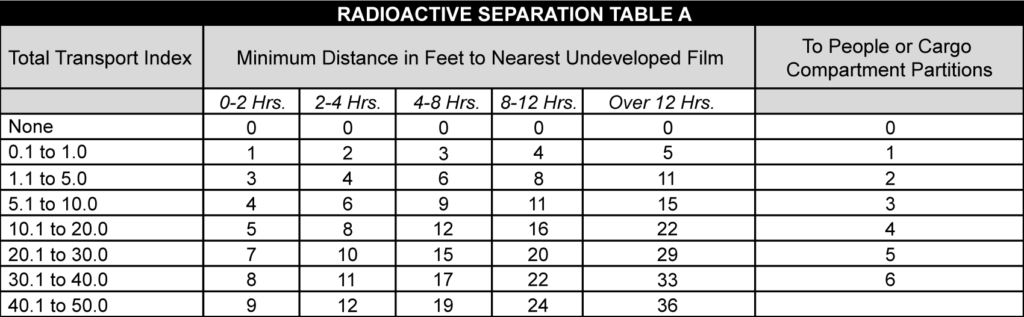
Figure 9.10
California Immediate Spill Reporting
Spills of HazMat on California highways must be reported immediately to the CHP office or police department having traffic control jurisdiction (CVC §23112.5).
Classes of Hazardous Materials
HazMat is categorized into 9 major hazard classes and additional categories for consumer commodities and combustible liquids. The classes of HazMat are listed in Figure 9.11.
HAZARD CLASS DEFINITIONS
TABLE B
| Class | Class Name | Example |
|---|---|---|
| Class1 | Class NameExplosives | ExampleAmmunition, Dynamite, Fireworks |
| Class2 | Class NameGases | ExamplePropane, Oxygen, Helium |
| Class3 | Class NameFlammable | ExampleGasoline Fuel, Acetone |
| Class4 | Class NameFlammable Solids | ExampleMatches, Fuses |
| Class5 | Class NameOxidizers | ExampleAmmonium Nitrate, Hydrogen Peroxide |
| Class6 | Class NamePoisons | ExamplePesticides, Arsenic |
| Class7 | Class NameRadioactive | ExampleUranium, Plutonium |
| Class8 | Class NameCorrosives | ExampleHydrochloric Acid, Battery Fluid |
| Class9 | Class NameMiscellaneous Hazardous Materials | ExampleFormaldehyde, Asbestos |
| ClassNone | Class NameORM-D (Other Regulated Material-Domestic) | ExampleHair Spray, Charcoal |
| ClassNone | Class NameCombustible Liquids | ExampleFuel Oils, Lighter Fluid |
Figure 9.11
SUBSECTIONS 9.6 AND 9.7
Test Your Knowledge
- If your placarded trailer has dual tires, how often should you check the tires?
- What is a safe haven?
- How close to the traveled part of the roadway can you park with Division 1.2 or 1.3 materials?
- How close can you park to a bridge, tunnel, or building with the same load?
- What type of fire extinguisher must placarded vehicles carry?
- You are hauling 100 pounds of Division 4.3 (DANGEROUS WHEN WET) materials. Do you need to stop before a railroad-highway crossing?
- At a rest area you discover your HazMat shipment is slowly leaking from the vehicle. There is no phone around. What should you do?
- What is the Emergency Response Guide (ERG)?
These questions may be on your test. If you cannot answer them all, reread Subsections 9.6 and 9.7.
9.8 – Hazardous Materials Glossary
This glossary presents definitions of certain terms used in this section. A complete glossary of terms can be found in the federal HMR (CFR, Title 49 §171.8). You should have an up-to-date copy of these rules for your reference.
Note You will not be tested on this glossary.
9.8.1 – CFR, Title 49 §171.8
Definitions and Abbreviations
Bulk packaging—Packaging, other than a vessel or barge, including a transport vehicle or freight container, in which HazMat are loaded with no intermediate form of containment and which has:
- A maximum capacity greater than 119 gallons (450 L) as a receptacle for a liquid.
- A maximum net mass greater than 882 pounds (400 kg) and a maximum capacity greater than 119 gallons (450 L) as a receptacle for a solid. OR
- A water capacity greater than 1,000 pounds (454 kg) as a receptacle for a gas as defined in CFR, Title 49 §173.115.
Cargo tank—A bulk packaging which is:
- A tank intended primarily for the carriage of liquids or gases and includes appurtenances, reinforcements, fittings, and closures (for “tank” definition, see CFR, Title 49 §§178.3451(c), 178.3371, or 178.3381, as applicable).
- Permanently attached to or forms a part of a motor vehicle, or not permanently attached to a motor vehicle but which, by reason of its size, construction, or attachment to a motor vehicle, is loaded or unloaded without being removed from the motor vehicle.
- Not fabricated under a specification for cylinders, portable tanks, tank cars, or multiunit tank car tanks.
Carrier—A person who transports passengers or property in commerce by rail, car, aircraft, motor vehicle, or vessel.
Consignee—The business or person to whom a shipment is delivered.
Division—A subdivision of a hazard class.
EPA—U.S. Environmental Protection Agency.
FMCSR—The Federal Motor Carrier Safety Regulations.
Freight container—A reusable container having a volume of 64 cubic feet or more, designed and constructed to permit being lifted with its contents intact and intended primarily for containment of packages (in unit form) during transportation.
Fuel tank—A tank, other than a cargo tank, used to transport flammable or combustible liquid or compressed gas for the purpose of supplying fuel for propulsion of the transport vehicle to which it is attached, or for the operation of other equipment on the transport vehicle.
Gross weight or mass—The weight of the packaging plus the weight of its contents.
Hazard class—The category of hazard assigned to a HazMat under the definitional criteria of Part 173 and the provisions of the CFR, Title 49 §172.101 table. A material may meet the defining criteria for more than one hazard class but is assigned to only one hazard class.
Hazardous materials (HazMat)—A substance or material which has been determined by the U.S. Secretary of Transportation to be capable of posing an unreasonable risk to health, safety, and property when transported in commerce, and which has been so designated. The term includes hazardous substances, hazardous wastes, marine pollutants, elevated temperature materials, and materials designated as hazardous in the Hazardous Materials Table of CFR, Title 49 §172.101, and materials that meet the definition criteria for hazard classes and divisions in CFR, Title 49 Part 173, Subchapter C.
Hazardous substance—A material, including its mixtures and solutions, that:
- Is listed in Appendix A to CFR, Title 49, Part §§173 and §172.101.
- Is in a quantity, in one package, which equals or exceeds the reportable quantity (RQ) listed in Appendix A to CFR, Title 49, Part 173 and §172.101. AND
- When in a mixture or solution for:
Radionuclides, conforms to paragraph 7 of Appendix A to CFR, Title 49, Part 173 and §172.101.
Other than radionuclides, is in a concentration by weight which equals or exceeds the concentration corresponding to the RQ of the material, as shown in Figure 9.12.
HAZARDOUS SUBSTANCE CONCENTRATIONS
| RQ Pounds (Kilograms) | Concentration by Weight – Percent | Concentration by Weight – PPM |
|---|---|---|
| RQ Pounds (Kilograms)5,000 (2,270) | Concentration by Weight – Percent10 | Concentration by Weight – PPM 100,000 |
| RQ Pounds (Kilograms)1,000 (454) | Concentration by Weight – Percent2 | Concentration by Weight – PPM 20,000 |
| RQ Pounds (Kilograms)100 (45.4) | Concentration by Weight – Percent.2 | Concentration by Weight – PPM 2,000 |
| RQ Pounds (Kilograms)10 (4.54) | Concentration by Weight – Percent.02 | Concentration by Weight – PPM 200 |
| RQ Pounds (Kilograms)1 (0.454) | Concentration by Weight – Percent.002 | Concentration by Weight – PPM 20 |
Figure 9.12
This definition does not apply to petroleum products that are lubricants or fuels (see CFR, Title 40 §300.6).
Hazardous waste—Any material that is subject to the Hazardous Waste Manifest Requirements of the EPA specified in CFR, Title 40 §262.
Intermediate bulk container (IBC)—A rigid or flexible portable packaging, other than a cylinder or portable tank, which is designed for mechanical handling. Standards for IBCs manufactured in the U.S. are set forth in CFR, Title 49, §178 Subparts N and O.
Limited quantity—The maximum amount of a HazMat for which there may be specific labeling or packaging exceptions.
Marking—The descriptive name, ID number, instructions, cautions, weight, specification, United Nations (UN) marks, or combinations thereof, required on outer packaging of HazMat.
Mixture—A material composed of more than 1 chemical compound or element.
Name of contents—The proper shipping name as specified in CFR, Title 49 §172.101.
Nonbulk packaging—A packaging, which has:
- A maximum capacity of 119 gallons (450 L) or less as a receptacle for a liquid.
- A maximum net mass of 882 pounds (400 kg) or less and a maximum capacity of 119 gallons (450 L) or less as a receptacle for a solid. OR
- A water capacity greater than 1,000 pounds (454 kg) or less as a receptacle for a gas as defined in CFR, Title 49 §173.115.
- Regardless of the definition of bulk packaging, a maximum net mass of 400 kg (882 pounds) or less for a bag or box conforming to the applicable requirements for specification packaging, including the maximum net mass limitations, provided in CFR, Title 49, Part 178, Subpart L.
N.O.S.—Not otherwise specified.
Outage or ullage—The amount by which a packaging falls short of being liquid full, usually expressed in percent by volume. The amount of outage required for liquids in cargo tank depends on how much the material will expand with temperature change during transit. Different materials expand at different rates. Enough outage must be allowed so that the tank will still not be full at 130 degrees Fahrenheit.
PHMSA—The Pipeline and Hazardous Materials Safety Administration, U.S. Department of Transportation, Washington, DC 20590.
Portable tank—Bulk packaging (except a cylinder having a water capacity of 1,000 pounds or less) designed primarily to be loaded onto, or on, or temporarily attached to a transport vehicle or ship, and equipped with skids, mountings, or accessories to facilitate handling of the tank by mechanical means. It does not include a cargo tank, tank car, multiunit tank car tank, or trailer carrying 3AX, 3AAX, or 3T cylinders.
Proper shipping name—The name of the HazMat shown in Roman print (not italics) in CFR, Title 49 §172.101.
P.s.i. or psi—Pounds per square inch.
P.s.i.a. or psia—Pounds per square inch absolute.
Reportable quantity (RQ)—The quantity specified in Column 2 of the Appendix A to CFR, Title 49 §172.101 for any material identified in Column 1 of Appendix A.
Shipper’s certification—A statement on a shipping paper, signed by the shipper, saying they prepared the shipment properly according to law. For example:
“This is to certify that the above named materials are properly classified, described, packaged, marked and labeled, and are in proper condition for transportation according to the applicable regulations or the Department of Transportation.”
OR
“I hereby declare that the contents of this consignment are fully and accurately described above by the proper shipping name and are classified, packaged, marked and labeled/placarded, and are in all respects in proper condition for transport by by (insert mode of transportation, such as rail, aircraft motor vehicle, or vessel) according to applicable international and national government regulations.
Shipping paper—A shipping order, bill of lading, manifest, or other shipping document serving a similar purpose prepared in accordance with CFR, Title 49, Part 172, Subpart C.
Technical name— A recognized chemical name or microbiological name currently used in scientific and technical handbooks, journals, and texts.
Transport vehicle—A cargo-carrying vehicle such as an automobile, van, tractor, truck, semi-trailer, tank car, or rail car used for the transportation of cargo by any mode. Each cargo-carrying body (trailer, rail car, etc.,) is a separate transport vehicle.
UN standard packaging—Packaging specifications conforming to standards in UN recommendations.
UN—United Nations
Section 8: Tank Vehicles
This section has information needed to pass the CDL knowledge test for driving a tank vehicle (tanker). (You should also study Sections 2, 5, 6, and 9). An “N” endorsement is required for certain vehicles that transport liquids or gases. The liquid or gas does not have to be a HazMat. An “N” endorsement is required if your vehicle needs a Class A, B, or C CDL and you want to haul a liquid or liquid gas in a tank or tanks having an individual rated capacity of more than 119 gallons and an aggregate rated capacity of 1000 gallons or more that is either permanently or temporarily attached to the vehicle or chassis.
A CMV transporting an empty storage container tank not designed for transportation, with a rated capacity of at least 1,000 gallons that is temporarily attached to a flatbed trailer, is not a tank vehicle (CVC §15210(r)).
Before loading, unloading, or driving a tanker, inspect the vehicle. This makes sure that the vehicle is safe to carry the liquid or gas and is safe to drive.
A CLP holder with an “N” endorsement (N) is prohibited from operating a tank vehicle unless it is empty. In addition, if the tanker previously contained HazMat, it must be purged (FMCSR §383.25).
If an applicant applies for a Class C CDL with an “N” endorsement only, a commercial skills test is required. The applicant must be tested in a representative Class C CMV designed to transport any liquid or gaseous materials in a tank or tanks having an individual rated capacity of more than 119 gallons and an aggregate rated capacity of 1,000 gallons or more that is permanently or temporarily attached to the vehicle or chassis.
An “N” endorsement may be added to an existing Class C CDL with the completion of all applicable knowledge tests; the commercial skills test is not required.
8.1 – Inspecting Tank Vehicles
Tank vehicles have special items that you need to check. Tank vehicles come in many types and sizes. You need to check the vehicle’s operator manual to make sure you know how to inspect your tank vehicle.
8.1.1 – Leaks
On all tank vehicles, the most important item to check for is leaks. Check under and around the vehicle for signs of any leaking. Do not carry liquids or gases in a leaking tank. To do so is a crime. You will be cited and prevented from driving further. You may also be liable for the cleanup of any spill. In general, check the following:
- Check the tank’s body or shell for dents or leaks.
- Check the intake, discharge, and cut-off valves. Make sure the valves are in the correct position before loading, unloading, or moving the vehicle.
- Check pipes, connections, and hoses for leaks, especially around joints.
- Check manhole covers and vents. Make sure the covers have gaskets and they close correctly. Keep the vents clear so they work correctly.
8.1.2 – Check Special Purpose Equipment
If your vehicle has any of the following equipment, make sure it works:
- Vapor recovery kits.
- Grounding and bonding cables.
- Emergency shutoff systems.
- Built in fire extinguisher.
Never drive a tank vehicle with open valves or manhole covers.
8.1.3 – Special Equipment
Check the emergency equipment required for your vehicle. Find out what equipment you are required to carry and make sure you have it (and it works).
8.2 – Driving Tank Vehicles
Hauling liquids in tanks requires special skills because of the high center of gravity and liquid movement. See Figure 8.1.

Figure 8.1
8.2.1 – High Center of Gravity
High center of gravity means that much of the load’s weight is carried high up off the road. This makes the vehicle top-heavy and easy to roll over. Liquid tankers are especially easy to roll over. Tests have shown that tankers can turn over at the speed limits posted for curves. Take highway curves and on ramp/off ramp curves well below the posted speeds.
8.2.2 – Danger of Surge
Liquid surge results from movement of the liquid in partially filled tanks. This movement can have bad effects on handling. For example, when coming to a stop, the liquid will surge back and forth. When the wave hits the end of the tank, it tends to push the truck in the direction the wave is moving. If the truck is on a slippery surface, such as ice, the wave can shove a stopped truck out into an intersection. The driver of a liquid tanker must be very familiar with handling the vehicle.
8.2.3 – Bulkheads
Some liquid tanks are divided into several smaller tanks by bulkheads. When loading and unloading smaller tanks, the driver must pay attention to weight distribution. Do not put too much weight on the front or rear of the vehicle.
8.2.4 – Baffled Tanks
Baffled liquid tanks have bulkheads in them with holes that let the liquid flow through. The baffles help to control the forward and backward liquid surge. Side-to-side surge can still occur this can cause a roll over.
8.2.5 – UnBaffled Tanks
Unbaffled liquid tankers (sometimes called “smooth bore” tanks) have nothing inside to slow down the flow of the liquid. Therefore, forward-and-back surge is very strong. Unbaffled tanks are usually those that transport food products (milk, for example). (Sanitation regulations forbid the use of baffles because of the difficulty in cleaning the inside of the tank.) Be extremely cautious (slow and careful) in driving smooth bore tanks, especially when starting and stopping.
8.2.6 – Outage
Never load a cargo tank totally full. Liquids expand as they warm and you must leave room for the expanding liquid. This is called “outage.” Since different liquids expand by different amounts, they require different amounts of outage. You must know the outage requirement when hauling liquids in bulk.
8.2.7 – How Much to Load?
A full tank of dense liquid (such as some acids) may exceed legal weight limits. For that reason, you may often only partially fill tanks with heavy liquids. The amount of liquid to load into a tank depends on:
- The amount the liquid will expand in transit.
- The weight of the liquid.
- Legal weight limits.
- The temperature of the load.
8.2.8 – Speeding in a Tank Vehicle
If you are driving a tank vehicle transporting more than 500 gallons of flammable liquid at a speed greater than the applicable speed limit or in willful or wanton disregard for the safety of persons or property, in addition to any other applicable penalty, you are subject to a fine for a first offense. For a second or subsequent offense within 2 years of a prior offense, you are subject to a fine of not less than $2,000 and a suspension of up to 6 months of a HazMat or cargo “N” endorsement, or both (CVC §22406.5).
8.2.9 – Hours of Service in a Tank Vehicle
The maximum driving time within a work period is 10 hours for drivers of tank vehicles with a capacity greater than 500 gallons when transporting flammable liquid (CVC §34501.2(b)(1)).
8.3 – Safe Driving Rules
In order to drive tank vehicles safely, you must remember to follow all the safe driving rules. A few of these rules are:
8.3.1 – Drive Smoothly
Because of the high center of gravity and the surge of the liquid, you must start, slow down, and stop very smoothly. Also, make smooth turns and lane changes.
8.3.2 – Controlling Surge
- Keep a steady pressure on the brakes. Do not release the brakes too soon when coming to a stop.
- Brake far in advance of a stop and increase your following distance.
- If you must make a quick stop to avoid an accident, use controlled or stab braking. If you do not remember how to stop using these methods, review Section 2. Also, remember that if you steer quickly while braking, your vehicle may roll over.
8.3.3 – Curves
Slow down before curves, and then accelerate slightly through the curve. The posted speed for a curve may be too fast for a tank vehicle.
8.3.4 – Stopping Distance
Keep in mind how much space you need to stop your vehicle. Remember that wet roads double the normal stopping distance. Empty tank vehicles may take longer to stop than full ones.
8.3.5 – Skids
Do not over steer, accelerate, or brake. If you do, your vehicle may skid. On tank trailers, if your drive or trailer wheels begin to skid, your vehicle may jackknife. When any vehicle starts to skid, you must take action to restore traction to the wheels.
Section 8
Test Your Knowledge
- How are bulkheads different than baffles?
- Should a tank vehicle take curves, on ramps, or off ramps at the posted speed limits?
- How are smooth bore tankers different to drive than those with baffles?
- What 3 things determine how much liquid you can load?
- What is outage?
- How can you help control surge?
- What 2 reasons make special care necessary when driving tank vehicles?
These questions may be on the test. If you cannot answer them all, reread Section 8.
Section 7: Doubles and Triples
This section has information you need to pass the CDL knowledge test for driving safely with double and triple trailers. It tells about how important it is to be very careful when driving with more than 1 trailer, how to couple and uncouple correctly, and about inspecting doubles and triples carefully. (You should also study Sections 2, 5, and 6.)
Note Triple combinations are not legal in California. Triples are discussed in this section because they are legal in many other states.
The endorsement is given by knowledge test only. Do not bring in a set of doubles for a Class A skills test.
7.1 – Pulling Double/Triple Trailers
Take special care when pulling 2 and 3 trailers. There are more things that can go wrong, and doubles/triples are less stable than other CMVs. Some areas of concern are discussed below.
7.1.1 – Prevent the Trailer From Rolling Over
To prevent trailers from rolling over, you must steer gently and go slowly around corners, on ramps, off ramps, and curves. A safe speed on a curve for a straight truck or a single trailer combination vehicle may be too fast for a set of doubles or triples.
7.1.2 – Beware of the Crack-the-Whip Effect
Doubles and triples are more likely to turn over than other combination vehicles because of the “crack-the-whip” effect. You must steer gently when pulling trailers. The last trailer in a combination is most likely to turn over. If you do not understand the crack-the-whip effect, study Subsection 6.1.2 of this handbook.
7.1.3 – Inspect Completely
There are more critical parts to check when you have 2 or 3 trailers. Check them all. Follow the procedures described later in this section.
7.1.4 – Look Far Ahead
Doubles and triples must be driven very smoothly to avoid rollover or jackknife. Therefore, look far ahead so you can slow down or change lanes gradually when necessary.
7.1.5 – Manage Space
Doubles and triples take up more space than other CMVs. They are not only longer, but also need more space because they cannot be turned or stopped suddenly. Allow more following distance. Make sure you have large enough gaps before entering or crossing traffic. Be certain you are clear at the sides before changing lanes.
7.1.6 – Adverse Conditions
Be more careful in adverse conditions. In bad weather, slippery conditions, and mountain driving, you must be especially careful if you drive double and triple bottoms. You will have greater length and more dead axles to pull with your drive axles than other drivers. There is more chance for skids and loss of traction.
7.1.7 – Parking the Vehicle
Make sure you do not get in a spot you cannot pull straight through. You need to be aware of how parking lots are arranged in order to avoid a long and difficult escape.
7.1.8 – Anti-lock Braking Systems on Converter Dollies
Converter dollies built on or after March 1, 1998, are required to have anti-lock brakes. These dollies have a yellow lamp on the left side of the dolly.
7.2 – Coupling and Uncoupling
Knowing how to couple and uncouple correctly is basic to safe operation of doubles and triples. Wrong coupling and uncoupling can be very dangerous. Coupling and uncoupling steps for doubles and triples are listed below.
7.2.1 – Coupling Double Trailers
Secure the Second (Rear) Trailer
If the second trailer does not have spring brakes, drive the tractor close to the trailer, connect the emergency line, charge the trailer air tank, and disconnect the emergency line. This will set the trailer emergency brakes (if the slack adjusters are correctly adjusted). Chock the wheels if you have any doubt about the brakes.
For the safest handling on the road, the more heavily loaded semitrailer should be in first position behind the tractor. The lighter trailer should be in the rear.
A converter gear on a dolly is a coupling device of 1 or 2 axles and a fifth-wheel by which a semitrailer can be coupled to the rear of a tractor-trailer combination forming a double bottom rig. See Figure 7.1.
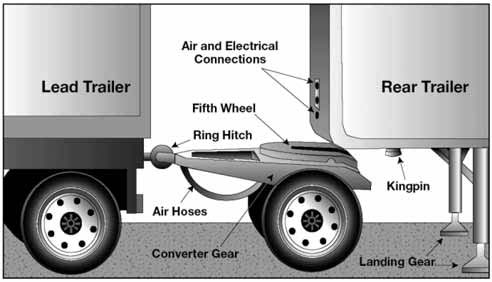
Figure 7.1
Position the Converter Dolly in Front of the Second (Rear) Trailer
- Release the dolly brakes by opening the air tank petcock. Or, if the dolly has spring brakes, use the dolly parking brake control.
- If the distance is not too great, wheel the dolly into position by hand so it is in line with the kingpin.
- Or, use the tractor and first semitrailer to pick up the converter dolly:
— Position the combination as close as possible to the converter dolly.
— Move the dolly to the rear of the first semitrailer and couple it to the trailer.
— Lock the pintle hook.
— Secure the dolly support in the raised position.
— Pull the dolly into position as close as possible to the nose of the second semitrailer.
— Lower the dolly support.
— Unhook the dolly from the first trailer.
— Wheel the dolly into position in front of the second trailer in line with the kingpin.
Connect the Converter Dolly to the Front Trailer
- Back the first semitrailer into position in front of the dolly tongue.
- Hook the dolly to the front trailer.
— Lock the pintle hook.
— Secure the converter gear support in the raised position.
Connect the Converter Dolly to the Rear Trailer
- Make sure the trailer brakes are locked and/or the wheels chocked.
- Make sure the trailer height is correct. (It must be slightly lower than the center of the fifth-wheel, so the trailer is raised slightly when the dolly is pushed under.)
- Back the converter dolly under the rear trailer.
- Raise the landing gear slightly off the ground to prevent damage if the trailer moves.
- Test the coupling by pulling against the pin of the second semitrailer.
- Make visual check of the coupling. (No space between the upper and lower fifth-wheel and the locking jaws are closed on the kingpin.)
- Connect the safety chains, air hoses, and light cords.
- Close the converter dolly air tank petcock and shut-off the valves at the rear of the second trailer (service and emergency shut-offs).
- Open the shut-off valves at the rear of the first trailer (and on the dolly, if so equipped).
- Raise the landing gear completely.
- Charge the trailer brakes (push the “air supply” knob in), and check for air at the rear of the second trailer by opening the emergency line shut-off. If the air pressure is not there, something is wrong and the brakes will not work.
7.2.2 – Uncoupling the Double Trailers
Uncouple the Rear Trailer
- Park the rig in a straight line, on firm level ground.
- Apply the parking brakes so the rig will not move.
- Chock the wheels of the second trailer if it does not have spring brakes.
- Lower the landing gear of the second semitrailer enough to remove some weight from the dolly.
- Close the air shut-offs at the rear of the first semitrailer (and on the dolly, if so equipped).
- Disconnect and secure all dolly air and electric lines.
- Release the dolly brakes.
- Release the converter dolly fifth-wheel latch.
- Slowly pull the tractor, first semitrailer, and dolly forward to pull the dolly out from under the rear semitrailer.
Uncouple the Converter Dolly
- Lower the dolly landing gear.
- Disconnect the safety chains.
- Apply the converter gear spring brakes or chock the wheels.
- Release the pintle hook on the first semi-trailer.
- Slowly pull clear of the dolly.
Never unlock the pintle hook with the dolly still under the rear trailer. The dolly tow bar may fly up, possibly causing injury, and make it very difficult to recouple.
7.2.3 – Coupling and Uncoupling Triple Trailers
Couple the Tractor/First Semitrailer to the Second/ Third Trailers
- Couple the tractor to the first trailer. Use the method already described for coupling tractor-semitrailers.
- Move the converter dolly into position and couple the first trailer to the second trailer using the method for coupling doubles. The triples rig is now complete.
Uncouple the Triple-Trailer Rig
- Uncouple the third trailer by pulling the dolly out, and then unhitching the dolly using the method for uncoupling doubles.
- Uncouple the remainder of the rig as you would any double-bottom rig using the method already described.
Remember: Operating triples is not allowed in California.
7.2.4 – Coupling and Uncoupling Other Combinations
The methods described so far apply to the more common tractor-trailer combinations. However, there are other ways of coupling and uncoupling the many types of truck-trailer and tractor-trailer combinations that are in use. There are too many to cover in this handbook. You will need to learn the correct way to couple and uncouple the vehicle(s). Drive according to the manufacturer and/or owner specifications.
7.3 – Inspecting Doubles and Triples
Use the 7-step inspection procedure described in Section 2 to inspect your combination vehicle. There are more things to inspect on a combination vehicle than on a single vehicle. Many of these items are simply more of what you would find on a single vehicle. (For example, tires, wheels, lights, reflectors, etc.) There are also some new things to check. These are discussed below.
7.3.1 – Additional Checks
Do these checks in addition to those already listed in Section 2, Step 5: Do Walk Around Inspection.
Coupling System Areas
- Check the fifth-wheel (lower).
— Is securely mounted to the frame.
— Has no missing or damaged parts.
— Has enough grease.
— Has no visible space between the upper and lower fifth-wheel.
— Locking jaws are around the shank, not the head of the kingpin.
— Release arm is properly seated and safety latch/lock is engaged. - Check the fifth-wheel (upper).
— Glide plate is securely mounted to the trailer frame.
— Kingpin is not damaged. - Air and electric lines to the trailer.
— Electrical cord is firmly plugged in and secured.
— Air lines are properly connected to the glad hands, with no air leaks, and properly secured with enough slack for turns.
— All lines are free from damage. - Sliding the fifth-wheel.
— Slide is not damaged or parts missing.
— Is properly greased.
— All locking pins are present and locked in place.
— If air powered, there are no air leaks.
— Check that the fifth-wheel is not so far forward that the tractor frame will hit the landing gear, or the cab will hit the trailer during turns.
Landing Gear
- Is fully raised, no missing parts, not bent, or otherwise damaged.
- Crank handle is in place and secured.
- If power operated, there are no air or hydraulic leaks.
Double and Triple Trailers
- Shut-off the valves (at the rear of the trailers, in service and emergency lines).
— The rear of the front trailers: OPEN.
— The rear of the last trailer: CLOSED.
— The converter dolly air tank drain valve: CLOSED. - Be sure the air lines are supported and the glad hands are properly connected.
- If the spare tire is carried on the converter gear (dolly), make sure it is secured.
- Be sure the pintle-eye of the dolly is in place in the pintle hook of the trailer(s).
- Make sure the pintle hook is latched.
- The safety chains should be secured to the trailer(s).
- Be sure the light cords are firmly connected in the sockets on the trailers.
7.3.2 – Additional Things to Check During a Walk Around Inspection
Do these checks in addition to Section 5, Inspecting Air Brake Systems.
7.4 – Doubles/Triples Air Brake Check
Check the brakes on a double or triple trailer as you would any combination vehicle. Section 6 explains how to check air brakes on combination vehicles. You must also make the following checks on your double or triple trailers.
7.4.1 – Additional Air Brake Checks
Check That Air Flows to all the Trailers (Double and Triple Trailers).
Use the tractor parking brake and/or chock the wheels to hold the vehicle. Wait for the air pressure to reach normal, and then push in the red “trailer air supply” knob. This will supply air to the emergency (supply) lines. Use the trailer handbrake to provide air to the service line. Go to the rear of the rig. Open the emergency line shut-off valve at the rear of the last trailer. You should hear air escaping, showing the entire system is charged. Close the emergency line valve. Open the service line valve to check that service pressure goes through all the trailers (this test assumes that the trailer handbrake or service brake pedal is on), and then close the valve. If you do not hear air escaping from both lines, check that the shut-off valves on the trailer(s) and dolly(ies) are in the OPEN position. You must have air all the way to the back for all the brakes to work.
Test the Tractor Protection Valve.
Charge the trailer air brake system (build up normal air pressure and push the “air supply” knob in). Shut the engine off. Step on and off the brake pedal several times to reduce the air pressure in the tanks. The trailer air supply control (also called the tractor protection valve control) should pop out (or go from the “normal” to “emergency” position) when the air pressure falls into the pressure range specified by the manufacturer (usually within the range of 20 to 45 psi).
If the tractor protection valve does not work properly, an air hose or trailer brake leak could drain all the air from the tractor. This would cause the emergency brakes to come on, with possible loss of control.
Test the Trailer Emergency Brakes.
Charge the trailer air brake system and check that the trailer rolls freely. Then stop and pull out the trailer air supply control (also called tractor protection valve control or trailer emergency valve) or place it in the “emergency” position. Pull gently on the trailer with the tractor to check that the trailer emergency brakes are on.
Test the Trailer Service Brakes.
Check for normal air pressure, release the parking brakes, move the vehicle forward slowly, and apply trailer brakes with the hand control (trolley valve), if so equipped. You should feel the brakes come on. This tells you the trailer brakes are connected and working. (The trailer brakes should be tested with the hand valve, but controlled in normal operation with the foot pedal, which applies air to the service brakes at all wheels.)
Section 7
Test Your Knowledge
- What is a converter dolly?
- Do converter dollies have spring brakes?
- What 3 methods can you use to secure a second trailer before coupling?
- How do you check to make sure trailer height is correct before coupling?
- What do you check when making a visual check of coupling?
- Why should you pull a dolly out from under a trailer before you disconnect it from the trailer in front?
- What should you check for when inspecting the converter dolly? The pintle hook?
- Should the shut-off valves on the rear of the last trailer be open or closed? On the first trailer in a set of doubles? On the middle trailer of a set of triples?
- How can you test that air flows to all trailers?
- How do you know if your converter dolly is equipped with anti-lock brakes?
These questions may be on your test. If you cannot answer them all, reread Section 7.
Section 6: Combination Vehicles
This section provides information needed to pass the tests for combination vehicles (tractor-trailer, doubles, triples, straight truck with trailer). The information is only to give you the minimum knowledge needed for driving common combination vehicles. You should also study Section 7 if you need to pass the test for doubles and triples.
6.1 – Driving Combination Vehicles Safely
Combination vehicles are usually heavier, longer, and require more driving skill than single CMVs. This means that drivers of combination vehicles need more knowledge and skill than drivers of single vehicles. This section has important safety factors that apply specifically to combination vehicles.
6.1.1 – Rollover Risks
More than half of truck driver deaths in accidents are the result of truck rollovers. When more cargo is piled up in a truck, the “center of gravity” moves higher up from the road and the truck becomes easier to turn over. Fully loaded rigs are 10 times more likely to roll over in an accident than empty rigs.
The following 2 things will help you prevent rollover: keep the cargo as close to the ground as possible, and drive slowly around turns. Keeping cargo low is even more important in combination vehicles than in straight trucks. Also, keep the load centered on your rig. If the load is to one side so it makes a trailer lean, a rollover is more likely. Make sure your cargo is centered and spread out as much as possible. (Cargo distribution is covered in Section 3 of this handbook.)
Rollovers happen when you turn too fast. Drive slowly around corners, on ramps, and off ramps. Avoid quick lane changes, especially when fully loaded.
6.1.2 – Steer Gently
Trucks with trailers have a dangerous “crack-the-whip” effect. When you make a quick lane change, the crack-the-whip effect can turn the trailer over. There are many accidents where only the trailer has overturned.
“Rearward amplification” causes the crack-the-whip effect. Figure 6.1 shows 8 types of combination vehicles and the rearward amplification each has in a quick lane change. Rigs with the least crack-the-whip effect are shown at the top, and those with the most,at the bottom. Rearward amplification of 2.0 in the chart means that the rear trailer is twice as likely to turn over as the tractor. You can see that triples have a rearward amplification of 3.5. This means you can roll the last trailer of triples 3.5 times as easily as a 5-axle tractor.
Steer gently and smoothly when you are pulling trailers. If you make a sudden movement with your steering wheel, your trailer could tip over. Follow far enough behind other vehicles (at least 1 second for each 10 feet of your vehicle length, plus another second if going over 40 mph). Look far enough down the road to avoid being surprised and having to make a sudden lane change. At night, drive slowly enough to see obstacles with your headlights before it is too late to change lanes or stop gently. Slow down to a safe speed before going into a turn.

Figure 6.1
6.1.3 – Brake Early
Control your speed whether fully loaded or empty. Large combination vehicles take longer to stop when they are empty than when they are fully loaded. When lightly loaded, the very stiff suspension springs and strong brakes give poor traction and make it very easy to lock up the wheels. Your trailer can swing out and strike other vehicles. Your tractor can jackknife very quickly. You also must be very careful about driving “bobtail” tractors (tractors without semitrailers). Bobtails can be very hard to stop smoothly. It takes them longer to stop than a tractor-semitrailer loaded to maximum gross weight.
In any combination rig, allow lots of following distance and look far ahead so you can brake early. Do not be caught by surprise and have to make a “panic” stop.
6.1.4 – Railroad-Highway Crossings
Railroad-highway crossings can also cause problems, particularly when pulling trailers with low underneath clearance.
These trailers can get stuck on raised crossings:
- Low slung units (lowboy, car carrier, moving van, or possum-belly livestock trailer).
- Single-axle tractor pulling a long trailer with its landing gear set to accommodate a tandem-axle tractor.
If for any reason you get stuck on the tracks, get out of the vehicle and away from the tracks. Check signposts or signal housing at the crossing for emergency notification information. Call 911 or another emergency number. Give the location of the crossing using all identifiable landmarks, especially the DOT number, if posted.
6.1.5 – Prevent Trailer Skids
When the wheels of a trailer lock up, the trailer will tend to swing around. This is more likely to happen when the trailer is empty or lightly loaded. This type of jackknife is often called a “trailer jackknife.” See Figure 6.2.
The procedure for stopping a trailer skid is:
- Recognize the Skid. The earliest and best way to recognize that the trailer has started to skid is by seeing it in your mirrors. Any time you apply the brakes hard, check the mirrors to make sure the trailer is staying where it should be. Once the trailer swings out of your lane, it is very difficult to prevent a jackknife.
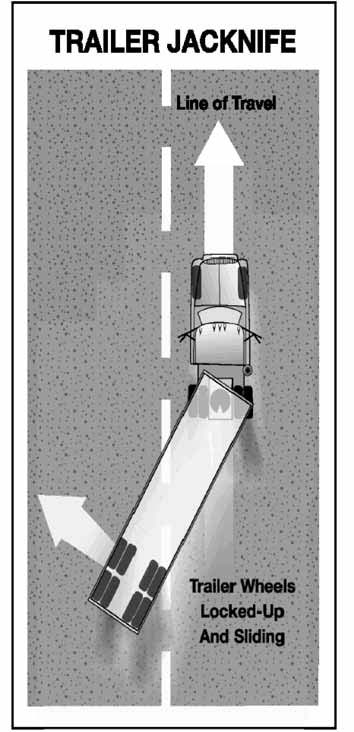
Figure 6.2
- Stop Using the Brake. Release the brakes to get traction back. Do not use the trailer hand brake (if you have one) to “straighten out the rig.” This is the wrong thing to do since the brakes on the trailer wheels caused the skid in the first place. Once the trailer wheels grip the road again, the trailer will start to follow the tractor and straighten out.
6.1.6 – Turn Wide
When a vehicle goes around a corner, the rear wheels follow a different path than the front wheels. This is called off-tracking or “cheating.” Figure 6.3 shows how off-tracking causes the path followed by a tractor to be wider than the rig itself. Longer vehicles will offtrack more. The rear wheels of the powered unit (truck or tractor) will off-track some, and the rear wheels of the trailer will off-track even more. If there is more than one trailer, the rear wheels of the last trailer will offtrack the most. Steer the front end wide enough around a corner so the rear end does not run over the curb, pedestrians, etc. However, keep the rear of your vehicle close to the curb. This will stop other drivers from passing you on the right. If you cannot complete your turn without entering another traffic lane, turn wide as you complete the turn. This is better than swinging wide to the left before starting the turn because it will keep other drivers from passing you on the right. See Figure 6.4.

Figure 6.3

Figure 6.4
6.1.7 – Backing With a Trailer.
When backing a car, straight truck, or bus, turn the top of the steering wheel in the direction you want to go. When backing a trailer, turn the steering wheel in the opposite direction. Once the trailer starts to turn, turn the wheel the other way to follow the trailer.
Whenever you back up with a trailer, try to position your vehicle so you can back in a straight line. If you must back on a curved path, back toward the driver’s side so you can see. See Figure 6.5.
Look at Your Path. Look at your line of travel before you begin. Get out and walk around the vehicle. Check your clearance to the sides and overhead, in and near the path of your vehicle.
Use Mirrors on Both Sides. Check the outside mirrors on both sides frequently. Get out of the vehicle and re-inspect your path if you are unsure.
Back Slowly. This will let you make corrections before you get too far off course.
Correct Drift Immediately. As soon as you see the trailer getting off the proper path, correct it by turning the top of the steering wheel in the direction of the drift.
Pull Forward. When backing a trailer, make pull-ups to reposition your vehicle as needed.

Figure 6.5
SUBSECTION 6.1
Test Your Knowledge
- What 2 things are important to prevent rollover?
- When you turn suddenly while pulling doubles, which trailer is most likely to turn over?
- Why should you not use the trailer hand brake to straighten out a jackknifing trailer?
- What is off-tracking?
- When you back a trailer, you should position your vehicle so you can back in a curved path to the driver’s side. True or False?
- What type of trailers can get stuck on railroad-highway crossings?
These questions may be on your test. If you cannot answer them all, reread Subsection 6.1.
6.2 – Combination Vehicle Air Brakes
You should study Section 5: Air Brakes before reading this. In combination vehicles, the braking system has parts to control the trailer brakes, in addition to the parts described in Section 5. These parts are described below.
6.2.1 – Trailer Hand Valve
The trailer hand valve (also called the trolley valve or Johnson bar) works the trailer brakes. The trailer hand valve should be used only to test the trailer brakes. Do not use it in driving because of the danger of making the trailer skid. The foot brake sends air to all of the brakes on the vehicle, including the trailer(s). There is much less danger of causing a skid or jackknife when using just the foot brake.
Never use the hand valve for parking because all the air might leak out, unlocking the brakes (in trailers that do not have spring brakes). Always use the parking brakes when parking. If the trailer does not have spring brakes, use wheel chocks to keep the trailer from moving.
6.2.2 – Tractor Protection Valve
The tractor protection valve keeps air in the tractor or truck brake system should the trailer break away or develop a bad leak. The tractor protection valve is controlled by the “trailer air supply” control valve in the cab. The control valve allows you to open and shut the tractor protection valve. The tractor protection valve will close automatically if air pressure is low (in the range of 20 to 45 psi). When the tractor protection valve closes, it stops any air from going out of the tractor. It also lets the air out of the trailer emergency line. This causes the trailer emergency brakes to come on, with possible loss of control. (Emergency brakes are covered later.)
6.2.3 – Trailer Air Supply Control
The trailer air supply control on newer vehicles is a red 8-sided knob, which you use to control the tractor protection valve. You push it in to supply the trailer with air, and pull it out to shut the air off and put on the trailer emergency brakes. The valve will pop out (which closes the tractor protection valve) when the air pressure drops into the range of 20 to 45 psi. Tractor protection valve controls or “emergency” valves on older vehicles may not operate automatically. There may be a lever rather than a knob. The “normal” position is used for pulling a trailer. The “emergency” position is used to shut the air off and put on the trailer emergency brakes.
6.2.4 – Trailer Air Lines
Every combination vehicle has 2 air lines, the service line and emergency line. They run between each vehicle (tractor to trailer, trailer to dolly, dolly to second trailer, etc.).
Service Air Line. The service line (also called the control line or signal line) carries air, which is controlled by the foot brake or trailer hand brake. Depending on how hard you press the foot brake or hand valve, the pressure in the service line will similarly change. The service line is connected to relay valves. These valves allow the trailer brakes to be applied more quickly than would otherwise be possible.
Emergency Air Line. The emergency line (also called the supply line) has 2 purposes. First, it supplies air to the trailer air tanks. Second, the emergency line controls the emergency brakes on combination vehicles. Loss of air pressure in the emergency line causes the trailer emergency brakes to come on. The pressure loss could be caused by a trailer breaking loose and thus tearing apart the emergency air hose. Or it could be caused by a hose, metal tubing, or other part breaking and letting the air out. When the emergency line loses pressure, it also causes the tractor protection valve to close (the air supply knob will pop out). Emergency lines are often coded with the color red (red hose, red couplers, or other red parts) to keep from getting them mixed up with the blue service line.
6.2.5 – Hose Couplers (Glad Hands)
Glad hands are coupling devices used to connect the service and emergency air lines from the truck or tractor to the trailer. The couplers have a rubber seal, which prevents air from escaping. Clean the couplers and rubber seals before a connection is made. When connecting the glad hands, press the two seals together with the couplers at a 90-degree angle to each other. A turn of the glad hand attached to the hose will join and lock the couplers.
When coupling, make sure to couple the proper glad hands together. Colors are sometimes used to help avoid mistakes. Blue is used for the service lines and red for the emergency (supply) lines. Sometimes, metal tags are attached to the lines with the words “service” and “emergency” stamped on them. See Figure 6.6.
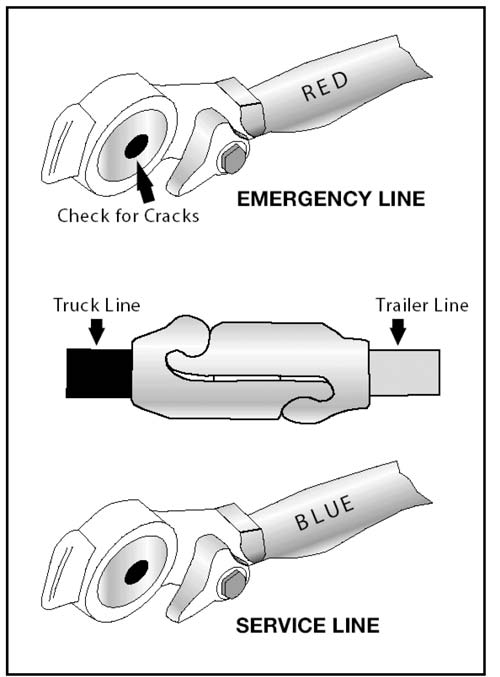
Figure 6.6
If you cross the air lines, supply air will be sent to the service line instead of going to charge the trailer air tanks. Air will not be available to release the trailer spring brakes (parking brakes). If the spring brakes do not release when you push the trailer air supply control, check the air line connections.
Older trailers do not have spring brakes. If the air supply in the trailer air tank has leaked away, there will be no emergency brakes and the trailer wheels will turn freely. If you cross the air lines, you can drive away but you will not have trailer brakes. This would be very dangerous. Always test the trailer brakes before driving with the hand valve or by pulling the air supply (tractor protection valve) control. Pull gently against them in a low gear to make sure the brakes work.
Some vehicles have “dead end” or dummy couplers to that hoses may be attached to when they are not in use. This will prevent water and dirt from getting into the coupler and the air lines. Use the dummy couplers when the air lines are not connected to a trailer. If there are no dummy couplers, the glad hands can sometimes be locked together (depending on the couplings). It is very important to keep the air supply clean.
6.2.6 – Trailer Air Tanks
Each trailer and converter dolly has one or more air tanks. They are filled by the emergency (supply) line from the tractor. They provide the air pressure used to operate trailer brakes. Air pressure is sent from the air tanks to the brakes by relay valves.
The pressure in the service line tells how much pressure the relay valves should send to the trailer brakes. The pressure in the service line is controlled by the brake pedal (and the trailer hand brake).
It is important that you do not let water and oil build up in the air tanks. If you do, the brakes may not work correctly. Each tank has a drain valve on it and you should drain each tank every day. If your tanks have automatic drains, they will keep most moisture out. You should still open the drains to make sure.
6.2.7 – Shut-Off Valves
Shut-off valves are used in the service and supply air lines at the back of trailers used to tow other trailers. These valves permit closing the air lines off when another trailer is not being towed. You must check that all shut-off valves are in the open position except the ones at the back of the last trailer, which must be closed.
6.2.8 – Trailer Service, Parking, and Emergency Brakes
Newer trailers have spring brakes just like trucks and truck tractors. However, converter dollies and trailers built before 1975 are not required to have spring brakes. Those that do not have spring brakes have emergency brakes, which work from the air stored in the trailer air tank. The emergency brakes come on whenever air pressure in the emergency line is lost. These trailers have no parking brake. The emergency brakes come on whenever the air supply knob is pulled out or the trailer is disconnected. A major leak in the emergency line will cause the tractor protection valve to close and the trailer emergency brakes to come on. However, the brakes will hold only as long as there is air pressure in the trailer air tank. Eventually, the air will leak away and there will be no brakes. Therefore, it is very important for safety that you use wheel chocks when you park trailers without spring brakes.
You may not notice a major leak in the service line until you try to put the brakes on. Then, the air loss from the leak will lower the air tank pressure quickly. If it goes low enough, the trailer emergency brakes will come on.
SUBSECTION 6.2
Test Your Knowledge
- Why should you not use the trailer hand valve while driving?
- Describe what the trailer air supply control does.
- Describe what the service line is for.
- What is the emergency air line for?
- Why should you use chocks when parking a trailer without spring brakes?
- Where are shut-off valves?
These questions may be on your test. If you cannot answer them all, reread Subsection 6.2.
6.3 – Anti-lock Brake Systems
6.3.1 – Trailers Required to Have ABS
- All trailers and converter dollies built on or after March 1, 1998, are required to have ABS. However, many trailers and converter dollies built before this date have been voluntarily equipped with ABS.
- Trailers will have yellow ABS malfunction lamps on the left side, either on the front or rear corner. See Figure 6.7. Dollies manufactured on or after March 1, 1998, are required to have a lamp on the left side.
- In the case of vehicles manufactured before the required date, it may be difficult to tell if the unit is equipped with ABS. Look under the vehicle for the ECU and wheel speed sensor wires coming from the back of the brakes.

Figure 6.7
6.3.2 – Braking With ABS
- ABS is an addition to your normal brakes. It does not decrease or increase your normal braking capability. ABS only activates when wheels are about to lock up.
- ABS does not necessarily shorten your stopping distance, but it helps you keep the vehicle under control during hard braking.
- ABS helps you avoid wheel lock up. The computer senses impending lockup, reduces the braking pressure to a safe level, and you maintain control.
- ABS on only the trailer, or even on only 1 axle, still gives you more control over the vehicle during braking.
- When only the trailer has ABS, the trailer is less likely to swing out, but if you lose steering control or start a tractor jackknife, let up on the brakes (if you can safely do so) until you gain control.
- When you drive a tractor-trailer combination with ABS, you should brake as you always have. In other words:
— Use only the braking force necessary to stop safely and stay in control.
— Brake the same way, regardless of whether you have ABS on the tractor, the trailer, or both.
— As you slow down, monitor your tractor and trailer and back off the brakes (if it is safe to do so) to stay in control. - Remember, if your ABS malfunctions, you still have regular brakes. Drive normally, but get the system serviced soon.
- ABS will not allow you to drive faster, follow more closely, or drive less carefully.
6.4 – Coupling and Uncoupling
Knowing how to couple and uncouple correctly is basic to safe operation of combination vehicles. Wrong coupling and uncoupling can be very dangerous. General coupling and uncoupling steps are listed below. There are differences between different rigs, so learn the details of coupling and uncoupling the truck(s) you will operate.
6.4.1 – Coupling Tractor-Semitrailers
Step 1: Inspecting the Fifth-Wheel
- Check for damaged and missing parts.
- Check to see that the mounting to the tractor is secure, no cracks in the frame, etc.
- Be sure that the fifth-wheel plate is greased as required. Failure to keep the fifth-wheel plate lubricated could cause steering problems because of friction between the tractor and trailer.
- Check if the fifth-wheel is in proper position for coupling:
— Wheel is tilted down towards the rear of the tractor.
— Jaws are open.
— Safety unlocking handle is in the automatic lock position.
— If you have a sliding fifth-wheel, make sure it is locked.
— Make sure the trailer kingpin is not bent or broken.
Step 2: Inspect the Area and Chock the Wheels
- Make sure the area around the vehicle is clear.
- Be sure the trailer wheels are chocked or spring brakes are on.
- Check that the cargo (if any) is secured against movement due to the tractor being coupled to the trailer.
Step 3: Position the Tractor
- Put the tractor directly in front of the trailer. (Never back under the trailer at an angle because you might push the trailer sideways and break the landing gear.)
- Check your position, using the outside mirrors, by looking down both sides of the trailer.
Step 4: Back Slowly
- Back until the fifth-wheel just touches the trailer.
- Do not hit the trailer.
Step 5: Secure the Tractor
- Apply the parking brakes.
- Put the transmission in Neutral.
Step 6: Check the Trailer Height
- The trailer should be low enough that it is raised slightly by the tractor when the tractor is backed under it. Raise or lower the trailer as needed. (If the trailer is too low, the tractor may strike and damage the trailer nose; if the trailer is too high, it may not couple correctly.)
- Check that the kingpin and fifth-wheel are aligned.
Step 7: Connect the Air Lines to the Trailer
- Check the glad hand seals and connect the tractor emergency air line to the trailer emergency glad hand.
- Check the glad hand seals and connect the tractor service air line to the trailer service glad hand.
- Make sure the air lines are safely supported where they will not be crushed or caught while the tractor is backing under the trailer.
Step 8: Supply Air to Trailer
- From the cab, push in the “air supply” knob or move the tractor protection valve control from the “emergency” to the “normal” position to supply air to the trailer brake system.
- Wait until the air pressure is normal.
- Check the brake system for crossed air lines.
— Shut the engine off so you can hear the brakes.
— Apply and release the trailer brakes and listen for the sound of trailer brakes being applied and released. You should hear the brakes move when applied and air escape when the brakes are released.
— Check the air brake system pressure gauge for signs of major air loss. - When you are sure the trailer brakes are working, start the engine.
- Make sure the air pressure is up to normal.
Step 9: Lock the Trailer Brakes
Pull out the “air supply” knob or move the tractor protection valve control from “normal” to “emergency.”
Step 10: Back Under the Trailer
- Use the lowest reverse gear.
- Back the tractor slowly under the trailer to avoid hitting the kingpin too hard.
- Stop when the kingpin is locked into the fifth-wheel.
Step 11: Check the Connection for Security
- Raise the trailer landing gear slightly off the ground.
- Pull the tractor gently forward while the trailer brakes are still locked to check that the trailer is locked onto the tractor.
Step 12: Secure the Vehicle
- Put the transmission in Neutral.
- Apply the parking brakes.
- Shut off the engine and take the key with you so someone else will not move the truck while you are under it.
Step 13: Inspect the Coupling
- Use a flashlight, if necessary.
- Make sure there is no space between the upper and lower fifth-wheel. If there is space, something is wrong (the kingpin may be on top of the closed fifth-wheel jaws, and the trailer would come loose very easily).
- Go under the trailer and look into the back of the fifth-wheel. Make sure the fifth-wheel jaws have closed around the shank of the kingpin.
- Check that the locking lever is in the “lock” position.
- Check that the safety latch is in position over the locking lever. (On some fifth-wheels the catch must be put in place by hand.)
- If the coupling is not right, do not drive the coupled unit; get it fixed.
Step 14: Connect the Electrical Cord and Check Air Lines
- Plug the electrical cord into the trailer and fasten the safety catch.
- Check both the air and electrical lines for signs of damage.
- Make sure the air and electrical lines will not hit any moving parts of the vehicle.
Step 15: Raise the Front Trailer Supports (Landing Gear)
- Use the low gear range (if so equipped) to begin raising the landing gear. Once free of weight, switch to the high gear range.
- Raise the landing gear all the way up. (Never drive with landing gear only part way up, as it may catch on railroad tracks or other things.)
- After raising the landing gear, secure the crank handle safely.
- When the full weight of the trailer is resting on tractor:
— Check for enough clearance between the rear of the tractor frame and landing gear. (When the tractor turns sharply, it must not hit the landing gear.)
— Check that there is enough clearance between the top of the tractor tires and the nose of the trailer.
Step 16: Remove the Trailer Wheel Chocks
Remove and store the wheel chocks in a safe place.
6.4.2 – Uncoupling the Tractor-Semitrailers
The following steps will help you to uncouple safely.
Step 1: Position the Rig
- Make sure the surface of the parking area can support the weight of the trailer.
- Have the tractor lined up with the trailer. (Pulling out at an angle can damage the landing gear.)
Step 2: Ease Pressure on the Locking Jaws
- Shut off the trailer air supply to lock the trailer brakes.
- Ease the pressure on the fifth-wheel locking jaws by backing up gently. (This will help you release the fifth-wheel locking lever.)
- Put the parking brakes on while the tractor is pushing against the kingpin. (This will hold the rig with pressure off the locking jaws.)
Step 3: Chock the Trailer Wheels
Chock the trailer wheels if the trailer does not have spring brakes or you are not sure. (The air could leak out of the trailer air tank, releasing its emergency brakes. Without the chocks, the trailer could move.)
Step 4: Lower the Landing Gear
- If the trailer is empty, lower the landing gear until it makes firm contact with the ground.
- If the trailer is loaded, after the landing gear makes firm contact with the ground, turn the crank in low gear a few extra turns. This will lift some weight off the tractor. (Do not lift the trailer off the fifth-wheel.) This will make it easier to:
—Unlatch the fifth-wheel.
—Couple next time.
Step 5: Disconnect the Air Lines and Electrical Cable
- Disconnect the air lines from the trailer. Connect the air line glad hands to the dummy couplers at the back of the cab or couple them together.
- Hang the electrical cable with the plug down to prevent moisture from entering it.
- Make sure the lines are supported so they will not be damaged while driving the tractor.
Step 6: Unlock the Fifth-Wheel
- Raise the release handle lock.
- Pull the release handle to “open” position.
- Keep legs and feet clear of the rear tractor wheels to avoid serious injury in case the vehicle moves.
Step 7: Pull the Tractor Partially Clear of the Trailer
- Pull tractor forward until the fifth-wheel comes out from under the trailer.
- Stop with the tractor frame under the trailer (prevents the trailer from falling to the ground if the landing gear should collapse or sink).
Step 8: Secure the Tractor
- Apply the parking brake.
- Place the transmission in Neutral.
Step 9: Inspect the Trailer Supports
- Make sure the ground is supporting the trailer.
- Make sure the landing gear is not damaged.
Step 10: Pull the Tractor Clear of the Trailer
- Release the parking brakes.
- Check the area and drive the tractor forward until it clears.
6.4.3 Coupling a Pintle Hook
Step 1. Inspect the Pintle Hook
Before operating, check for worn, damaged, or missing parts, and make sure the mount is secure. If the pintle hook is not secured to the mounting surface, the pintle hook could separate from the vehicle, which, if not avoided, could result in death or serious injury.
Step 2. Unlock the Lock Pin and Open Latch
Unlock and remove the tethered lock pin, if applicable.

Lift the lock handle away from the vehicle until the lock clears the lock seat on the hook body. Open the latch by rotating the latch assembly up toward the vehicle until the latch is in its most upright position, and then release the lock handle. (See Figure 6.9 and 6.10.)
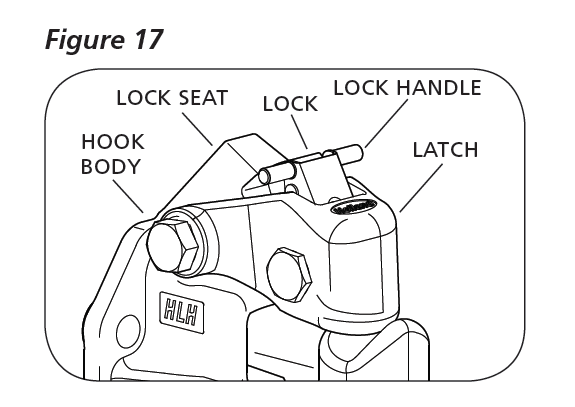

Step 3. Lower the Drawbar Into Place
Position the drawbar eye over the horn of the pintle hook and lower it into place.
Step 4. Lock the Pintle Hook
Push the latch closed. When correctly locked, the lock handle will rotate and move up until it is flush with the top of the latch. (See Figure 6.11.)

Insert the tethered lock pin through the latch and lock holes, and close the tethered wire lock pin, if applicable. See Figure 6.8. Failure to correctly lock the latch can result in separation of the trailer and vehicle, which, if not avoided, could result in death or serious injury.
6.4.4- Uncoupling a Pintle Hook
Step 1. Park on a Level Surface
Park the trailer on a firm level surface and block trailer tires
Step 2. Disconnect the Electrical Connector, Breakaway Brake Switch, and Safety Chains
- Disconnect the electrical connector.
- Disconnect the breakaway brake switch lanyard.
- Disconnect the safety chains from the tow vehicle.
Step 3. Unlock the Coupler
Unlock the coupler and open it.
Step 4. Check the Ground Surface for Correct Support
Before extending the jack, make certain the ground surface below the jack pad will support the tongue load.
Step 5. Rotate the Jack Handle
Rotate the jack handle to extend the jack and transfer the weight of the trailer tongue to the jack.
Step 6. Raise the Trailer Coupler
Raise the trailer coupler above the tow vehicle hitch.
Step 7. Drive Forward
Drive the tow vehicle forward.
6.4.5 – Coupling a Drawbar

Step 1: Remove the Safety Lock Screw and Rotate the Safety Cover Bar
- Remove the safety lock screw (2), recover and keep the relative self-locking nut (12) aside.
- Loosen the safety lock screw (2a) and turn the adjustment screw (3) outwards at least 5 turns.
- Rotate the safety cover bar (4) outwards so that it is completely open.
Step 2. Reverse the Truck
Reverse the truck very slowly until the ball cup drawbar eye (6) is in position exactly above the drawbar-coupling ball (5).
Step 3. Lower the Drawbeam
Lower the drawbeam until the ball cup drawbar eye (6) lies completely covering the drawbar-coupling ball (5).
Step 4. Rotate the Safety Cover Bar
- Rotate the safety cover bar back inwards (4) and fit in safety lock screw (2) together with its self-locking nut.
- Tighten in both the lock screws (2, 2a) together with their relative self-locking nuts (12, 12a) at a 350 to 400 newton meters (Nm) torque wrench setting.
Step 5. Adjust the Adjustment Screw
- Adjust the adjustment screw (3) until a 0.3—0.5 mm vertical clearance between the guard disk (13) and the ball cup (6) is reached.
- Lock the setting with counter nut (11).
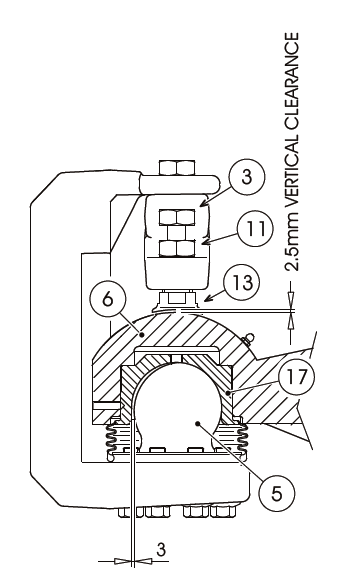
In the event that the safety cover bar (4) will not perfectly lodge into its seating appropriately, travel is strictly forbidden.
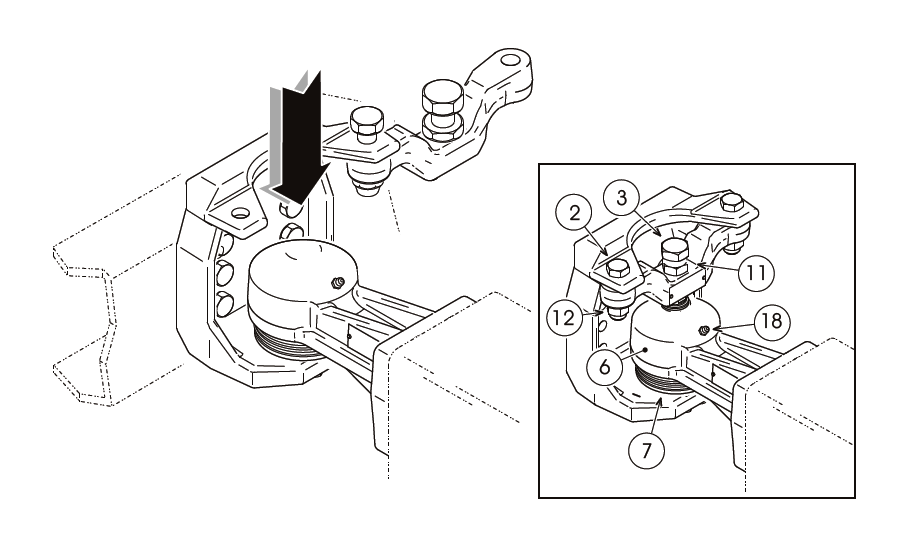
Step 6. Protect the Coupling Ball and Anchor the Edge Onto Ball
- Protect the part that is still visible of the coupling ball (5) with the rubber dust proof bellows protection cover (7).
- Accurately anchor the edge directly onto the ball itself.
Step 7. Lubricate the Drawbar Eye
Lubricate the inside of the drawbar eye ball cup (6) directly through the grease nipple (18).
6.4.6 – Uncoupling a Drawbar
Step 1. Turn the Trailer Brake On
Make sure that the trailer brake is on.
Step 2. Remove the Cover and Loosen the Screws
- Remove the rubber dust proof bellows protection cover (7).
- Loosen the adjustment screw (3) and the counter nut (11).
- Loosen safety lock screw (2a) and remove safety lock screw (2) together with its self-locking nut (12).
Step 3. Rotate the Safety Cover Bar and Lift Trailer Drawbeam
- Rotate the safety cover bar (4) outwards so that it is completely open.
- Lift the trailer drawbeam until the drawbar-coupling ball (5) is fully visible, and then travel forward with the trailer very slowly.
- Rotate the safety cover bar inwards (4) until it lodges back in its housing.
Step 4. Lock the Safety Screw and Tighten the Self-Locking Nut
Fit in the safety lock screw (2) and tighten in the self-locking nut (12).
6.4.7 – Coupling a Gooseneck Hitch
If you are hooking up a gooseneck or a fifth-wheel hitch, the procedure is a little different from a receiver and ball, but it is not difficult.
Step 1. Open the Latch and Lubricate the Gooseneck Ball
- Open the clamp latch on the gooseneck coupler.
- Make sure that the gooseneck ball is properly lubricated.
Step 2. Position the Coupler and Latch the Clamp
- Position the trailer’s coupler directly over the ball
- Lower the gooseneck trailer into position.
- Latch the clamp.
Step 3. Attach the Safety Chains
- Attach your safety chains.
- Remember that all trailers are required by law to have safety chains.
Step 4. Connect the Trailer Light Wiring
- Connect your trailer light wiring to your vehicle’s connector.
- Check all of your lights, including your brake lights.
Step 5. Lower and Stow the Trailer Jacks
Completely lower and stow the trailer jacks, allowing the weight to settle onto the tow vehicle.
6.4.8 Uncoupling a Gooseneck Hitch
Step 1. Remove the Safety Pin and Clip
Simply remove the safety pin and clip.
Step 2. Rotate the Handle and Raise the Trailer Off the Ball
- Rotate the handle to this position (See Figure 6.15) and raise the trailer off the ball.
- The coupler will return to the load position automatically.
Step 3. Install the Safety Pin and Clip
Install the safety pin and clip. (See Figure 6.15.)
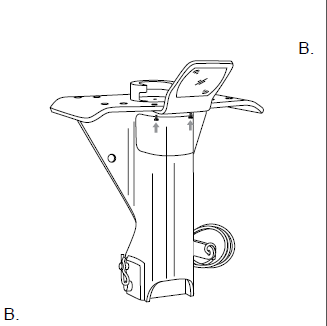
SUBSECTIONS 6.3 AND 6.4
Test Your Knowledge
- What might happen if the trailer is too high when you try to couple?
- After coupling, how much space should be between the upper and lower fifth-wheel?
- You should look into the back of the fifth-wheel to see if it is locked onto the kingpin. True or False?
- To drive, you need to raise the landing gear only until it just lifts off the pavement. True or False?
- How do you know if your trailer is equipped with anti-lock brakes?
These questions may be on your test. If you cannot answer them all, reread Subsections 6.3 and 6.4.
6.5 – Inspecting a Combination Vehicle
Use the 7-step inspection procedure described in Section 2 to inspect your combination vehicle. There are more things to inspect on a combination vehicle than on a single vehicle (for example, tires, wheels, lights, reflectors, etc.). There are also some new things to check. These are discussed below.
6.5.1 – Additional Things to Check During a Walk Around Inspection
Do these checks in addition to those already listed in Section 2.
Coupling System Areas
- Check the fifth-wheel (lower).
— Is securely mounted to the frame.
— Has no missing or damaged parts.
— Has enough grease.
— Has no visible space between upper and lower fifth-wheel.
— Locking jaws are around the shank, not the head of the kingpin. See Figure 6.16.
— Release arm is properly seated and the safety latch/lock is engaged.
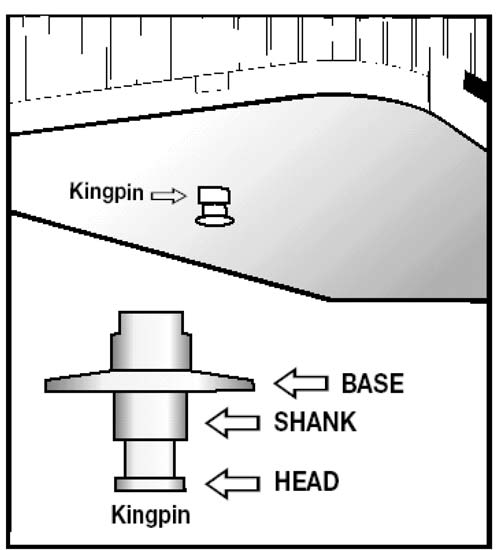
Figure 6.16
- Check the fifth-wheel (upper).
— Glide plate is securely mounted to the trailer frame.
— Kingpin is not damaged. - Check the air and electric lines to the trailer.
— Electrical cord is firmly plugged in and secured.
— Air lines are properly connected to the glad hands, no air leaks, and properly secured with enough slack for turns.
— All lines are free from damage. - Check the sliding fifth-wheel.
— the slide is not damaged or parts missing.
— Is properly greased.
— All locking pins are present and locked in place.
— If air powered, there are no air leaks.
— The fifth-wheel is not so far forward that the tractor frame will hit the landing gear, or the cab will hit the trailer during turns.
Landing Gear
- Is fully raised, has no missing parts, not bent, or otherwise damaged.
- Crank handle is in place and secured.
- If power operated, there are no air or hydraulic leaks.
6.5.2 – Combination Vehicle Brake Check
Do these checks in addition to Section 5.3: Inspecting Air Brake Systems.
The following section explains how to check air brakes on combination vehicles. Check the brakes on a double or triple trailer as you would any combination vehicle.
- Check That Air Flows to all the Trailers. Use the tractor parking brake and/or chock the wheels to hold the vehicle. Wait for air pressure to reach normal, and then push in the red “trailer air supply” knob. This will supply air to the emergency (supply) lines. Use the trailer handbrake to provide air to the service line. Go to the rear of the rig. Open the emergency line shut-off valve at the rear of the last trailer. You should hear air escaping, showing the entire system is charged. Close the emergency line valve. Open the service line valve to check that service pressure goes through all the trailers (this test assumes that the trailer handbrake or the service brake pedal is on), and then close the valve. If you do not hear air escaping from both lines, check that the shut-off valves on the trailer(s) and dolly(ies) are in the OPEN position. You must have air all the way to the back for all the brakes to work.
- Test the Tractor Protection Valve. Charge the trailer air brake system. (That is, build up normal air pressure and push the “air supply” knob in.) Shut the engine off. Step on and off the brake pedal several times to reduce the air pressure in the tanks. The trailer air supply control (also called the tractor protection valve control) should pop out (or go from “normal” to”emergency”position)when the air pressure falls into the pressure range specified by the manufacturer. (Usually within the range of 20 to 45 psi.)
— If the tractor protection valve does not work right, an air hose or trailer brake leak could drain all the air from the tractor. This would cause the emergency brakes to come on, with possible loss of control.
- Test the Trailer Emergency Brakes. Charge the trailer air brake system and check that the trailer rolls freely. Then stop and pull out the trailer air supply control (also called tractor protection valve control or trailer emergency valve), or place it in the “emergency” position. Pull gently on the trailer with the tractor to check that the trailer emergency brakes are on.
- Test the Trailer Service Brakes. Check for normal air pressure, release the parking brakes, move the vehicle forward slowly, and apply trailer brakes with the hand control (trolley valve), if so equipped. You should feel the brakes come on. This tells you the trailer brakes are connected and working. (The trailer brakes should be tested with the hand valve but controlled in normal operation with the foot pedal, which applies air to the service brakes at all wheels.)
SUBSECTION 6.5
Test Your Knowledge
- Which shut-off valves should be open and which closed?
- How can you test that air flows to all trailers?
- How can you test the tractor protection valve?
- How can you test the trailer emergency brakes?
- How can you test the trailer service brakes?
These questions may be on your test. If you cannot answer all of them, reread Subsection 6.5.
Section 5: Air Brakes
This section tells you about air brakes. If you want to drive a truck, bus, or pull a trailer with air brakes, you need to read this section. If you want to pull a trailer with air brakes, you also need to read Section 6: Combination Vehicles in this handbook.
Air brakes use compressed air to make the brakes work. Air brakes are a good and safe way of stopping large and heavy vehicles, but the brakes must be well maintained and used properly.
Air brakes are really 3 different braking systems: service brake, parking brake, and emergency brake. The:
- Service brake system applies and releases the brakes when you use the brake pedal during normal driving.
- Parking brake system applies and releases the parking brakes when you use the parking brake control.
- Emergency brake system uses parts of the service and parking brake systems to stop the vehicle in a brake system failure.
CDL Air Brake Requirements. For CDL purposes, a vehicle’s air brake system must meet the above definition and contain the following, which will be checked during the vehicle inspection test:
- Air gauges.
- Low pressure warning device(s).
If the vehicle you use for your road test does not have these components, your vehicle will not be considered as having an air brake system and you will have a “No Air Brakes” (“L”) restriction on your CDL.
Note A full service brake application must deliver to all brake chambers not less than 90 percent of the air reservoir pressure remaining with the brakes applied (CVC §26502).
The parts of these systems are discussed in greater detail in the following paragraphs.
5.1 – Parts of an Air Brake System
There are many parts to an air brake system. You should know about the parts discussed here.
5.1.1 – Air Compressor
The air compressor pumps air into the air storage tanks (reservoirs). The air compressor is connected to the engine through gears or a v-belt. The compressor may be air cooled or cooled by the engine cooling system. It may have its own oil supply or be lubricated by engine oil. If the compressor has its own oil supply, check the oil level before driving.
5.1.2 – Air Compressor Governor
The governor controls when the air compressor will pump air into the air storage tanks. When air tank pressure rises to the “cut-out” level (around 125 pounds per-square-inch or “psi”), the governor stops the compressor from pumping air. When the tank pressure falls to the “cut-in” pressure (around 100 psi), the governor allows the compressor to start pumping again.
5.1.3 – Air Storage Tanks
Air storage tanks are used to hold compressed air. The number and size of air tanks varies among vehicles. The tanks will hold enough air to allow the brakes to be used several times, even if the compressor stops working.
5.1.4 – Air Tank Drains
Compressed air usually has some water and some compressor oil in it, which is bad for the air brake system. The water can freeze in cold weather and cause brake failure. The water and oil tend to collect in the bottom of the air tank. Be sure that you drain the air tanks completely. Each air tank is equipped with a drain valve in the bottom. There are 2 types:
- Manual—operated by turning a quarter turn or pulling a cable. You must drain the tanks yourself at the end of each day of driving. See Figure 5.1.
- Automatic—the water and oil are automatically expelled. These tanks may be equipped for manual draining as well.
Automatic air tanks are available with electric heating devices. These help prevent freezing of the automatic drain in cold weather.

Figure 5.1
5.1.5 – Alcohol Evaporator
Some air brake systems have an alcohol evaporator to put alcohol into the air system. This helps to reduce the risk of ice in air brake valves and other parts during cold weather. Ice inside the system can make the brakes stop working.
Check the alcohol container and fill up as necessary. (every day during cold weather). Daily air tank drainage is still needed to get rid of water and oil (unless the system has automatic drain valves).
5.1.6 – Safety Valve
A safety relief valve is installed in the first tank the air compressor pumps air to. The safety valve protects the tank and the rest of the system from too much pressure. The valve is usually set to open at 150 psi. If the safety valve releases air, something is wrong. Have the fault fixed by a mechanic.
5.1.7 – The Brake Pedal
You engage the brakes by pushing down the brake pedal (It is also called a foot valve or treadle valve). Pushing the pedal down harder applies more air pressure. Letting up on the brake pedal reduces the air pressure and releases the brakes. Releasing the brakes lets some compressed air go out of the system, so the air pressure in the tanks is reduced. It must be made up by the air compressor. Pressing and releasing the pedal unnecessarily can let air out faster than the compressor can replace it. If the pressure gets too low, the brakes will not work.
5.1.8 – Foundation Brakes
Foundation brakes are used at each wheel. The most common type is the S-cam drum brake. The parts of the brake are discussed below.
Brake Drums, Shoes, and Linings. Brake drums are located on each end of the vehicle’s axles. The wheels are bolted to the drums. The braking mechanism is inside the drum. To stop, the brake shoes and linings are pushed against the inside of the drum. This causes friction, which slows the vehicle (and creates heat). The heat a drum can take without damage depends on how hard and how long the brakes are used. Too much heat can make the brakes stop working.
S-cam Brakes. When you push the brake pedal, air is let into each brake chamber. Air pressure pushes the rod out, moving the slack adjuster, thus twisting the brake camshaft. This turns the S-cam (it is shaped like the letter “S”). The S-cam forces the brake shoes away from one another and presses them against the inside of the brake drum. When you release the brake pedal, the S-cam rotates back and a spring pulls the brake shoes away from the drum, letting the wheels roll freely again. See Figure 5.2.
CamLaster. The CamLaster brake has 2 key design differences over traditional S-cam brakes.
One feature is a completely internal adjustment system which is designed to continually keep the brake in proper adjustment. S-cam brakes, on the other hand, require an external slack adjuster. The second feature is a unique cam design that applies the brake shoe. Unlike a standard drum brake that has either a single or double anchor-pin brake, the CamLaster slides the shoes down an inclined ramp on a cam to evenly contact the brake drum.

Figure 5.2
Wedge Brakes. In this type of brake, the brake chamber push rod pushes a wedge directly between the ends of 2 brake shoes. This shoves them apart and against the inside of the brake drum. Wedge brakes may have a single brake chamber or 2 brake chambers that push wedges in at both ends of the brake shoes. Wedge type brakes may be self-adjusting or may require manual adjustment.
Disc Brakes. In air-operated disc brakes, air pressure acts on a brake chamber and slack adjuster, like S-cam brakes. But instead of the S-cam, a “power screw” is used. The pressure of the brake chamber on the slack adjuster turns the power screw. The power screw clamps the disc or rotor between the brake lining pads of a caliper, similar to a large c-clamp.
Wedge brakes and disc brakes are less common than S-cam brakes.
5.1.9 – Supply Pressure Gauges
All vehicles with air brakes have a pressure gauge connected to the air tank. If the vehicle has a dual air brake system, there will be a gauge for each half of the system (or a single gauge with two needles). Dual systems will be discussed later. These gauges tell you how much pressure is in the air tanks.
5.1.10 – Application Pressure Gauge
This gauge shows how much air pressure you are applying to the brakes. (This gauge is not on all vehicles.) Increasing application pressure to hold the same speed means the brakes are fading. You should slow down and use a lower gear. Brakes that are of adjustment, air leaks, or mechanical problems can also cause the need for increased pressure.
5.1.11 – Low Air Pressure Warning
A low air pressure warning signal is required on vehicles with air brakes. A warning signal you can see must come on when the air pressure in the tanks falls between 55 and 75 psi (or 1/2 the compressor governor cutout pressure on older vehicles). The warning is usually a red light. A buzzer may also come on.
Another type of warning is the “wig wag.” This device drops a mechanical arm into your view when the pressure in the system drops between 55 and 75 psi. An automatic wig wag will rise out of your view when the pressure in the system goes above 55 and 75 psi. The manual reset type must be placed in the “out of view” position manually. It will not stay in place until the pressure in the system is above 55 psi.
On large buses, it is common for the low pressure warning devices to signal at 80–85 psi.
5.1.12 – Stop Light Switch
Drivers behind you must be warned when you put your brakes on. The air brake system does this with an electric switch that works by air pressure. The switch turns on the brake lights when you put on the air brakes.
5.1.13 – Front Brake Limiting Valve
Some vehicles made before 1975 have a front brake limiting valve and a control in the cab. The control is usually marked “normal” and “slippery.” When you put the control in the “slippery” position, the limiting valve cuts the “normal” air pressure to the front brakes by half. Limiting valves were used to reduce the chance of the front wheels skidding on slippery surfaces. However, they actually reduce the stopping power of the vehicle. Front wheel braking is good under all conditions. Tests have shown front wheel skids from braking are not likely even on ice. Make sure the control is in the “normal” position to have normal stopping power.
Many vehicles have automatic front wheel limiting valves. They reduce the air to the front brakes except when the brakes are put on very hard (60 psi or more application pressure). The driver cannot control these valves.
5.1.14 – Spring Brakes
All trucks, truck tractors, and buses must be equipped with emergency brakes and parking brakes. They must be held on by mechanical force (because air pressure can eventually leak away). Spring brakes are usually used to meet these needs. Powerful springs are held back by air pressure when driving. If the air pressure is removed, the springs put on the brakes. A parking brake control in the cab allows the driver to let the air out of the spring brakes. This lets the springs put the brakes on. A leak in the air brake system, which causes all the air to be lost, will also cause the springs to put on the brakes.
Tractor and straight truck spring brakes will come fully on when air pressure drops to a range of 20 to 45 psi (typically 20 to 30 psi). Do not wait for the brakes to come on automatically. When the low air pressure warning light, and buzzer first come on, bring the vehicle to a safe stop right away, while you can still control the brakes.
The braking power of spring brakes depends on the brakes being in adjustment. If the brakes are not adjusted properly, neither the regular brakes nor the emergency/parking brakes will work right.
5.1.15 – Parking Brake Controls
In newer vehicles with air brakes, you put on the parking brakes using a diamond-shaped, yellow, push-pull control knob. You pull the knob out to put the parking brakes (spring brakes) on, and push it in to release them. On older vehicles, the parking brakes may be controlled by a lever. Use the parking brakes whenever you park.
Caution. Never push the brake pedal down when the spring brakes are on. If you do, the brakes could be damaged by the combined forces of the springs and the air pressure. Many brake systems are designed so this will not happen. Not all systems are set up that way, and those that are may not always work. It is much better to develop the habit of not pushing the brake pedal down when the spring brakes are on.
Modulating Control Valves. In some vehicles a control handle on the dash board may be used to apply the spring brakes gradually. This is called a modulating valve. It is spring-loaded so you have a feel for the braking action. The more you move the control lever, the harder the spring brakes come on. They work this way so you can control the spring brakes if the service brakes fail. When parking a vehicle with a modulating control valve, move the lever as far as it will go and hold it in place with the locking device.
Dual Parking Control Valves. When main air pressure is lost, the spring brakes come on. Some vehicles, such as buses, have a separate air tank which can be used to release the spring brakes. This is so you can move the vehicle in an emergency. One of the valves is a push-pull type and is used to put on the spring brakes for parking. The other valve is spring loaded in the “out” position. When you push the control in, air from the separate air tank releases the spring brakes so you can move. When you release the button, the spring brakes come on again. There is only enough air in the separate tank to do this a few times. Therefore, plan carefully when moving. Otherwise, you may be stopped in a dangerous location when the separate air supply runs out. See Figure 5.3.

Figure 5.3
5.1.16 – Anti-lock Braking Systems
Truck tractors with air brakes built on or after March 1, 1997, and other air brakes vehicles (trucks, buses, trailers, and converter dollies) built on or after March 1, 1998, are required to be equipped with anti-lock brakes. Many commercial vehicles built before these dates have been voluntarily equipped with ABS. Check the certification label for the date of manufacture to determine if your vehicle is equipped with ABS. ABS is a computerized system that keeps your wheels from locking up during hard brake applications.
- Vehicles with ABS have yellow malfunction lamps to tell you if something is not working.
- Tractors, trucks, and buses will have yellow ABS malfunction lamps on the instrument panel.
- Trailers will have yellow ABS malfunction lamps on the left side, either on the front or rear corner. Dollies manufactured on or after March 1, 1998, are required to have a lamp on the left side.
On newer vehicles, the malfunction lamp comes on at start-up for a bulb check, and then goes out quickly. On older systems, the lamp could stay on until you are driving over 5 mph.
- If the lamp stays on after the bulb check, or goes on once you are under way, you may have lost ABS control at one or more wheels.
- In the case of towed units manufactured before it was required by the DOT, it may be difficult to tell if the unit is equipped with ABS. Look under the vehicle for the ECU and wheel speed sensor wires coming from the back of the brakes.
- ABS is an addition to your normal brakes. It does not decrease or increase your normal braking capability. ABS only activates when wheels are about to lock up.
- ABS does not necessarily shorten your stopping distance, but it does help you keep the vehicle under control during hard braking.
SUBSECTION 5.1
Test Your Knowledge
- Why must air tanks be drained?
- What is a supply pressure gauge used for?
- All vehicles with air brakes must have a low air pressure warning signal. True or False?
- What are spring brakes?
- Front wheel brakes are good under all conditions. True or False?
- How do you know if your vehicle is equipped with anti-lock brakes?
These questions may be on your test. If you cannot answer them all, reread Subsection 5.1.

Figure 5.4
5.2 – Dual Air Brake
Most heavy-duty vehicles use dual air brake systems for safety. A dual air brake system has 2 separate air brake systems, which use a single set of brake controls. Each system has its own air tanks, hoses, lines, etc. One system typically operates the regular brakes on the rear axle or axles. The other system operates the regular brakes on the front axle (and possibly one rear axle). Both systems supply air to the trailer (if there is one). The first system is called the “primary” system. The other is called the “secondary” system. See Figure 5.4.
Before driving a vehicle with a dual air system, allow time for the air compressor to build up a minimum of 100 psi pressure in both the primary and secondary systems. Watch the primary and secondary air pressure gauges (or needles, if the system has 2 needles in one gauge). Pay attention to the low air pressure warning light and buzzer. The warning light and buzzer should shut off when air pressure in both systems rises to a value set by the manufacturer. This value must be greater than 55 psi.
The warning light and buzzer should come on before the air pressure drops below 55 psi in either system. If this happens while driving, you should stop right away and safely park the vehicle. If one air system is very low on pressure, either the front or the rear brakes will not be operating fully. This means it will take you longer to stop. Bring the vehicle to a safe stop, and have the air brakes system fixed.
One-Way Check Valve
This device allows air to flow in one direction only. All air tanks on air-brake vehicles must have a check valve located between the air compressor and the first reservoir (CVC §26507). The check valve keeps air from going out if the air compressor develops a leak.
5.3 – Inspecting Air Brake Systems
You should use the basic 7-step inspection procedure described in Section 2 to inspect your vehicle. There is more to inspect on a vehicle with air brakes than one without them. These components are discussed below, in the order that they fit into the 7-step method.
5.3.1 – During Step 2 Engine Compartment Checks
Check the air compressor drive belt (if the compressor is belt-driven). If the air compressor is belt-driven, check the condition and tightness of the belt. It should be in good condition.
5.3.2 – During Step 5 Walk Around Inspection
Check slack adjusters on S-cam brakes. Park on level ground and chock the wheels to prevent the vehicle from moving. Release the parking brakes so you can move the slack adjusters. Use gloves and pull hard on each slack adjuster that you can reach. If a slack adjuster moves more than about one inch where the push rod attaches to it, it probably needs adjustment. Adjust it or have it adjusted. Vehicles with too much brake slack can be very hard to stop. Out-of-adjustment brakes are the most common problem found in roadside inspections. Be safe. Check the slack adjusters.
All vehicles built since 1994 have automatic slack adjusters. Even though automatic slack adjusters adjust themselves during full brake applications, they must be checked.
Automatic adjusters should not have to be manually adjusted except when performing maintenance on the brakes and during installation of the slack adjusters. In a vehicle equipped with automatic adjusters, when the pushrod stroke exceeds the legal brake adjustment limit, it is an indication that a mechanical problem exists in the adjuster itself, a problem exists with the related foundation brake components, or the adjuster was improperly installed.
The manual adjustment of an automatic adjuster to bring a brake pushrod stroke within legal limits is generally masking a mechanical problem and is not fixing it. Further, routine adjustment of most automatic adjusters will likely result in premature wear of the adjuster itself. It is recommended that when brakes equipped with automatic adjusters are found to be out of adjustment, the driver takes the vehicle to a repair facility as soon as possible to have the problem corrected. The manual adjustment of automatic slack adjusters is dangerous because it may give the driver a false sense of security regarding the effectiveness of the braking system.
The manual adjustment of an automatic adjuster should only be used as a temporary measure to correct the adjustment in an emergency situation. It is likely the brake will soon be back out of adjustment since this procedure usually does not fix the underlying adjustment problem.
Note Automatic slack adjusters are made by different manufacturers and do not all operate the same. Therefore, the specific manufacturer’s service manual should be consulted prior to troubleshooting a brake adjustment problem.
Check Brake Drums (or Discs), Linings, and Hoses
Brake drums (or discs) must not have cracks longer than 1/2 the width of the friction area. Linings (friction material) must not be loose or soaked with oil or grease and must not be worn dangerously thin (less than 1/4 inch). Mechanical parts must be in place, not broken, or missing. Check the air hoses connected to the brake chambers to make sure they are not cut or worn due to rubbing.
5.3.3 – Step 7: Final Air Brake Check
All air brake system tests in this section are considered important and each can be considered critical parts of the in-cab air brakes tests. The items marked with an asterisk (*) in this section are required for testing purposes during the vehicle inspection portion of the CDL skills test. They may be performed in any order as long as they are performed correctly and effectively. If these items are not demonstrated and the parameters for each test are not verbalized correctly, it is considered an automatic failure of the vehicle inspection portion of the skills test.
Do the following checks instead of the hydraulic brake check shown in Section 2, Step 7: Check Brake System.
1. Applied Leakage Test (1-minute hold): *
To perform this test, the driver must start with the engine running and with the air pressure built to governor cut-out (120–140 psi or another level specified by the manufacturer). The driver identifies when cut-out occurred, shuts off the engine, chocks the wheels if necessary, releases the parking brake (all vehicles) and tractor protection valve (combination vehicle), and fully applies the foot brake. The driver then holds the foot brake for 1 minute after stabilization of the air gauge. The driver checks the air gauge to see that the air pressure drops no more than 3 pounds in one minute (single vehicle) or 4 pounds in 1 minute (combination vehicle) and listens for air leaks. The driver must identify how much air the system lost and verbalize the maximum air loss rate allowed for the representative vehicle being tested.
Note For a Class A combination vehicle, if the power unit is equipped with air brakes and the trailer is equipped with electric/surge brakes, the pressure drop should be no more than 3 psi.
- 3 psi for single vehicles.
- 4 psi for a combination of 2 vehicles.
- 6 psi for a combination of 3 or more vehicles.
Important The maximum air loss rate for a combination of 2 or more vehicles is 3 psi if the towed vehicles are not equipped with air brakes.
An air loss greater than those listed above, indicates a problem in the braking system and repairs are needed before operating the vehicle. If the air loss is too much, check for air leaks and fix any that are identified.
Note For testing purposes, you must be able to demonstrate this test and verbalize the allowable air loss for your vehicle. For testing purposes, identify if the air loss rate is too much.
2. Low Air Warning Device*
To perform this test the vehicle must have enough air pressure so the low-pressure warning signal is off. The engine maybe on or off; however, the key must be in the “on” or “battery charge” position. Next, the driver begins fanning off the air pressure by rapidly applying and releasing the foot brake. Low-air warning devices (buzzer, light, and flag) must activate before air pressure drops below 55 psi or the level specified by the manufacturer. The driver must indicate the approximate pressure when the device gave warning and identify the parameter at which this must occur; no lower than 55 psi. See Figure 5.5.
For testing purposes, identify and verbalize the pressure at which the low air pressure warning signal activates and identify the parameter(s) at which this should occur. On large buses, it is common for low-pressure warning devices to signal at 80–85 psi. If testing in a large bus, identify the parameter(s) mentioned above (55–75 psi) and inform the examiner that your vehicle’s low-pressure warning devices are designed to activate at a higher pressure.
If the warning signal does not work, you could lose air pressure and not know it. This could cause sudden emergency braking in a single-circuit air system. In dual systems, the stopping distance will be increased. Only limited braking can be done before the spring brakes come on.
Note Farm labor vehicles and Type I school buses must be equipped with both an audible and visible type warning device.

Figure 5.5
3. Spring Brake Test:*
To perform this test, the parking brake (all vehicles) and tractor protection valve (combination vehicles) must be released; (engine running or not) as the driver fans off the air pressure. Normally between 20-45 psi (or the level specified by the manufacturer) on a tractor-trailer combination vehicle, the tractor protection valve and parking brake valve should close (pop out). On other combination vehicle types and single vehicle types, the parking brake valve should close (pop out). The driver must identify and verbalize the approximate pressure at which the brake(s) activated.
Note The parking brake valve will not pop out on buses that are equipped with an emergency park brake air reservoir (tank). If your bus is equipped with an emergency park brake air tank, you must perform the spring brake test for triple reservoir vehicles to check the automatic actuation of the spring brakes.
Spring Brake Test for Triple Reservoir Vehicles
If the parking brake valve does not pop out when the air pressure has been reduced to approximately 20 psi, you must demonstrate that the spring brakes have activated. To do this, you must:
- Remove the wheel chocks, if necessary.
- Leave the parking brake valve in the open (released) position.
- With the engine running, put the vehicle in a forward gear and attempt to drive forward.
The spring brakes should drag and prevent the vehicle from easily moving forward. If the spring brakes do not prevent the vehicle from easily moving forward, your road test will be postponed.
Note This test must only be performed on single vehicles designed with an isolated parking brake reservoir. Do not perform this test on combination vehicles.
Check the Rate of Air Pressure Buildup
To perform this test, the engine must be running at normal operating idle, typically 600–900 rpms. Observe the air gauge to determine if the pressure builds at the proper rate. For dual air systems, the pressure should build from approximately 85 to 100 psi within 45 seconds. For single air systems (in pre-1975 vehicles), the pressure should build from approximately 50 to 90 psi within 3 minutes.
For testing purposes, you must verbalize the parameters of the test and identify if the vehicle met the appropriate standards.
Test Air Leakage Rate
There are 3 tests as follows:
Static Leakage Test
With a basically fully-charged air system (within the effective operating range for the compressor), turn off the engine, release all brakes, and let the system settle (air gauge needle stops moving). Time for 1 minute. The air pressure should not drop more than:
- 2 psi for single vehicles.
- 3 psi for a combination of 2 vehicles.
- 5 psi for a combination of 3 or more vehicles.
Important The maximum air loss rate for a combination of 2 or more vehicles is 2 psi if the towed vehicles are not equipped with air brakes.
An air loss greater than those listed above, indicate a problem in the braking system and repairs are needed before operating the vehicle.
Test Parking Brake
Fasten your seat belt. Set the parking brake, and gently pull against it in a low gear to test that the parking brake will hold.
Test Service Brakes
Wait for normal air pressure, release the parking brake, move the vehicle forward slowly (about 5 mph), and apply the brakes firmly using the brake pedal. Note any vehicle “pulling” to one side, unusual feel, or delayed stopping action.
This test may show you problems, which you otherwise would not know about until you needed the brakes on the road.
SUBSECTIONS 5.2 AND 5.3
Test Your Knowledge
- What is a dual air brake system?
- What are the slack adjusters?
- How can you check slack adjusters?
- How can you test the low pressure warning signal?
- How can you check the spring brakes come on automatically?
- What are the maximum leakage rates?
These questions may be on your test. If you cannot answer them all, reread Subsections 5.2 and 5.3.
5.4 – Using Air Brakes
5.4.1 – Normal Stops
Push the brake pedal down. Control the pressure so the vehicle comes to a smooth, safe stop. If you have a manual transmission, do not push the clutch in until the engine rpm is down close to idle. When stopped, select a starting gear.
5.4.2 – Braking With Anti-lock Brakes
- When you brake hard on slippery surfaces in a vehicle without ABS, your wheels may lock up. When your steering wheels lock up, you lose steering control. When your other wheels lock up, you may skid, jackknife, or even spin the vehicle.
- ABS helps you avoid wheel lock up. The computer senses impending lockup, reduces the braking pressure to a safe level, and helps you maintain control.
- You may or may not be able to stop faster with ABS, but you should be able to steer around an obstacle while braking, and avoid skids caused by over braking.
- Having ABS on only the tractor, only the trailer, or even on only 1 axle, still gives you more control over the vehicle during braking. Brake normally.
- When only the tractor has ABS, you should be able to maintain steering control, and there is less chance of jackknifing. But keep your eye on the trailer and let up on the brakes (if you can safely do so) if it begins to swing out.
- When only the trailer has ABS, the trailer is less likely to swing out. But if you lose steering control or start a tractor jackknife, let up on the brakes (if you can safely do so) until you gain control.
- When you drive a tractor-trailer combination with ABS, you should brake as you always have. In other words:
— Use only the braking force necessary to stop safely and stay in control.
— Brake the same way, regardless of whether you have ABS on the tractor, the trailer, or both.
— As you slow down, monitor your tractor and trailer and back off the brakes (if it is safe to do so) to stay in control.
— There is only 1 exception to this procedure. If you always drive a straight truck or combination with working ABS on all axles, in an emergency stop, you can fully apply the brakes.
— Without ABS, you still have normal brake functions. Drive and brake as you always have.
— Remember, if your ABS malfunctions, you still have regular brakes. Drive normally, but get the system serviced soon.
5.4.3 – Emergency Stops
If somebody suddenly pulls out in front of you, your natural response is to hit the brakes. This is a good response if there is enough distance to stop, and you use the brakes correctly.
You should brake in a way that will keep your vehicle in a straight line and allow you to turn if it becomes necessary. You can use the “controlled braking” or “stab braking” method.
Controlled Braking. With this method, you apply the brakes as hard as you can without locking the wheels. Keep steering wheel movements very small while doing this. If you need to make a larger steering adjustment or if the wheels lock, release the brakes. Reapply the brakes as soon as you can.
Stab Braking. Apply your brakes all the way. Release the brakes when wheels lock up. As soon as the wheels start rolling, apply the brakes fully again. (It can take up to one second for the wheels to start rolling after you release the brakes. If you reapply the brakes before the wheels start rolling, the vehicle will not straighten out.)
5.4.4 – Stopping Distance
Stopping distance was described in Section 2.6 under “Speed and Stopping Distance.” With air brakes there is an added delay, “brake lag”. This is the time required for the brakes to work after the brake pedal is pushed. With hydraulic brakes (used on cars and light/medium trucks), the brakes work instantly. However, with air brakes, it takes a little time (one half second or more) for the air to flow through the lines to the brakes. Thus, the total stopping distance for vehicles with air brake systems is made up of 4 different factors.
Perception Distance + Reaction Distance + Brake Lag Distance + Braking Distance = Total Stopping Distance
The air brake lag distance at 55 mph on dry pavement adds about 32 feet. Therefore, at 55 mph for an average driver under good traction and brake conditions, the total stopping distance is over 450 feet. See Figure 5.6.

Figure 5.6
5.4.5 – Brake Fading or Failure
Brakes are designed so that brake shoes or pads rub against the brake drum or discs to slow the vehicle. Braking creates heat, but brakes are designed to take a lot of heat. However, brakes can fade or fail from excessive heat caused by using them too much and not relying on the engine braking effect.
Excessive use of the service brakes results in overheating and leads to brake fade. Brake fade results from excessive heat causing chemical changes in the brake lining, which reduce friction, and cause expansion of the brake drums. As the overheated drums expand, the brake shoes and linings have to move farther to contact the drums, and the force of this contact is reduced. Continued overuse may increase brake fade until the vehicle cannot be slowed down or stopped.
Brake fade is also affected by adjustment. To safely control a vehicle, every brake must do its share of the work. Brakes out of adjustment will stop doing their share before those that are in adjustment. The other brakes can then overheat and fade, and there will not be enough braking available to control the vehicle(s). Brakes can get out of adjustment quickly, especially when they are hot. Therefore, check brake adjustment often.
5.4.6 – Proper Braking Technique
Remember, the use of brakes on a long and/or steep downgrade is only a supplement to the braking effect of the engine. Once the vehicle is in the correct low gear, the following is the proper braking technique:
- Apply the brakes just hard enough to feel a definite slowdown.
- When your speed has been reduced to approximately 5 mph below your “safe” speed, release the brakes. (This application should last for about 3 seconds.)
When your speed has increased to your “safe” speed, repeat steps 1 and 2.
If your “safe” speed is 40 mph, you would not apply the brakes until your speed reaches 40 mph. You now apply the brakes hard enough to gradually reduce your speed to 35 mph and then release the brakes. Repeat this as often as necessary until you have reached the end of the downgrade.
5.4.7 – Low Air Pressure
If the low air pressure warning comes on, stop and safely park your vehicle as soon as possible. There might be an air leak in the system. Controlled braking is possible only while enough air remains in the air tanks. The spring brakes will come on when the air pressure drops into the range of 20 to 45 psi. A heavily loaded vehicle will take a long distance to stop because the spring brakes do not work on all axles. Lightly loaded vehicles or vehicles on slippery roads may skid out of control when the spring brakes come on. It is much safer to stop while there is enough air in the tanks to use the foot brakes.
5.4.8 – Parking Brakes
Any time you park, use the parking brakes, except as noted below. Pull the parking brake control knob out to apply the parking brakes and push it in to release. The control will be a yellow, diamond-shaped knob labeled “parking brakes” on newer vehicles. On older vehicles, it may be a round blue knob or some other shape (including a lever that swings from side to side or up and down).
- Do not use the parking brakes if the brakes are very hot (from just having come down a steep grade), or if the brakes are very wet in freezing temperatures. If they are used while they are very hot, they can be damaged by the heat. If they are used in freezing temperatures when the brakes are very wet, they can freeze so the vehicle cannot move. Use wheel chocks on a level surface to hold the vehicle. Let hot brakes cool before using the parking brakes. If the brakes are wet, use the brakes lightly while driving in a low gear to heat and dry them.
- If your vehicle does not have automatic air tank drains, drain your air tanks at the end of each working day to remove moisture and oil. Otherwise, the brakes could fail.
Never leave your vehicle unattended without applying the parking brakes or chocking the wheels. Your vehicle might roll away and cause injury and damage.
SUBSECTION 5.4
Test Your Knowledge
- Why should you be in the proper gear before starting down a hill?
- What factors can cause brakes to fade or fail?
- The use of brakes on a long, steep downgrade is only a supplement to the braking effect of the engine. True or False?
- If you are away from your vehicle only a short time, you do not need to use the parking brake. True or False?
- How often should you drain air tanks?
- How do you brake when you drive a tractor-trailer combination with ABS?
- You still have normal brake functions if your ABS is not working. True or False?
These questions may be on your test. If you cannot answer them all, reread Subsection 5.4.
Section 4: Transporting Passengers Safely
Passenger vehicle drivers must have a CDL with a “P” endorsement if they drive a vehicle designed to transport more than 10 persons, including the driver.
A passenger transportation vehicle includes, but is not limited to, a bus, farm labor vehicle, or general public paratransit vehicle when the vehicle is designed, used, or maintained to carry more than 10 passengers, including the driver, for hire or for profit, or by any nonprofit organization or group.
If you take a driving test in a van designed, used, or maintained to carry 15 persons or less, including the driver, you will be restricted to driving a 15-passenger or less small-size bus.
To get the endorsement, you must pass a knowledge test on Sections 2 and 4 of this handbook. If your bus has air brakes, you must also pass a knowledge test on Section 5. You must also pass the skills tests required for the class of vehicle you drive.
A CLP holder with a “P” and/or an “S” endorsement is prohibited from operating a CMV with passengers, other than federal/state auditors and inspectors, test examiners, other trainees, and the accompanying CDL holder (FMCSR §383.25).
4.1 – Vehicle Inspection
Before driving your bus, you must be sure it is safe. You must review the inspection report made by the previous driver. Only if defects reported earlier have been certified as repaired or repairs not needed, should you sign the previous driver’s report. This is your certification that the defects reported earlier have been fixed.
See Section 11 for inspection information and guidelines. Memory aids are shown at the end of Section 11. You may only use one of these when you take your CDL vehicle inspection test for your CDL at DMV. The memory aid cannot include instructions on how to perform the vehicle inspection test. Refer to Section 5 for Air Brake information.
4.1.1 – Vehicle Systems
Make sure these things are in good working order before driving:
- Service brakes, including air hose couplings (if your bus has a trailer or semitrailer).
- Parking brake.
- Steering mechanism.
- Lights and reflectors.
- Tires (front wheels must not have recapped or regrooved tires).
- Horn.
- Windshield wiper or wipers.
- Rear-vision mirror or mirrors.
- Coupling devices (if present).
- Wheels and rims.
- Emergency equipment.
- Make sure the bus has fire extinguishers and emergency reflectors required by law.
- The bus must have spare electrical fuses, unless equipped with circuit breakers.
4.1.2 – Access Doors and Panels
As you check the outside of the bus, close any open emergency exits. Also, close any open access panels (for baggage, restroom service, engine, etc.) before driving.
4.1.3 – Bus Interior
People sometimes damage unattended buses. Always check the interior of the bus before driving to ensure rider safety. Aisles and stairwells should always be clear. The following parts of your bus must be in safe working condition:
- Each handhold and railing.
- Floor covering.
- Signaling devices, including the restroom emergency buzzer, if the bus has a restroom.
- Emergency exit handles.
The seats must be safe for riders. All seats must be securely fastened to the bus.
Check the emergency exits for ease of operation, correct markings, and ensure any required buzzers or devices work properly.
Never drive with an open emergency exit door or window. The “Emergency Exit” sign on an emergency door must be clearly visible. If there is a red emergency door light, it must work. Turn it on at night or any other time you use your outside lights.
In the passenger compartment of a farm labor vehicle, all cutting tools or tools with sharp edges must be placed in a covered container. All other tools, equipment, or materials carried in the passenger compartment shall be secured to the body of the vehicle. The driver and all passengers must wear seat belts.
4.1.4 – Roof Hatches
You may lock some emergency roof hatches in a partly open position for fresh air. Do not leave them open as a regular practice. Keep in mind the bus’s higher clearance while driving with them open.
4.1.5 – Use Your Seatbelt!
The driver’s seat should have a seat belt. Always use it for safety.
4.2 – Loading and Trip Start
Do not allow riders to leave carry-on baggage in a doorway or aisle. There should be nothing in the aisle that might trip other riders. Secure baggage and freight in ways that avoid damage and:
- Allow the driver to move freely and easily.
- Allow riders to exit by any window or door in an emergency.
- Protect riders from injury if carry-ons fall or shift.
4.2.1 – Hazardous Materials
Watch for cargo or baggage containing HazMat. Most HazMat cannot be carried on a bus.
The Federal Hazardous Class Definitions Table shows which materials are hazardous. They pose a risk to health, safety, and property during transportation. The rules require shippers to mark containers of HazMat with the material’s name, ID number, and hazard label. There are 9 different 4-inch, diamond-shaped hazard labels. See Figure 4.1. Watch for the diamond-shaped labels. Do not transport any HazMat unless you are sure the rules allow it.
HAZARD CLASS DEFINITIONS
| Class | Class Name | Example |
|---|---|---|
| Class1 | Class NameExplosives | ExampleAmmunition, Dynamite, Fireworks |
| Class2 | Class NameGases | ExamplePropane, Oxygen, Helium |
| Class3 | Class NameFlammable | ExampleGasoline Fuel, Acetone |
| Class4 | Class NameFlammable Solids | ExampleMatches, Fuses |
| Class5 | Class NameOxidizers | ExampleAmmonium Nitrate, Hydrogen Peroxide |
| Class6 | Class NamePoisons | ExamplePesticides, Arsenic |
| Class7 | Class NameRadioactive | ExampleUranium, Plutonium |
| Class8 | Class NameCorrosives | ExampleHydrochloric Acid, Battery Acid |
| Class9 | Class NameMiscellaneous Hazardous Materials | ExampleFormaldehyde, Asbestos |
| ClassNone | Class NameORM-D (Other Regulated Material-Domestic) | ExampleHair Spray or Charcoal |
| ClassNone | Class NameCombustible Liquids | ExampleFuel Oils, Lighter Fluid |
Figure 4.1
4.2.2 – Forbidden Hazardous Materials
Buses may carry small-arms ammunition labeled ORM-D, emergency hospital supplies, and drugs. You can carry small amounts of other HazMat if the shipper cannot send them any other way. Buses must never carry:
- Division 2.3 poison gas, liquid Class 6 poison, tear gas, or irritating material.
- More than 100 pounds of solid Class 6 poisons.
- Explosives in the space occupied by people, except small-arms ammunition.
- Labeled radioactive materials in the space occupied by people.
- More than 500 pounds total of allowed HazMat, and no more than 100 pounds of any 1 class.
Riders sometimes board a bus with an unlabeled HazMat. Do not allow riders to carry on common hazards such as car batteries or gasoline.
Oxygen medically prescribed for, in the possession of a passenger, and in a container designed for personal use is allowed.
Wheelchairs transported on buses (except school buses) must have brakes or other mechanical means of holding still while it is raised or lowered on the wheelchair platform. Batteries must be spill resistant and securely attached to the wheelchair. Wheelchairs may not use flammable fuel. School bus wheelchair regulations are in CCR, Title 13 §1293.
4.2.3 – Standee Line
No rider may stand forward of the rear of the driver’s seat. Buses designed to allow standing must have a 2-inch line on the floor or some other means of showing riders where they cannot stand. This is called the standee line. All standing riders must stay behind it.
4.2.4 – At Your Destination
When arriving at the destination or intermediate stops, announce:
- The location.
- Reason for stopping.
- Next departure time.
- Bus number.
Remind riders to take carry-ons with them if they get off the bus. If the aisle is on a lower level than the seats, remind riders of the step-down. It is best to tell them before coming to a complete stop.
Charter bus drivers should not allow riders on the bus until departure time. This will help prevent theft or vandalism of the bus.
4.2.5 – Loading and Unloading
Bus drivers need to consider passenger safety during loading and unloading. Always ensure your passengers are safely on the bus before closing the door(s) and pulling away. Allow passengers enough time to sit down or brace themselves before departing. Starting and stopping should be as smooth as possible to avoid rider injury.
4.2.6 – Animals
Transporting animals is prohibited except for certified service, guide, or signal dogs used by physically challenged passengers (California Civil Code (CCC) §54.2).
4.3 – On the Road
4.3.1 – Passenger Supervision
Many charter and intercity carriers have passenger comfort and safety rules. Mention rules about smoking, drinking, and electronic devices at the start of the trip. Explaining the rules at the start will help to avoid trouble later on.
While driving, scan the interior of your bus, as well as the road ahead, to the sides, and to the rear. You may have to remind riders about rules, or to keep their arms and heads inside the bus.
4.3.2 – At Stops
Riders can stumble when getting on or off and when the bus starts or stops. Caution riders to watch their step when leaving the bus. Wait for them to sit down or brace themselves before starting. Starting and stopping should be as smooth as possible to avoid rider injury.
Occasionally, you may have a drunk or disruptive rider. You must ensure this rider’s safety, as well as that of others. Do not discharge such riders where it would be unsafe for them. It may be safer at the next scheduled stop or a well-lit area where there are other people. Many carriers have guidelines for handling disruptive riders.
4.3.3 – Common Accidents
Most Common Bus Accidents. Bus accidents often happen at intersections. Use caution, even if a signal or stop sign controls other traffic. School and mass transit buses sometimes scrape off mirrors or hit passing vehicles when pulling out from a bus stop. Remember the clearance your bus needs, and watch for poles and tree limbs at stops. Know the size of the gap your bus needs to accelerate and merge with traffic. Wait for the gap to open before leaving the stop. Never assume other drivers will brake to give you room when you signal or start to pull out.
4.3.4 – Speed on Curves
Accidents occurring on curves that kill people, and destroy buses result from excessive speed, often when rain or snow has made the road slippery. Every banked curve has a safe “design speed.” In good weather, the posted speed is safe for cars but it may be too fast for many buses. With good traction, the bus may roll over. With poor traction, it might slide off the curve. Reduce speed for curves! If your bus leans toward the outside on a banked curve, you are driving too fast.
4.3.4(a) – Using Your Mirrors
When you use your mirrors while driving on the road, check them quickly. Look back and forth regularly as part of your scan for potential hazards. Do not focus on the mirrors for too long. Otherwise, you will travel quite a distance without knowing what is happening ahead.
Many buses have convex mirrors that show a wider area than flat mirrors. This is often helpful. Remember, these mirrors make things seem smaller and farther away than they really are.
4.3.5 – Railroad-Highway Crossing/Stops
Stop at Railroad Crossings.
- Stop your bus between 15 and 50 feet before railroad crossings.
- Listen and look in both directions for trains. You should open your forward door if it improves your ability to see or hear an approaching train.
- Before crossing after a train has passed, make sure there is not another train coming in the other direction on other tracks.
- If your bus has a manual transmission, never change gears while crossing the tracks.
- You do not have to stop, but must slow down and carefully check for other vehicles:
— At railroad tracks which run alongside and on the roadway within a business or residence district.
— At streetcar crossings.
— Where a peace officer or flagman is directing traffic.
— If a traffic signal is green.
— At crossings marked as “exempt” or “abandoned.”
4.3.6 – Drawbridges
Stop at Drawbridges. Stop at drawbridges that do not have a signal light or traffic control attendant. Stop at least 50 feet before the draw of the bridge. Look to make sure the draw is completely closed before crossing. You do not need to stop, but must slow down and make sure it is safe, when:
- There is a traffic light showing green.
- The bridge has an attendant or traffic officer who controls traffic whenever the bridge opens.
4.4 – After-Trip Vehicle Inspection
Inspect your bus at the end of each shift. If you work for an interstate carrier, you must complete a written inspection report for each bus driven. The report must specify each bus and list any defect that would affect safety or result in a breakdown. If there are no defects, the report should say so.
Riders sometimes damage safety-related parts such as handholds, seats, emergency exits, and windows. If you report this damage at the end of a shift, mechanics can make repairs before the bus goes out again. Mass transit drivers should also make sure passenger signaling devices and brake-door interlocks work properly.
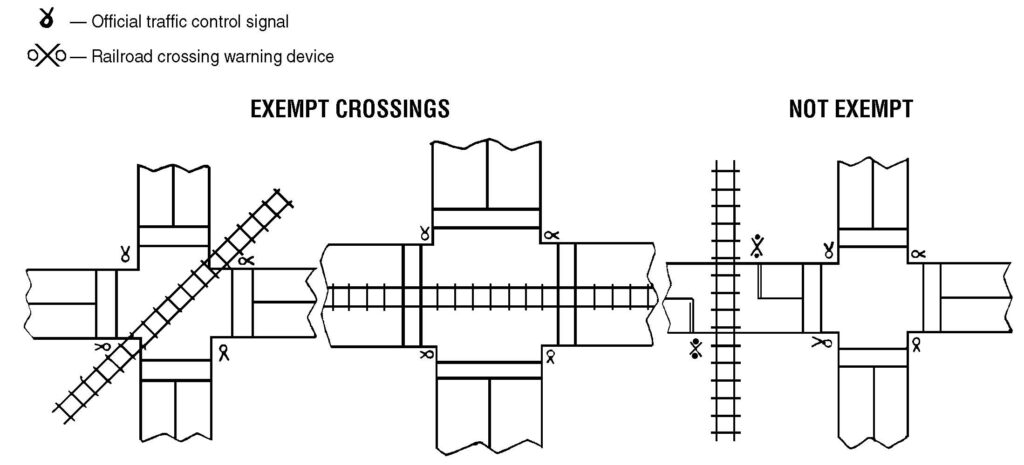
Figure 4-A
4.5 – Prohibited Practices
Avoid fueling your bus with riders on board unless absolutely necessary. Never refuel in a closed building with riders on board.
Do not talk with riders, or engage in any other distracting activity, while driving.
Do not tow or push a disabled bus with riders aboard the vehicle, unless getting off would be unsafe. Only tow or push the bus to the nearest safe spot to discharge passengers. Follow your employer’s guidelines on towing or pushing disabled buses.
4.6 – Use of Brake-Door Interlocks
Urban mass transit coaches may have a brake and accelerator interlock system. The interlock applies the brakes and holds the throttle in the idle position when the rear door is open. The interlock releases when you close the rear door. Do not use this safety feature in place of the parking brake.
SECTION 4
Test Your Knowledge
- Name some things to check in the interior of a bus during a vehicle inspection.
- What are some HazMat you can transport by bus?
- What are some HazMat you cannot transport by bus?
- What is a standee line?
- Does it matter where you make a disruptive passenger get off the bus?
- How far from a railroad crossing should you stop?
- When must you stop before crossing a drawbridge?
- Describe from memory the “prohibited practices” listed in this handbook.
- The rear door of a transit bus has to be open to put on the parking brake. True or False?
These questions may be on your test. If you cannot answer them all, reread Section 4.
Section 3: Transporting Cargo Safely
This section tells you about hauling cargo safely. You must understand basic cargo safety rules to get a CDL.
If you load cargo wrong or do not secure it properly, it can be a danger to others and yourself. Loose cargo that falls off a vehicle can cause traffic problems and others could be hurt or killed. Loose cargo could hurt or kill you during a quick stop or accident. Your vehicle could be damaged by an overload. Steering could be affected by how a vehicle is loaded, making it more difficult to control the vehicle. Whether or not you load and secure the cargo yourself, you are responsible for:
- Inspecting your cargo.
- Recognizing overloads and poorly balanced weight.
- Knowing your cargo is properly secured and does not obscure your view ahead or to the sides.
- Knowing your cargo does not restrict your access to emergency equipment.
If you intend to carry HazMat that requires placards on your vehicle, you will also need to have an “H” endorsement. Section 9 of this handbook has the information you need to pass the HazMat test.
3.1 – Inspecting Cargo
As part of your vehicle inspection, make sure the truck is not overloaded and the cargo is balanced and secured properly.
After Starting. Inspect the cargo and its securing devices again within the first 50 miles after beginning a trip. Make any adjustments needed.
Re-Check. Re-check the cargo and securing devices as often as necessary during a trip to keep the load secure. You need to inspect again:
- After you have driven for 3 hours or 150 miles.
- After every break you take during your trip.
Federal, state, and local regulations for CMV weight, securing cargo, covering loads, and where you can drive large vehicles vary from place to place. Know the rules where you will be driving.
3.2 – Cargo Weight and Balance
You are responsible for not being overloaded. The following are some definitions of weight you should know.
3.2.1 – Definitions You Should Know
Gross Vehicle Weight (GVW). The total weight of a single vehicle including its load.
Gross Combination Weight (GCW). The total weight of a combination of vehicles including the load.
Gross Vehicle Weight Rating (GVWR). The value specified by the manufacturer as the loaded weight of a single vehicle.
Gross Combination Weight Rating (GCWR). The value specified by the manufacturer as the loaded weight of a combination (articulated) vehicle. In the absence of a value specified by the manufacturer, GCWR will be determined by adding the GVWR of the power unit, the total weight of the towed unit, and any load thereon.
Axle Weight. The weight transmitted to the ground by 1 axle or one set of axles.
Tire Load. The maximum safe weight a tire can carry at a specified pressure. This rating is stated on the side of each tire.
Suspension Systems. Suspension systems have a manufacturer’s weight capacity rating.
Coupling Device Capacity. Coupling devices are rated for the maximum weight they can pull and/or carry.
3.2.2 – Legal Weight Limits
You must keep weights within legal limits. States have maximums for GVWRs, GCWRs, and axle weights. Often, maximum axle weights are set by a bridge formula. A bridge formula permits less maximum axle weight for axles that are closer together. This is to prevent overloading bridges and roadways.
Overloading can have bad effects on steering, braking, and speed control. Overloaded trucks have to go very slowly on upgrades. Worse, they may gain too much speed on downgrades. Stopping distance increases. Brakes can fail when forced to work too hard.
During bad weather or in mountains, it may not be safe to operate at legal maximum weights. Take this into account before driving.
3.2.3 – Do Not Be Top-Heavy
The height of the vehicle’s center of gravity is very important for safe handling. A high center of gravity (cargo piled up high or heavy cargo on top) means you are more likely to tip over. It is most dangerous in curves, or if you have to swerve to avoid a hazard. It is very important to distribute the cargo so it is as low as possible. Put the heaviest parts of the cargo under the lightest parts.
3.2.4 – Balance the Weight
Poor weight balance can make vehicle handling unsafe. Too much weight on the steering axle can cause hard steering. It can damage the steering axle and tires. Under-loaded front axles (caused by shifting weight too far to the rear) can make the steering axle weight too light to steer safely. Too little weight on the driving axles can cause poor traction. The drive wheels may spin easily. During bad weather, the truck may not be able to keep going. Weight loaded with a high center of gravity causes a greater chance of rollover. On flatbed vehicles, there is also a greater chance that the load will shift to the side or fall off. See Figure 3.1.
3.3 – Securing Cargo
3.3.1 – Blocking and Bracing
Blocking is used in the front, back, and/or sides of a piece of cargo to keep it from sliding. Blocking is shaped to fit snugly against cargo. It is secured to the cargo deck to prevent cargo movement. Bracing is also used to prevent movement of cargo. Bracing goes from the upper part of the cargo to the floor and/or walls of the cargo compartment.
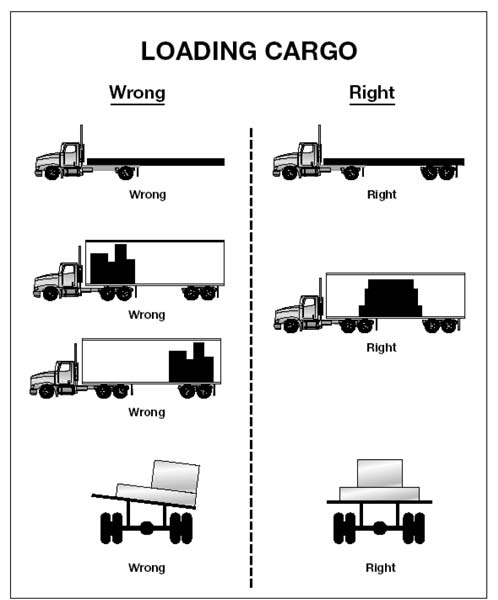
Figure 3.1
3.3.2 – Cargo Tie-down
On flatbed trailers or trailers without sides, cargo must be secured to keep it from shifting or falling off. In closed vans, tiedowns can also be important to prevent cargo shifting that may affect the handling of the vehicle. Tiedowns must be of the proper type and proper strength. Federal regulations require the aggregate working load limit of any securement system used to secure an article or group of articles against movement must be at least 1/2 times the weight of the article or group of articles. Proper tie-down equipment must be used, including ropes, straps, chains, and tensioning devices (such as, winches, ratchets, and clinching components). Tiedowns must be attached to the vehicle correctly (with hooks, bolts, rails, rings). See Figure 3.2.

Figure 3.2
Cargo should have at least one tie-down for each 10 feet of cargo. Make sure you have enough tie-downs to meet this need. No matter how small the cargo, it should have at least 2 tie-downs.
There are special requirements for securing various heavy pieces of metal. Find out what they are if you are to carry such loads.
Rules governing the loading and securement of logs, dressed lumber, metal coils, paper rolls, concrete pipe, intermodal containers, automobiles, heavy vehicles, flattened or crushed vehicles, roll-on/roll-off containers, and large boulders are contained in CFR, Title 49 §393.
3.3.3 – Header Boards
Front-end header boards (“headache racks”) protect you from your cargo in case of an accident or emergency stop. Make sure the front-end structure is in good condition. The front-end structure should block the forward movement of any cargo you carry.
3.3.4 – Covering Cargo
There are 2 basic reasons for covering cargo:
- To protect people from spilled cargo.
- To protect the cargo from weather.
Spill protection is a safety requirement in many states. Be familiar with the laws in the states you drive in.
You should look at your cargo covers in the mirrors from time to time while driving. A flapping cover can tear loose, uncover the cargo, and possibly blocking your view or someone else’s.
3.3.5 – Sealed and Containerized Loads
Containerized loads generally are used when freight is carried part way by rail or ship. Delivery by truck occurs at the beginning and/or end of the journey. Some containers have their own tiedown devices or locks that attach directly to a special frame. Others have to be loaded onto flatbed trailers. They must be properly secured just like any other cargo.
You cannot inspect sealed loads, but you should check that you do not exceed gross weight and axle weight limits.
3.3.6 – Spilling Loads and Damage to the Highway
It is against the law to operate on the highway a vehicle which is improperly covered, constructed, or loaded so that any part of its contents or load spills, drops, leaks, blows, sifts, or in any other way escapes from the vehicle. EXCEPTION: clear water or feathers from live birds (CVC §§23114 and 23115).
Any vehicle transporting garbage, trash, rubbish, ashes, etc., must have the load covered to prevent any part of the load from spilling on to the highway. Aggregate material must be carried in the cargo area of the vehicle and be 6 inches below the upper edge. The cargo area must not have any holes, cracks, or openings which could allow the material to escape. The vehicle used to transport aggregate material must be equipped with seals on any openings used to empty the load, splash flaps behind every tire or set of tires, and fenders. Other requirements are listed in CVC §23114. This does not apply to vehicles carrying wet, waste fruit, or vegetable matter, or waste from food processing plants.
Any person who willfully or negligently damages any street or highway is liable for the cost of repairing the road or any sign, signal, guard rail, or other facility that is damaged. The liability may include the cost of removing debris from the roadway.
3.4 – Cargo Needing Special Attention
3.4.1 – Dry Bulk
Dry bulk tanks require special care because they have a high center of gravity, and the load can shift. Be extremely cautious (slow and careful) going around curves and making sharp turns.
3.4.2 – Hanging Meat
Hanging meat (suspended beef, pork, lamb) in a refrigerated truck can be a very unstable load with a high center of gravity. Particular caution is needed on sharp curves such as off ramps and on ramps. Go slowly.
3.4.3 – Livestock
Livestock can move around in a trailer, causing unsafe handling. With less than a full load, use false bulkheads to keep livestock bunched together. Even when bunched, special care is necessary because livestock can lean on curves. This shifts the center of gravity and makes rollover more likely.
3.4.4 – Oversized Loads
Over-length, over-width, and/or overweight loads require special (CalTrans in California) transit permits. Driving is usually limited to certain times. Special equipment may be necessary such as “wide load” signs, flashing lights, flags, etc. Such loads may require a police escort or pilot vehicles bearing warning signs and/or flashing lights. These special loads require special driving care.
3.4.5 – Special Markings Needed
Any vehicle and load over 80 inches in width must, in addition to required vehicle lighting, show an amber combination clearance and side-marker lamp on the side of the load projection at the front and show a red combination clearance and side-marker lamp on the side of the projection at the rear.
Alternatively, if the over width of the projection does not extend more than 3 feet from front to rear, and the projection is near the front of the vehicle, at least one amber combination clearance lamp must be visible from the front, side, and rear at the extreme width. If the projection is near the rear, at least one red combination side clearance lamp must be displayed (CVC §25100).
3.4.6 – Projecting Loads
Lights (or Flags) on Projecting Loads. When the load on any vehicle extends 4 feet (48 inches) or more beyond the rear of the body, a solid red or fluorescent orange flag at least 12 inches square must be placed at the extreme end of the load. If the vehicle is operated during darkness, there must be 2 lit red lights at the end of the load, visible at a distance of 500 feet to the side and rear of the vehicle (CVC §24604).
A load extending 1 foot or more to the left on any vehicle must have an amber light on the extreme left side of the load. It must be visible at least 300 feet to the front and rear during darkness. If the load extends more than 120 inches, there must be an amber lamp at the front and a red lamp at the rear, each visible at least 300 feet.
If the vehicle is wider than 102 inches, a red or fluorescent flag not less than 12 inches square must be displayed at the left front and left rear during daylight (CVC §25104).
3.4.7 – Piggyback Trailers
When any trailer is loaded upon another vehicle (piggyback) to be moved on any highway, the trailer must be securely bound to the vehicle to prevent the trailer from shifting, toppling over, or becoming unstable.
SECTION 3
Test Your Knowledge
- What four things related to cargo are drivers responsible for?
- How often must you stop while on the road to check your cargo?
- How is gross combination weight rating different from gross combination weight?
- Name 2 situations where legal maximum weights may not be safe.
- What can happen if you do not have enough weight on the front axle?
- What is the minimum number of tiedowns for any flatbed load?
- What is the minimum number of tiedowns for a 20-foot load?
- Name the 2 basic reasons for covering cargo on an open bed.
- What must you check before transporting a sealed load?
These questions may be on your test. If you cannot answer them all, reread Section 3.
Section 2: Driving Safely
This section contains knowledge and safe driving information that all CDL holders should know. You must pass a test on this information to get a CDL. This section does not have specific information on air brakes, combination vehicles, doubles, or passenger vehicles. When preparing for the vehicle inspection test, you must review the material in Section 11 in addition to the information in this section. This section does have basic information on HazMat that all drivers should know. If you need an “H” endorsement, study Section 9.
2.1 – Vehicle Inspection
2.1.1 – Why Inspect
Safety is the most important reason you inspect your vehicle, safety for yourself and other road users.
A vehicle defect found during an inspection could save you problems later. You could have a breakdown on the road that will cost time and dollars, or even worse, an accident caused by the defect.
Federal and state laws require that drivers inspect their vehicles. Federal and state inspectors may also inspect your vehicles. If they judge the vehicle to be unsafe, they will put it “out-of-service” until it is fixed.
2.1.2 – Types of Vehicle Inspections
Vehicle Inspection
A vehicle inspection will help you find problems that could cause an accident or breakdown. Vehicle inspections should be done routinely before operating the vehicle. Review the last vehicle inspection report. Make sure the vehicle has been released for service by the maintenance mechanics, if applicable. The motor carrier must repair any items in the report that affect safety, and certify on the report that repairs were made or were unnecessary. Remember, when you get behind the wheel, you (not the mechanic) are responsible for the safe operation of the vehicle. If the defects have been repaired, sign the previous driver’s report. There is detailed information on vehicle inspections in Section 11 of this handbook.
Trip Inspection
For safety during a trip, you should:
- Watch gauges for signs of trouble.
- Use your senses to check for problems (look, listen, smell, and feel).
Check these critical items when you stop:
- Tires, wheels, and rims.
- Brakes.
- Lights and reflectors.
- Brake and electrical connections to trailer.
- Trailer coupling devices.
- Cargo securement devices.
After-Trip Inspection and Report
You should do an after-trip inspection at the end of the trip, day, or tour of duty on each vehicle you operated. It may include filling out a vehicle condition report listing any problems you find. The inspection report helps a motor carrier know when the vehicle needs repairs.
2.1.3 – What to Look For
Tire Problems
- Too much or too little air pressure.
- Bad wear. You need at least 4/32-inch tread depth in every major groove on front tires. You need 2/32 inch on other tires. No fabric should show through the tread or sidewall.
- Cuts or other damage.
- Tread separation.
- Dual tires that come in contact with each other or parts of the vehicle.
- Mismatched sizes.
- Radial and bias-ply tires used together.
- Cut or cracked valve stems.
- Regrooved, recapped, or retreaded tires on the front wheels of a bus. These are prohibited.
Wheel and Rim Problems
- Damaged rims.
- Rust around wheel nuts may mean the nuts are loose (check tightness). After a tire has been changed, stop a short while later and recheck tightness of nuts.
- Missing clamps, spacers, studs, or lugs mean danger.
- Mismatched, bent, or cracked lock rings are dangerous.
- Wheels or rims that have had welding repairs are not safe.
Bad Brake Drums or Shoes
- Cracked drums.
- Shoes or pads with oil, grease, or brake fluid on them.
- Shoes worn dangerously thin, missing, or broken.
Steering System Defects
- Missing nuts, bolts, cotter keys, or other parts.
- Bent, loose, or broken parts, such as steering column, steering gear box, or tie rods.
- If power steering equipped, check hoses, pumps, fluid level, and check for leaks.
- Steering wheel play of more than 10 degrees (approximately 2 inches movement at the rim of a 20 inch steering wheel) can make it hard to steer.
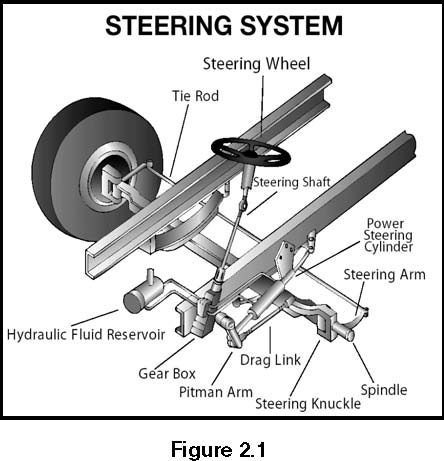
Suspension System Defects
The suspension system holds up the vehicle and its load and keeps the axles in place. Therefore, broken suspension parts can be extremely dangerous.
Look for:
- Spring hangers hat allow movement of an axle from its proper position. See Figure 2.2.

Cracked or Broken Spring Hangers.
- Missing or broken leaves in any leaf spring. If 1/4 or more are missing, it will put the vehicle “out-of-service,” but any defect could be dangerous. See Figure 2.3.
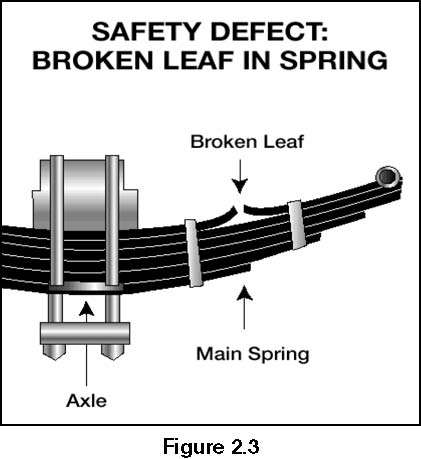
- Broken leaves in a multi-leaf spring or leaves that have shifted so they might hit a tire or other part.
- Leaking shock absorbers.
- Torque rods or arms, u-bolts, spring hangers, or other axle positioning parts that are cracked, damaged, or missing.
- Air suspension systems that are damaged and/or leaking. See Figure 2.4.
- Any loose, cracked, broken, or missing frame members.
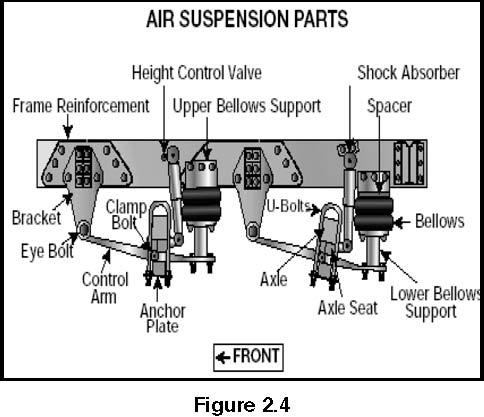
Exhaust System Defects
A broken exhaust system can let poison fumes into the cab or sleeper berth. Look for:
- Loose, broken, or missing exhaust pipes, mufflers, tailpipes, or vertical stacks.
- Loose, broken, or missing mounting brackets, clamps, bolts, or nuts.
- Exhaust system parts rubbing against fuel system parts, tires, or other moving parts of the vehicle.
- Exhaust system parts that are leaking.
Emergency Equipment
Vehicles must be equipped with emergency equipment. Look for:
- Fire extinguisher(s).
- Spare electrical fuses (unless equipped with circuit breakers).
- Warning devices for parked vehicles (for example, 3 red reflective warning triangles, 6 fuses, or 3 liquid burning flares).
2.1.4 – CDL Vehicle Inspection Test
To obtain a CDL, you will be required to pass a vehicle inspection test. You will be tested to see if you know whether your vehicle is safe to drive. You will be asked to do an inspection of your vehicle. You must point to or touch and name the item you are inspecting and explain why to the examiner. The following 7-step inspection method should be useful.
Cargo (Trucks). You must make sure the truck is not overloaded and the cargo is balanced and secured before each trip. If the cargo contains HazMat, you must inspect for proper papers and placarding.
2.1.5 – 7-Step Inspection Method
Method of Inspection. Do a vehicle inspection the same way each time so you will learn all the steps and be less likely to forget something.
Approaching the Vehicle. Notice the general condition. Look for damage or the vehicle leaning to one side. Look under the vehicle for fresh oil, coolant, grease, or fuel leaks. Check the area around the vehicle for hazards to vehicle movement (people, other vehicles, objects, low-hanging wires, limbs, etc.).
Vehicle Inspection Guide
Step 1: Vehicle Overview
Review Last Vehicle Inspection Report. Drivers may have to make a vehicle inspection report in writing each day. The motor carrier must repair any items in the report that affect safety and certify on the report that repairs were made or were unnecessary. You must sign the report only if defects were noted and certified to be repaired or repairs are not needed.
Step 2: Check the Engine Compartment
Check that the parking brakes are on and/or wheels chocked. You may have to raise the hood, tilt the cab (secure loose things so they do not fall and break something), or open the engine compartment door. Check the following:
- Engine oil level.
- Coolant level in radiator and condition of hoses.
- Power steering fluid level and condition of hose (if so equipped).
- Windshield washer fluid level.
- Battery fluid level, connections and tie downs (battery may be located elsewhere).
- Automatic transmission fluid level (may require engine to be running).
- Check belts for tightness and excessive wear (alternator, water pump, air compressor). Know how much “give” the belts should have when adjusted right, and check each one.
- Engine compartment for leaks (fuel, coolant, oil, power steering fluid, hydraulic fluid, battery fluid).
- Electrical wiring insulation for cracks and wear.
Lower and secure hood, cab, or engine compartment door.
Step 3: Start the Engine and Inspect the Inside the Cab
Get in and Start the Engine
- Make sure the parking brake is on.
- Put the gearshift in Neutral (or “Park” if automatic).
- Start engine and listen for unusual noises.
- If equipped, check the anti-lock braking system (ABS) indicator lights. The light on the dash should come on and then turn off. If it stays on, the ABS is not working properly. For trailers only, if the yellow light on the left rear of the trailer stays on, the ABS is not working properly.
Look at the Gauges
- Oil pressure. Pressure should come up to normal within seconds after the engine is started. See Figure 2.5.
- Air pressure. Pressure should build from 50 – 90 pounds per square inch (psi) within 3 minutes. Build the air pressure to governor cut-out (usually around 120–140 psi.) Know your vehicle’s requirements.
- Ammeter and/or voltmeter. Should be in normal range(s).
- Coolant temperature. Should begin gradual rise to normal operating range.
- Engine oil temperature. Should begin gradual rise to normal operating range.
- Warning lights and buzzers. Oil, coolant, charging circuit warning, and ABS lights should go out right away.
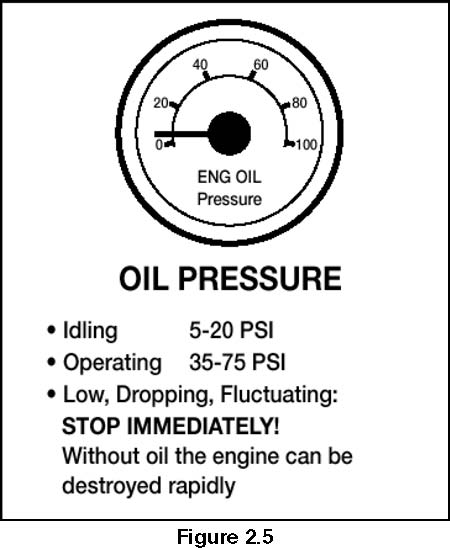
Check the Condition of the Controls
Check all of the following for looseness, sticking, damage, or improper setting:
- Steering wheel.
- Clutch.
- Accelerator (gas pedal).
- Brake controls:
— Foot brake.
— Trailer brake (if the vehicle has one).
— Parking brake.
— Retarder controls (if the vehicle has them). - Transmission controls.
- Inter-axle differential lock (if the vehicle has one).
- Horn(s).
- Windshield wiper/washer.
- Lights.
— Headlights.
— Dimmer switch.
— Turn signal.
— 4-way emergency flashers.
— Parking, clearance, identification, marker switch(es).
Check Mirrors and Windshield
Inspect mirrors and windshield for cracks, dirt, illegal stickers, or other obstructions to seeing clearly. Clean and adjust as necessary.
Check the Emergency Equipment
Check for safety equipment:
- Spare electrical fuses (unless the vehicle has circuit breakers).
- 3 red reflective triangles, 6 fuses, or 3 liquid burning flares.
- Properly charged and rated fire extinguisher.
Check for optional items, such as:
- Chains (where winter conditions require them).
- Tire changing equipment.
- List of emergency phone numbers.
- Accident reporting kit (packet).
Check the Safety Belt
Check that the safety belt is securely mounted, adjusts, and latches properly, and is not ripped or frayed.
Step 4: Turn off the Engine and Check the Lights
Make sure the parking brake is set, turn off the engine, and take the key with you. Turn on the headlights (low beams) and 4-way emergency flashers, and get out of the vehicle.
Step 5: Do a Walk Around Inspection
Go to the front of the vehicle and check that the low beams are on and both 4-way flashers are working:
- Push the dimmer switch and check that the high beams work.
- Turn off the headlights and 4-way emergency flashers.
- Turn on the parking, clearance, side-marker, and identification lights.
- Turn on the right turn signal, and start the walk-around inspection.
General
- Walk around and inspect the vehicle.
- Clean all lights, reflectors, and glass as you go along.
Left Front Side
- Driver’s door glass should be clean.
- Door latches and locks should work properly.
Left Front Wheel
- Condition of the wheel and rim—no missing, bent, or broken spacer studs, clamps, lugs, or any signs of misalignment.
- Condition of the tire—properly inflated, valve stem and cap intact and no serious cuts, bulges, or tread wear.
- Use a wrench to test rust-streaked lug nuts, indicating looseness.
- Hub oil level okay and no leaks.
Left Front Suspension
- Condition of spring, spring hangers, shackles, and u-bolts.
- Shock absorber condition.
Left Front Brake
- Condition of the brake drum or disc.
- Condition of the hoses.
Front
- Condition of the front axle.
- Condition of the steering system.
— No loose, worn, bent, damaged, or missing parts.
— Must grab the steering mechanism to test for looseness.
Condition of the Windshield
- Check for damage and clean if dirty.
- Check the windshield wiper arms for proper spring tension.
- Check the wiper blades for damage, “stiff” rubber, and securement.
Lights and Reflectors
- Parking, clearance, and identification lights are clean, operating, and the proper color (amber at front).
- Reflectors are clean and the proper color (amber at front).
- Right front turn signal light is clean, operating, and the proper color (amber or white on signals facing forward).
Right Side
- Right front: check all items as done for the left front.
- Primary and secondary safety cab locks are engaged (if cab-over-engine design).
- Right fuel tank(s):
— Securely mounted, and not damaged, or leaking.
— Fuel crossover line is secure.
— Tank(s) contain enough fuel.
— Cap(s) are on and secure.
Condition of the Visible Parts
- Rear of engine is not leaking.
- Transmission is not leaking.
- Exhaust system is secure, not leaking, and not touching wires, fuel, or air lines.
- Frame and cross members have no bends or cracks.
- Air lines and electrical wiring is secured against snagging, rubbing, or wearing.
- Spare tire carrier or rack is not damaged (if so equipped).
- Spare tire and/or wheel is securely mounted in rack.
- Spare tire and wheel is adequate (proper size, properly inflated).
Cargo Securement (Trucks)
- Cargo is properly blocked, braced, tied, chained, etc.
- Header board is adequate and secure (if required).
- Side boards and stakes are strong enough, free of damage, and properly set in place (if so equipped).
- Canvas or tarp (if required) is properly secured to prevent tearing, billowing, or blocking of mirrors.
- If oversize, all required signs (flags, lamps, and reflectors) are safely and properly mounted and all required permits are in the driver’s possession.
- Curbside cargo compartment doors are in good condition, securely closed, latched/locked, and required security seals are in place.
Right Rear
- Condition of wheels and rims—no missing, bent, or broken spacers, studs, clamps, or lugs.
- Condition of tires—properly inflated, valve stems and caps intact, and no serious cuts, bulges, or tread wear, tires not rubbing each other, and nothing stuck between them.
- Tires are the same type (for example, not mixed radial and bias types).
- Tires are evenly matched (same size).
- Wheel bearing/seals are not leaking.
Suspension
- Condition of the spring(s), spring hangers, shackles, and u-bolts.
- Axle(s) secure.
- Powered axle(s) are not leaking lube (gear oil).
- Condition of torque rod arms and bushings.
- Condition of the shock absorber(s).
- If retractable axle equipped, check the condition of the lift mechanism. If air powered, check for leaks.
- Condition of the air ride components.
Brakes
- Brake adjustment.
- Condition of brake drum(s) or discs.
- Condition of hoses—look for any wear due to rubbing.
Lights and Reflectors
- Side-marker lights are clean, operating, and the proper color (red at rear, others amber).
- Side-marker reflectors are clean and the proper color (red at rear, others amber).
Rear
- Lights and reflectors.
— Rear clearance and identification lights are clean, operating, and the proper color (red at rear).
— Reflectors are clean and the proper color (red at rear).
— Taillights are clean, operating, and the proper color (red at rear).
— Right rear turn signals are operating,and the proper color (red, yellow, or amber at rear). - License plate(s) is present, clean, and secured.
- Splash guards are present, not damaged, properly fastened, not dragging on the ground, and not rubbing the tires.
- Cargo is secure (trucks).
- Cargo is properly blocked, braced, tied, chained, etc.
- Tailboards are up and properly secured.
- End gates are free of damage and properly secured in stake sockets.
- Canvas or tarp (if required) is properly secured to prevent tearing, billowing, and blocking of either the rearview mirrors and rear lights.
- If over-length or over-width, make sure all signs and/or additional lights/flags are safely and properly mounted and all required permits are in the driver’s possession.
- Rear doors securely closed, latched, and locked.
Left Side
Check all items as done for the right side, plus:
- Battery(ies) (if not mounted in the engine compartment).
- Battery box(es) is securely mounted to vehicle.
- Box has a secure cover.
- Battery(ies) is secured against movement.
- Battery(ies) is not broken or leaking.
- Fluid in battery(ies) is at the proper level (except maintenance-free type).
- Cell caps are present and securely tightened (except maintenance-free type).
- Vents in the cell caps are free of foreign material (except maintenance-free type).
Step 6: Check the Signal Lights
Get in and Turn off the Lights
- Turn off all the lights.
- Turn on the stop lights (apply the trailer hand brake or have a helper press the brake pedal).
- Turn on the left turn signal lights.
Get out and Check the Lights
- Left front turn signal light is clean, operating, and the proper color (amber or white on signals facing the front).
- Left rear turn signal light and both stop lights are clean, operating, and the proper color (red, yellow, or amber).
Note Checks of brake, turn signal, and 4-way flasher functions must be done separately.
Get in the Vehicle
- Turn off the lights not needed for driving.
- Check for all the required papers, trip manifests, permits, etc.
- Secure all loose articles in the cab (they might interfere with operation of the controls or hit you in an accident).
- Start the engine.
Step 7: Start the Engine and Check
Test for Hydraulic Leaks
If the vehicle has hydraulic brakes, pump the brake pedal 3 times. Then apply firm pressure to the pedal and hold for 5 seconds. The pedal should not move. If it does, there may be a leak or other problem. Get it fixed before driving. If the vehicle has air brakes, do the checks described in Sections 5 and 6 of this handbook.
Brake System
Test the Parking Brake(s)
- Fasten the safety belt.
- Set the parking brake (power unit only).
- Release the trailer parking brake (if applicable).
- Place the vehicle into a low gear.
- Gently pull forward against the parking brake to make sure the parking brake holds.
- Repeat the same steps for the trailer with the trailer parking brake set and the power unit parking brakes released (if applicable).
- If it does not hold the vehicle, it is faulty. Get it fixed.
Test the Service Brake Stopping Action
- Drive the vehicle about 5 mph.
- Push the brake pedal firmly.
- “Pulling” to one side or the other can mean brake trouble.
- Any unusual brake pedal “feel” or delayed stopping action can mean trouble.
- If you find anything unsafe during the vehicle inspection, get it fixed. Federal and state laws forbid operating an unsafe vehicle.
2.1.6 – Inspection During a Trip
Check Vehicle Operation Regularly
You Should Check:
- Instruments.
- Air pressure gauge (if you have air brakes).
- Temperature gauges.
- Pressure gauges.
- Ammeter/voltmeter.
- Mirrors.
- Tires.
- Cargo and cargo covers.
- Lights.
If you see, hear, smell, or feel anything that might mean trouble, check it out.
Safety Inspection. Drivers of trucks and truck tractors transporting cargo must inspect the securement of the cargo within the first 50 miles of a trip and every 150 miles or every 3 hours after (whichever comes first).
2.1.7 – After-Trip Inspection and Report
You may have to make a written report each day on the condition of the vehicle(s) you drove. Report anything affecting safety or possibly leading to a mechanical breakdown. The vehicle inspection report tells the motor carrier about problems that may need fixing. Keep a copy of your report in the vehicle for 1 day. That way, the next driver can learn about any problems you have found.
SUBSECTION 2.1
Test Your Knowledge
- What is the most important reason for doing a vehicle inspection?
- What things should you check during a trip?
- Name some key steering system parts.
- Name some suspension system defects.
- What 3 kinds of emergency equipment must you have?
- What is the minimum tread depth for front tires? For other tires?
- Name some things you should check on the front of your vehicle during the walk around inspection.
- What should wheel bearing seals be checked for?
- How many red reflective triangles should you carry?
- How do you test hydraulic brakes for leaks?
- Why put the starter switch key in your pocket during the vehicle inspection test?
These questions may be on your test. If you cannot answer them all, reread Subsection 2.1.
2.2 – Basic Control of Your Vehicle
To drive a vehicle safely, you must be able to control its speed and direction. Safe operation of a CMV requires skill in:
- Accelerating.
- Steering.
- Stopping.
- Backing safely.
Fasten your seatbelt when on the road. Apply the parking brake when you leave your vehicle.
2.2.1 – Accelerating
Do not roll back when you start. You may hit someone behind you. If you have a manual transmission vehicle, partly engage the clutch before you take your right foot off the brake. Apply the parking brake whenever necessary to keep from rolling back. Release the parking brake only when you have applied enough engine power to keep from rolling back. On a tractor-trailer equipped with a trailer brake hand valve, the hand valve can be applied to keep from rolling back.
Speed up smoothly and gradually so the vehicle does not jerk. Rough acceleration can cause mechanical damage. When pulling a trailer, rough acceleration can damage the coupling. When starting a bus on a level surface with good traction, there is often no need for the parking brake.
Speed up very gradually when traction is poor, as in rain or snow. If you use too much power, the drive wheels may spin and you could lose control. If the drive wheels begin to spin, take your foot off the accelerator.
2.2.2 – Steering
Hold the steering wheel firmly with both hands. Your hands should be on opposite sides of the wheel. If you hit a curb or pothole (chuckhole), the wheel could pull away from your hands unless you have a firm hold.
2.2.3 – Stopping
Push the brake pedal down gradually. The amount of brake pressure you need to stop the vehicle will depend on the speed of the vehicle and how quickly you need to stop. Control the pressure so the vehicle comes to a smooth, safe stop. If you have a manual transmission, push the clutch in when the engine is close to idle.
2.2.4 – Backing Safely
Because you cannot see everything behind your vehicle, backing is always dangerous. Avoid backing whenever you can. When you park, try to park so you will be able to pull forward when you leave. When you have to back, here are a few simple safety rules:
- Start in the proper position.
- Look at your path.
- Use the mirrors on both sides.
- Back slowly.
- Back and turn toward the driver’s side whenever possible.
- Use a helper whenever possible.
These rules are discussed as follows.
Start in the Proper Position. Put the vehicle in the best position to allow you to back safely. This position will depend on the type of backing to be done.
Look at Your Path. Look at your line of travel before you begin. Get out and walk around the vehicle. Check your clearance to the sides, and overhead, in, and near the path your vehicle will take.
Use Mirrors on Both Sides. Check the outside mirrors on both sides frequently. Get out of the vehicle and check your path if you are unsure.
Back Slowly. Always back as slowly as possible. Use the lowest reverse gear. That way you can more easily correct any steering errors. You also can stop quickly if necessary.
Back and Turn Toward the Driver’s Side. Back toward the driver’s side so you can see better. Backing toward the right side is very dangerous because you cannot see as well. If you back and turn toward the driver’s side, you can watch the rear of your vehicle by looking out the side window. Use driver-side backing–even if it means going around the block to put your vehicle in this position. The added safety is worth it.
Use a Helper. Use a helper when you can. There are blind spots you cannot see. That is why a helper is important. The helper should stand near the back of your vehicle where you can see them. Before you begin backing, work out a set of hand signals that you both understand. Agree on a signal for “stop.”
2.2.5 – Backing With a Trailer
When backing a car, straight truck, or bus, turn the steering wheel toward the direction you want to go. When backing a trailer, turn the steering wheel in the opposite direction. Once the trailer starts to turn, you must turn the wheel the other way to follow the trailer.
Whenever you back with a trailer, try to position your vehicle so you can back in a straight line. If you must back on a curved path, back toward the driver’s side so you can see. Back slowly so you can make corrections before you get too far off course.
Correct Drift Immediately. As soon as you see the trailer getting off the proper path, correct it by turning the steering wheel in the direction of the drift.
Pull Forward. When backing, make pull-ups to reposition your vehicle when needed.
2.3 – Shifting Gears
Correct shifting of gears is important. If you cannot get your vehicle into the right gear while driving, you will have less control.
2.3.1 – Manual Transmissions
Basic Method for Shifting Up. Most heavy vehicles with unsynchronized manual transmission require double clutching to change gears. If equipped with a synchronized manual transmission, double clutching is not required. This is the method:
- Release the accelerator, push in the clutch, and shift to Neutral at the same time.
- Release the clutch.
- Let the engine and gears slow down to the revolutions per minute (rpm) required for the next gear (this takes practice).
- Push in the clutch and shift to the higher gear at the same time.
- Release the clutch and press the accelerator at the same time.
Shifting gears using double clutching requires practice. If you remain too long in Neutral, you may have difficulty putting the vehicle into the next gear. If so, do not try to force it. Return to Neutral, release the clutch, increase the engine speed to match the road speed, and try again.
Knowing When to Shift Up. There are 2 ways of knowing when to shift:
- Use Engine Speed (rpm). Study the driver’s manual for your vehicle and learn the operating rpm range. Watch your tachometer, and shift up when your engine reaches the top of the range. (Some newer vehicles use “progressive” shifting: the rpm at which you shift becomes higher as you move up in the gears. Find out what is right for the vehicle you will operate.)
- Use Road Speed (mph). Learn what speeds each gear is good for. Then, by using the speedometer, you will know when to shift up.
With either method, you may learn to use engine sounds to know when to shift.
Basic Procedures for Shifting Down
- Release the accelerator, push in the clutch, and shift to Neutral at the same time.
- Release the clutch.
- Press the accelerator and increase the engine and gear speed to the rpm required in the lower gear.
- Push in the clutch and shift to the lower gear at the same time.
- Release the clutch and press the accelerator at the same time.
Downshifting, like upshifting, requires knowing when to shift. Use either the tachometer or the speedometer and downshift at the right rpm or road speed.
Special conditions where you should downshift are:
- Before Starting Down a Hill. Slow down and shift down to a speed that you can control without using the brakes hard. Otherwise, the brakes can overheat and lose their braking power. Make sure you are in a low enough gear, usually lower than the gear required to climb the same hill.
- Before Entering a Curve. Slow down to a safe speed, and downshift to the right gear. This lets you use some power through the curve to help the vehicle be more stable while turning. It also allows you to speed up as soon as you are out of the curve.
2.3.2 – Multi-Speed Rear Axles and Auxiliary Transmissions
Multi-speed rear axles and auxiliary transmissions are used on many vehicles to provide extra gears. You usually control them by a selector knob or switch on the gearshift lever of the main transmission. There are many different shift patterns. Learn the right way to shift gears in the vehicle you will drive.
2.3.3 – Automatic Transmissions
Some vehicles have automatic transmissions. You can select a low range to get greater engine braking when going down grades. The lower ranges prevent the transmission from shifting up beyond the selected gear (unless the governor rpm is exceeded). It is very important to use this braking effect when going down grades.
2.3.4 – Retarders
Some vehicles have “retarders.” Retarders help slow a vehicle, reducing the need for using your brakes. They reduce brake wear and give you another way to slow down. There are 4 basic types of retarders (exhaust, engine, hydraulic, and electric). All retarders can be turned on or off by the driver. On some vehicles, the retarding power can be adjusted. When turned “on,” retarders apply their braking power (to the drive wheels only) whenever you let up on the accelerator pedal all the way.
Because these devices can be noisy, be sure you know where their use is permitted.
Caution. When your drive wheels have poor traction, the retarder may cause them to skid. Therefore, you should turn the retarder off whenever the road is wet, icy, or snow covered.
SUBSECTIONS 2.2 AND 2.3
Test Your Knowledge
- Why should you back toward the driver’s side?
- If stopped on a hill, how can you start moving without rolling back?
- When backing, why is it important to use a helper?
- What is the most important hand signal that you and the helper should agree on?
- What are the 2 special conditions where you should downshift?
- When should you downshift automatic transmissions?
- Retarders keep you from skidding when the road is slippery. True or False?
- What are the 2 ways to know when to shift?
These questions may be on the test. If you cannot answer them all, reread Subsections 2.2 and 2.3.
2.4 – Seeing
To be a safe driver you need to know what is going on all around your vehicle. Not looking properly is a major cause of accidents.
2.4.1 – Seeing Ahead
All drivers look ahead but many do not look far enough ahead.
Importance of Looking far Enough Ahead.
Because stopping or changing lanes can take a lot of distance, knowing what the traffic is doing on all sides of you is very important. You need to look well ahead to make sure you have room to make these moves safely.
How far Ahead to Look. Most good drivers look at least 12 to 15 seconds ahead. That means looking ahead of the distance you will travel in 12 to 15 seconds. At lower speeds, that is about one block. At highway speeds, it is about a quarter of a mile. If you are not looking that far ahead, you may have to stop too quickly or make quick lane changes. Looking 12 to 15 seconds ahead does not mean not paying attention to things that are closer. Good drivers shift their attention back and forth, near and far. Figure 2.6 illustrates how far to look ahead.
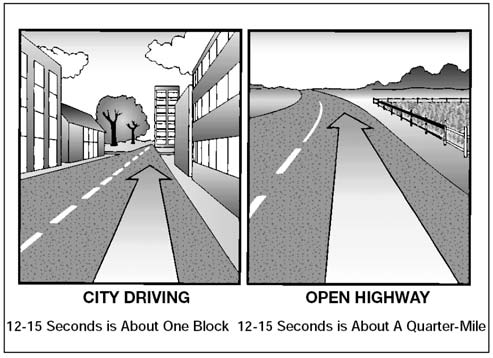
Figure 2.6
Look for Traffic. Look for vehicles coming onto the highway, into your lane, or turning. Watch for brake lights from slowing vehicles. By seeing these things far enough ahead, you can adjust your speed, or change lanes if necessary to avoid a problem. If a traffic light has been green for a long time, it will probably change before you get there. Start slowing down and be ready to stop.
Road Conditions. Look for hills and curves– anything for which you will have to slow or change lanes. Pay attention to traffic signals and signs. Traffic signs may alert you to road conditions where you may have to change speed.
2.4.2 – Seeing to the Sides and Rear
It is important to know what is going on behind and to the sides of you. Check your mirrors regularly. Check more often in special situations.
Every California registered motor vehicle must have at least 2 mirrors, including one attached to the left-hand side, and located to give a clear view of the roadway to the rear for a distance of at least 200 feet. Both left and right-hand rear view mirrors are required on a motor vehicle that is constructed or loaded to obscure the driver’s view to the rear, or which is towing a vehicle or load that blocks the view (CVC §26709).
How to Use Mirrors. Use mirrors correctly by checking them quickly and understanding what you see.
When using your mirrors while driving on the road, check them quickly. Look back and forth between the mirrors and the road ahead. Do not focus on the mirrors for too long. Otherwise, you will travel quite a distance without knowing what is happening ahead.
Many large vehicles have curved (convex, “fisheye,” “spot,” “bugeye”) mirrors that show a wider area than flat mirrors. This is often helpful. However, everything appears smaller in a convex mirror than it would if you were looking at it directly. Things also seem farther away than they really are. It is important to realize this and to allow for it. Figure 2.7 shows the field of vision using a convex mirror.

Mirror Adjustment. Mirror adjustment should be checked prior to the start of any trip and can only be checked accurately when the trailer(s) are straight. You should check and adjust each mirror to show some part of the vehicle. This will give you a reference point for judging the position of the other images.
Regular Checks. Make regular checks of your mirrors to be aware of traffic and to check your vehicle.
Traffic. Check your mirrors for vehicles on either side and behind you. In an emergency, you may need to know whether you can make a quick lane change. Use your mirrors to spot overtaking vehicles. There are “blind spots” that your mirrors cannot show you. Check your mirrors regularly to know where other vehicles are around you, and to see if they move into your blind spots.
Check Your Vehicle. Use the mirrors to keep an eye on your tires. It is one way to spot a tire fire. If you are carrying open cargo, you can use the mirrors to check it. Look for loose straps, ropes, or chains. Watch for a flapping or ballooning tarp.
Special Situations. Special situations require more than regular mirror checks. These are lane changes, turns, merges, and tight maneuvers.
Lane Changes. Check your mirrors to make sure no one is alongside or about to pass you. Check your mirrors:
- Before you change lanes to make sure there is enough room.
- After you signaled to check that no one has moved into your blind spot.
- Right after you start the lane change to double-check that your path is clear.
- After you complete the lane change.
Turns. In turns, check your mirrors to make sure the rear of your vehicle will not hit anything.
Merges. When merging, use your mirrors to make sure the gap in traffic is large enough for you to enter safely.
Tight Maneuvers. Any time you are driving in close quarters, check your mirrors often. Make sure you have enough clearance.
Figure 2.7
2.5 – Communicating
2.5.1 – Signal Your Intentions
Other drivers cannot know what you are going to do until you tell them.
Signaling what you intend to do is important for safety. Here are some general rules for signaling.
Turns. There are 3 good rules for using turn signals:
1. Signal Early. Signal well before you turn. It is the best way to keep others from trying to pass you.
2. Signal Continuously. You need both hands on the wheel to turn safely. Do not cancel the signal until you have completed the turn.
3. Cancel Your Signal. Do not forget to turn off your turn signal after you have turned (if you do not have self-canceling signals).
Note For information on vehicles that must be equipped with lamp turn signal systems and two stop lamps, see CVC §§24951 and 24600.
Lane Changes. Put your turn signal on before changing lanes. Change lanes slowly and smoothly. That way, a driver you did not see may have a chance to honk their horn, or avoid your vehicle.
Slowing Down. Warn drivers behind you when you see you will need to slow down. A few light taps on the brake pedal — enough to flash the brake lights — should warn following drivers. Use the 4-way emergency flashers for times when you are driving very slowly or are stopped. Warn other drivers in any of the following situations:
- Trouble Ahead. The size of your vehicle may make it hard for drivers behind you to see hazards ahead. If you see a hazard that will require slowing down, warn the drivers behind by flashing your brake lights.
- Tight Turns. Most car drivers do not know how slowly you have to go to make a tight turn in a large vehicle. Give drivers behind you warning by braking early, slowly, and gradually.
- Stopping on the Road. Truck and bus drivers sometimes stop in the roadway to unload cargo or passengers, or to stop at a railroad crossing. Warn following drivers by flashing your brake lights. Do not stop suddenly.
- Driving Slowly. Drivers often do not realize how fast they are catching up to a slow vehicle until they are very close. If you must drive slowly, alert following drivers by turning on your emergency flashers if it is legal. (Laws regarding the use of flashers differ from one state to another. Check the laws of the states where you will drive).
Do Not Direct Traffic. Some drivers try to help out others by signaling when it is safe to pass. You should not do this, it could cause an accident. You could be blamed and it could cost you many thousands of dollars.
2.5.2 – Communicating Your Presence
Other drivers may not notice your vehicle, even when in plain sight. To help prevent accidents, let them know you are there.
When Passing. Whenever you are about to pass a vehicle, pedestrian, or bicyclist, assume they do not see you. They could suddenly move in front of you. When it is legal, tap the horn lightly or, at night, flash your lights from low to high beam and back. Drive carefully enough to avoid an accident, even if they do not see or hear you.
When It Is Hard to See. At dawn, dusk, in rain, or snow, you need to make yourself easier to see. If you are having trouble seeing other vehicles, other drivers will have trouble seeing you. Turn on your lights. Use the headlights, not just the identification or clearance lights, use the low beams: high beams can bother people in the daytime as well as at night.
When Parked at the Side of the Road. When you pull off the road and stop, be sure to turn on the 4-way emergency flashers. This is important at night. Do not trust the taillights to give warning. Drivers have crashed into the rear of a parked vehicle because they thought it was moving normally.
If you must stop on a road or the shoulder of any road, you must put out your emergency warning devices within 10 minutes. Place your warning devices at the following locations:
- If you must stop on or by a one-way or divided highway, place warning devices 10 feet, 100 feet, and 200 feet toward the approaching traffic. See Figure 2.8.

Figure 2.8
- If you stop on a 2-lane road carrying traffic in both directions or on an undivided highway, place warning devices within 10 feet of the front or rear corners to mark the location of the vehicle and 100 feet behind and ahead of the vehicle, on the shoulder or in the lane you stopped in. See Figure 2.9.

Figure 2.9
- Back beyond any hill, curve, or other obstruction that prevents other drivers from seeing the vehicle within 500 feet. If line of sight view is obstructed due to hill or curve, move the rear-most triangle to a point back down the road so warning is provided. See Figure 2.10.
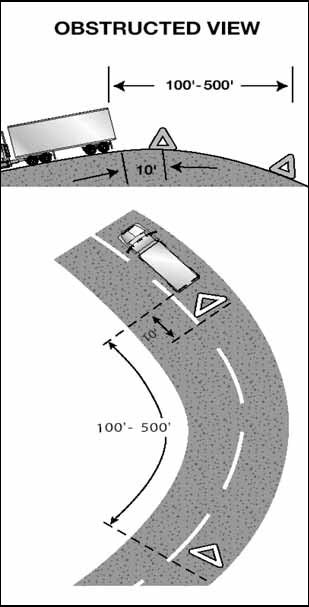
Figure 2.10
When putting out the triangles, hold them between yourself and the oncoming traffic for your own safety. (So other drivers can see you.)
Use Your Horn When Needed. Your horn can let others know you are there. It can help to avoid an accident. Use your horn when needed. However, it can startle others and be dangerous when used unnecessarily.
2.6 – Controlling Your Speed
Driving too fast is a major cause of fatal accidents. You must adjust your speed depending on driving conditions. These include traction, curves, visibility, traffic. and hills.
2.6.1 – Stopping Distance
Perception Distance + Reaction Distance + Braking Distance = Total Stopping Distance
- Perception Distance. This is the distance your vehicle travels, in ideal conditions, from the time your eyes see a hazard until your brain recognizes it. Keep in mind, certain mental and physical conditions can affect your perception distance. It can be affected greatly, depending on visibility and the hazard itself. The average perception time for an alert driver is 1 3/4 seconds. At 55 mph, this accounts for 142 feet traveled.
- Reaction Distance. This is the distance you will continue to travel, in ideal conditions, before you physically hit the brakes, in response to a hazard seen ahead. The average driver has a reaction time of 3/4 second to 1 second. At 55 mph, this accounts for 61 feet traveled.
- Braking Distance. This is the distance your vehicle will travel, in ideal conditions, while you are braking. At 55 mph, on dry pavement with good brakes, it can take about 216 feet.
- Total Stopping Distance. The total minimum distance your vehicle has traveled, in ideal conditions, with everything considered, including perception distance, reaction distance, and braking distance, until you can bring your vehicle to a complete stop. At 55 mph, your vehicle will travel a minimum of 419 feet. See Figure 2.11 shows the American football field in using distance.

Figure 2.11
Effect of Speed on Stopping Distance. The faster you drive, the greater the impact or striking power of your vehicle. When you double your speed from 20 to 40 mph, the impact is 4 times greater. The braking distance is also 4 times longer. Triple the speed from 20 to 60 mph and the impact and braking distance is 9 times greater. At 60 mph, your stopping distance is greater than the length of an American football field. Increase the speed to 80 mph and the impact and braking distance are 16 times greater than at 20 mph. High speeds greatly increase the severity of accidents and stopping distances. By slowing down, you can reduce braking distance.
Effect of Vehicle Weight on Stopping Distance. The heavier the vehicle, the more work the brakes must do to stop it and the more heat they absorb. The brakes, tires, springs, and shock absorbers on heavy vehicles are designed to work best when the vehicle is fully loaded. Empty trucks require greater stopping distances because an empty vehicle has less traction.
Control and Stopping Requirements. The service brake must hold the vehicle or combination of vehicles stationary on any grade on which it is operated under all conditions of loading or unloading (CVC §26454).
The service brakes of every motor vehicle or combination of vehicles must be capable of stopping from an initial speed of 20 mph as follows maximum stopping distance (MSD) in feet:
- Passenger vehicle—25 MSD
- Single motor vehicle with a manufacturer’s GVWR of less than 10,000 pounds—30 MSD
- Single motor vehicle with a manufacturer’s GVWR of 10,000 pounds or more, or any bus—40 MSD
- Combination of vehicles consisting of a passenger vehicle or any motor vehicle with a manufacturer’s GVWR of less than 10,000 pounds in combination with any trailer, semitrailer, or trailer coach—40 MSD
- All other combinations of vehicles—50 MSD
2.6.2 – Matching Speed to the Road Surface
You cannot steer or brake a vehicle unless you have traction. Traction is friction between the tires and the road. Some road conditions reduce traction and call for lower speeds.
Slippery Surfaces. will take longer to stop, and it will be harder to turn without skidding, when the road is slippery. Wet roads can double stopping distance. You must drive slower to be able to stop in the same distance as on a dry road. Reduce speed by about 1/3 (for example, slow from 55 to about 35 mph) on a wet road. On packed snow, reduce speed by a half or more. If the surface is icy, reduce speed to a crawl and stop driving as soon as you can safely do so.
Identifying Slippery Surfaces. Sometimes it is hard to know if the road is slippery. Here are some signs of slippery roads:
- Shaded Areas. Shady parts of the road will remain icy and slippery long after open areas have melted.
- Bridges. When the temperature drops, bridges will freeze before the road will. Be especially careful when the temperature is close to 32 degrees Fahrenheit.
- Melting Ice. Slight melting will make ice wet. Wet ice is much more slippery than ice that is not wet.
- Black Ice. Black ice is a thin layer that is clear enough that you can see the road underneath it. It makes the road look wet. Any time the temperature is below freezing and the road looks wet, watch out for black ice.
- Vehicle Icing. An easy way to check for ice is to open the window and feel the front of the mirror, mirror support, or antenna. If there is ice on these, the road surface is probably starting to ice up.
- Just After Rain Begins. Right after it starts to rain, the water mixes with oil left on the road by vehicles. This makes the road very slippery. If the rain continues, it will wash the oil away.
Hydroplaning. In some weather, water or slush collects on the road. When this happens, your vehicle can hydroplane. It is like water skiing–the tires lose their contact with the road and have little or no traction. You may not be able to steer or brake. You can regain control by releasing the accelerator and pushing in the clutch. This will slow your vehicle and let the wheels turn freely. If the vehicle is hydroplaning, do not use the brakes to slow down. If the drive wheels start to skid, push in the clutch to let them turn freely.
It does not take a lot of water to cause hydroplaning. Hydroplaning can occur at speeds as low as 30 mph if there is a lot of water. Hydroplaning is more likely if tire pressure is low, or the tread is worn. (The grooves in a tire carry away the water: if the grooves are not deep, they do not work well.)
Road surfaces where water can collect may create conditions that cause a vehicle to hydroplane. Watch for clear reflections, tire splashes, and raindrops on the road. These are indications of standing water.
2.6.3 – Speed and Curves
Drivers must adjust their speed for curves in the road. If you take a curve too fast, two things can happen. The tires can lose their traction and continue straight ahead, so you skid off the road. Or, the tires may keep their traction and the vehicle rolls over.
Slow to a safe speed before you enter a curve. Braking in a curve is dangerous because it is easier to lock the wheels and cause a skid. Slow down as needed. Do not ever exceed the posted speed limit for the curve. Be in a gear that will let you accelerate slightly in the curve. This will help you keep control.
2.6.4 – Speed and Distance Ahead
You should always be able to stop within the distance you can see ahead. Fog, rain, or other conditions may require that you slow down to be able to stop in the distance you can see. At night, you cannot see as far with low beams as you can with high beams. Slow down when you must use your low beams.
2.6.5 – Speed and Traffic Flow
When you are driving in heavy traffic, the safest speed is the speed of other vehicles. Vehicles going the same direction at the same speed are not likely to run into one another. In California, speed limits are lower for trucks and buses than for cars. It can vary as much as 15 mph. Use extra caution when you change lanes or pass on these roadways. Drive at the speed of the traffic, if you can without going at an illegal or unsafe speed. Keep a safe following distance.
The main reason drivers exceed speed limits is to save time. Anyone trying to drive faster than the speed of traffic will not be able to save much time. The risks involved are not worth it. If you go faster than the speed of other traffic, you will have to keep passing other vehicles. This increases the chance of an accident, and it is more tiring. Fatigue increases the chance of an accident. Going with the flow of traffic is safer and easier.
2.6.6 – Speed on Downgrades
Your vehicle’s speed will increase on downgrades because of gravity. Your most important objective is to select and maintain a speed that is not too fast for the:
- Total weight of the vehicle and cargo.
- Length of the grade.
- Steepness of the grade.
- Road conditions.
- Weather.
If a speed limit is posted, or there is a sign indicating “Maximum Safe Speed,” never exceed the speed shown. Also, look for and heed warning signs indicating the length and steepness of the grade. You must use the braking effect of the engine as the principal way of controlling your speed on downgrades. The braking effect of the engine is greatest when it is near the governed rpms and the transmission is in the lower gears. Save your brakes so you will be able to slow or stop as required by road and traffic conditions. Shift your transmission to a low gear before starting down the grade and use the proper braking techniques. Carefully read the information on going down long, steep downgrades safely in Subsections 2.16 Mountain Driving in this handbook.
2.6.7 – Roadway Work Zones
Speeding traffic is the number one cause of injury and death in roadway work zones. Observe the posted speed limits at all times when approaching and driving through a work zone. Watch your speedometer, and do not allow your speed to creep up as you drive through long sections of road construction. Decrease your speed for adverse weather or road conditions. Decrease your speed even further when a worker is close to the roadway.
2.6.8 – Overtaking or Following Another Vehicle
You may not overtake and pass another vehicle which is moving at less than 20 mph on a grade (outside a business or residential district) unless you can pass that vehicle at least 10 mph faster than it is travelling and the pass can be completed within 1/4 mile (CVC §21758). You must not follow the vehicles listed below any closer than 300 feet. The rule does not apply during overtaking and passing, when there are 2 or more lanes for traffic in each direction, or in a business or residential district (CVC §21704).
- A motor truck or truck tractor having 3 or more axles.
- Any motor truck or truck tractor towing any other vehicle.
- A passenger vehicle or bus towing any other vehicle.
- A school bus transporting any school pupil.
- A farm labor vehicle when transporting passengers.
- A vehicle transporting explosives.
- A trailer bus.
When large vehicles are being driven in caravan on the open highway, at least 100 feet must be left between them to allow other vehicles to overtake and pass them (CVC §21705).
SUBSECTIONS 2.4, 2.5 AND 2.6
Test Your Knowledge
- How far ahead does the handbook say you should look?
- What are two main things to look for ahead?
- What’s your most important way to see the sides and rear of your vehicle?
- What does “communicating” mean in safe driving?
- Where should your reflectors be placed when stopped on a divided highway?
- What 3 things add up to total stopping distance?
- If you go twice as fast, will your stopping distance increase by 2 or 4 times?
- Empty trucks have the best braking. True or False?
- What is hydroplaning?
- What is black ice?
These questions may be on the test. If you cannot answer them all, reread Subsections 2.4, 2.5, and 2.6.
2.7 – Managing Space
You need space all around your vehicle to be a safe driver. When things go wrong, space gives you time to think and take action.
You need to manage space to have space available when something goes wrong. While this is true for all drivers, it is very important for large vehicles. They take up more space and require more space for stopping and turning.
2.7.1 – Space Ahead
Of all the space around your vehicle, it is the area ahead of the vehicle–the space you are driving into, that is most important.
Need for Space Ahead. You need space ahead in case you must suddenly stop. Remember, if the vehicle ahead of you is smaller than yours, it can probably stop faster than you can. You may crash if you are following too closely.
How Much Space? How much space should you keep in front of you? One good rule says you need at least 1 second for each 10 feet of vehicle length at speeds below 40 mph. At greater speeds, you must add 1 second for safety. For example, if you are driving a 40-foot vehicle, you should leave 4 seconds between you and the vehicle ahead. In a 60-foot rig, you will need 6 seconds. Over 40 mph, you would need 5 seconds for a 40-foot vehicle and 7 seconds for a 60-foot vehicle. See Figure 2.12.
To know how much space you have, wait until the vehicle ahead passes a shadow on the road, a pavement marking, or some other clear landmark. Then count off the seconds like this: “one thousand-and-one, one thousand-and-two” and so on, until you reach the same spot. Compare your count with the rule of 1 second for every 10 feet of length.
If you are driving a 40-foot truck and only counted up to 2 seconds, you are too close. Drop back a little and count again until you have 4 seconds of following distance (or 5 seconds, if you are going over 40 mph). After a little practice, you will know how far back you should be. Remember to add 1 second for speeds above 40 mph. Also, remember that when the road is slippery, you need more space to stop.
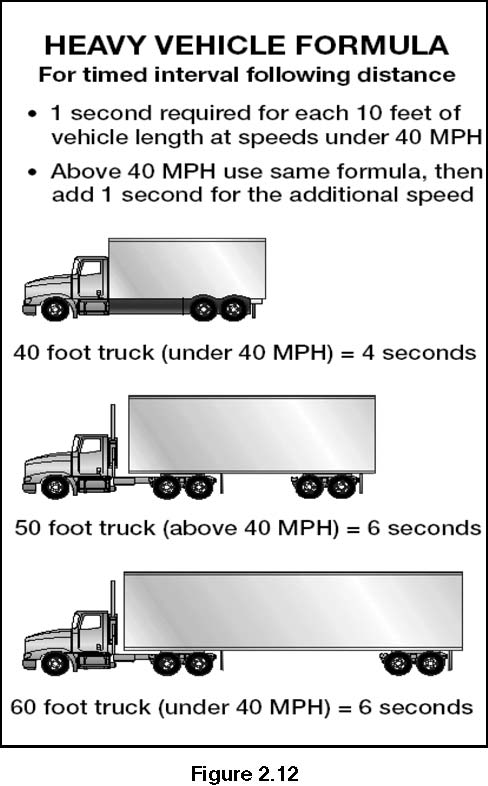
2.7.2 – Space Behind
You cannot stop others from following you too closely, but there are things you can do to make it safer.
- Stay to the Right. Heavy vehicles are often tailgated when they cannot keep up with the speed of traffic. This often happens when you are going uphill. If a heavy load is slowing you down, stay in the right lane if you can. Going uphill,you should not pass another slow vehicle unless you can get around quickly and safely.
- Dealing With Tailgaters Safely. In a large vehicle, it is often hard to see whether a vehicle is close behind you. You may be tailgated:
— When you are Traveling Slowly. Drivers trapped behind slow vehicles often follow closely.
— In Bad Weather. Many small vehicle drivers follow large vehicles closely during bad weather, especially when it is hard to see the road ahead.
If you find yourself being tailgated, here are some things you can do to reduce the chances of an accident:
- Avoid Quick Changes. If you have to slow down or turn, signal early, and reduce speed very gradually.
- Increase Your Following Distance. Open up room in front of you to help you avoid having to make sudden speed or direction changes. It also makes it easier for the tailgater to get around you.
- Do Not Speed Up. It is safer to be tailgated at a low speed than a high speed.
- Avoid Tricks. Do not turn on your taillights or flash your brake lights. Follow the suggestions above.
2.7.3 – Space to the Sides
CMVs are often wide and take up most of a lane. Safe drivers will manage what little space they have. You can do this by keeping your vehicle centered in your lane, and avoiding driving alongside others.
Staying Centered in a Lane. Keep your vehicle centered in the lane to keep a safe clearance on either side. If your vehicle is wide, you have little room to spare.
Traveling Next to Others. There are 2 dangers in traveling alongside other vehicles:
- Another driver may change lanes suddenly and turn into you.
- You may be trapped when you need to change lanes.
Find an open spot where you are not near other traffic. When traffic is heavy, it may be hard to find an open spot. If you must travel near other vehicles, try to keep as much space as possible between you and them. Also, drop back or pull forward so that you are sure the other driver can see you.
Strong Winds. Strong winds make it difficult to stay in your lane. The problem is usually worse for lighter vehicles. This problem can be especially bad coming out of tunnels. Do not drive alongside others if you can avoid it.
2.7.4 – Space Overhead
Hitting overhead objects is a danger. Make sure you always have overhead clearance.
- Do not assume that the heights posted at bridges and overpasses are correct. Repaving or packed snow may have reduced the clearances since the heights were posted.
- The weight of a cargo van changes its height. An empty van is higher than a loaded one. Clearing under a bridge when your CMV was loaded does not mean it will clear when you are empty.
- If you doubt you have safe space to pass under an object, go slowly. If you are not sure you can make it, take another route. Warnings are often posted on low bridges or underpasses, but sometimes they are not.
- Some roads can cause a vehicle to tilt. There can be a problem clearing objects along the edge of the road, such as signs, trees, or bridge supports. Where this is a problem, drive a little closer to the center of the road.
- Before you back into an area, get out and check for overhanging objects such as trees, branches, or electric wires. It is easy to miss seeing them while you are backing. Also, check for other hazards at the same time.
2.7.5 – Space Below
Many drivers forget about the space under their vehicles. This space can be very small when a vehicle is heavily loaded. This is often a problem on dirt roads and unpaved yards. Do not take a chance on getting hung up. Drainage channels across roads can cause the ends of some vehicles to drag. Cross such depressions carefully.
Railroad tracks can also cause problems, particularly when pulling trailers with a low underneath clearance. Do not take a chance on getting hung up halfway across.
2.7.6 – Space for Turns
The space around a truck or bus is important in turns. Large vehicles can hit other vehicles or objects during turns because of wide turning and off-tracking.
Right Turns. Here are some rules to help prevent right-turn accidents:
- Turn slowly to give yourself and others more time to avoid problems.
- If you are driving a truck or bus that cannot make the right turn without swinging into another lane, turn wide as you complete the turn. Keep the rear of your vehicle close to the curb. This will stop other drivers from passing you on the right.
- Do not turn wide to the left as you start the turn. A following driver may think you are turning left and try to pass you on the right. You may crash into the other vehicle as you complete your turn.
- If you must cross into the oncoming lane to make a turn, watch out for vehicles coming toward you. Give them room to go by or stop. However, do not back up for them because you might hit someone behind you. See Figure 2.13.
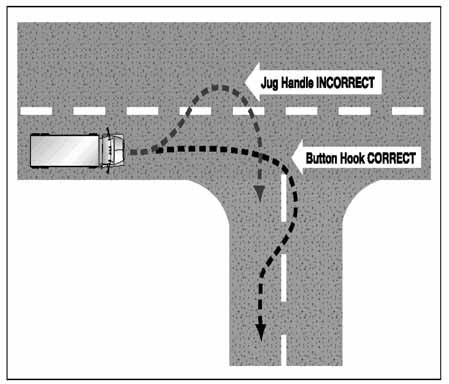
Figure 2.13
Left Turns. On a left turn, make sure you reach the center of the intersection before you start the left turn. If you turn too soon, the left side of your vehicle may hit another vehicle because of off-tracking.
If there are 2 turning lanes, always take the right turn lane. Do not start in the inside lane because you may have to swing right to make the turn. Drivers on your left can be more readily seen. See Figure 2.14.
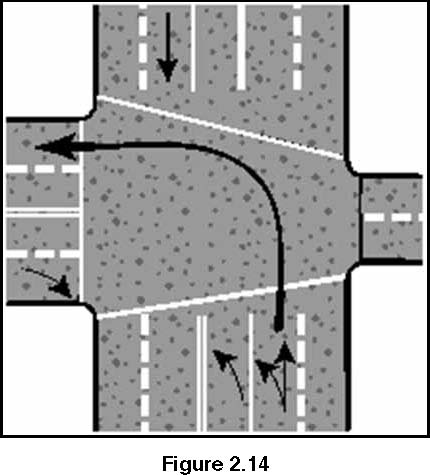
2.7.7 – Space Needed to Cross or Enter Traffic
Be aware of the size and weight of your vehicle when you cross or enter traffic. Here are some important things to keep in mind:
- Because of slow acceleration and the space large vehicles require, you may need a much larger gap to enter traffic than you would in a car.
- Acceleration varies with the load. Allow more room if your vehicle is heavily loaded.
- Before you start across a road, make sure you can get all the way across before traffic reaches you.
2.8 – Seeing Hazards
2.8.1 – Importance of Seeing Hazards
What is a Hazard? A hazard is any road condition or other road user (driver, motorcyclist, bicyclist, and pedestrian) that is a possible danger. For example, a vehicle in front of you is headed toward the freeway exit, the brake lights come on and they begin braking hard. This could mean the driver is uncertain about taking the off ramp. They might suddenly return to the highway. This vehicle is a hazard. If the vehicle cuts in front of you, it is no longer just a hazard; it is an emergency.
Seeing Hazards Lets you be Prepared. You will have more time to act if you see hazards before they become emergencies. In the example above, you might make a lane change or slow down to prevent an accident if the vehicle suddenly cuts in front of you. Seeing this hazard gives you time to check your mirrors and signal a lane change. Being prepared reduces the danger. A driver who did not see the hazard until the slow vehicle pulled back on the highway in front of them would have to do something very suddenly. Sudden braking or a quick lane change is more likely to lead to an accident.
Learning to See Hazards. There are often clues to help you see hazards. The more you drive, the better you can learn to see hazards. This section will talk about hazards that you should be aware of.
2.8.2 – Hazardous Roads
Move-Over Laws
The incidents of law enforcement officers, emergency medical services, fire department personnel, and people working on the road being struck while performing duties at the roadside are increasing at a frightening pace. Move-over laws have been enacted, which require drivers to slow and change lanes when approaching a roadside incident, to lessen the problem. Signs are posted on roadways in states that have such laws.
When approaching an authorized emergency vehicle stopped on the roadside or a work zone, proceed with caution by slowing and yielding the right-of-way by changing into a lane not next to that of the authorized emergency vehicle or work zone if safety and traffic conditions permit. If a lane change is unsafe, slow down and proceed with caution while maintaining a safe speed for traffic conditions.
In California, failing to obey the move-over law is an infraction, punishable by a fine (CVC §21809).
Slow down and be very careful if you see any of the following road hazards:
- Work Zones. When people are working on the road, it is a hazard. There may be narrower lanes, sharp turns, or uneven surfaces. Other drivers are often distracted and drive unsafely. Workers and construction vehicles may get in the way. Drive slowly and carefully near work zones. Use your 4-way emergency flashers or brake lights to warn drivers behind you.
- Drop Off. Sometimes the pavement drops off sharply near the edge of the road. Driving too near the edge can tilt your vehicle toward the side of the road. This can cause the top of your vehicle to hit roadside objects (such as signs, or tree limbs). Also, it can be hard to steer as you cross the drop off, go off the road, or come back on.
- Foreign Objects. Things that have fallen on the road can be hazards. They can be a danger to your tires and wheel rims. They can damage electrical and brake lines. They can be caught between dual tires and cause severe damage. Some obstacles that appear to be harmless can be very dangerous. For example, cardboard boxes may be empty, but they may also contain some solid or heavy material capable of causing damage. The same is true of paper and cloth sacks. It is important to remain alert for objects of all sorts, so you can see them early enough to avoid them without making sudden, unsafe moves.
- Off Ramps/On Ramps. Freeway and turnpike exits can be particularly dangerous for CMVs. Off and on ramps often have speed limit signs posted. Remember, these speeds may be safe for small vehicles, but may not be safe for larger vehicles or heavily loaded vehicles. Exits that go downhill and turn at the same time can be especially dangerous. The downgrade makes it difficult to reduce speed. Braking and turning at the same time can be a dangerous practice. Make sure you are going slowly enough before you get on the curved part of an off or on ramp.
2.8.3 – Drivers who Are Hazards
In order to protect yourself and others, you must know when other drivers may do something hazardous. Some clues to this type of hazard are discussed below.
Blocked Vision. People who cannot see others are a very dangerous hazard. Be alert for drivers whose vision is blocked. Vans, loaded station wagons, and small vehicles with the rear window blocked are examples. Rental trucks should be watched carefully. Their drivers are often not used to the limited vision they have to the sides and rear of the truck. In winter, vehicles with frosted, ice-covered, or snow-covered windows are hazards.
Vehicles may be partly hidden by blind intersections or alleys. If you only can see the rear or front end of a vehicle but not the driver, then they cannot see you. Be alert because they may back out or enter into your lane. Always be prepared to stop.
Delivery Trucks Can Present a Hazard. Packages or vehicle doors often block the driver’s vision. Drivers of step vans, postal vehicles, and local delivery vehicles are often in a hurry and may suddenly step out of their vehicle or drive their vehicle into the traffic lane.
Parked Vehicles Can Be Hazards. People may start to get out of their vehicles, or they may suddenly start up and drive into your way. Watch for movement inside the vehicle or movement of the vehicle itself that shows people are inside. Watch for brake lights, backup lights, exhaust, and other clues that a driver is about to move.
Be careful of a stopped bus. Passengers may cross in front of or behind the bus, and they often cannot see you.
Pedestrians and Bicyclists Can Also Be Hazards. Walkers, joggers, and bicyclists may be on the road with their back to the traffic, so they cannot see you. Sometimes they wear portable stereos with headsets, so they cannot hear you either. This can be dangerous. On rainy days, pedestrians may not see you because of hats or umbrellas. They may be hurrying out of the rain and may not pay attention to the traffic.
Distractions. People who are distracted are hazards. Watch where they are looking. If they are looking elsewhere, they cannot see you. Be alert even when they are looking at you. They may believe they have the right of way.
Children. Children tend to act quickly without checking traffic. Children playing with one another may not look for traffic and are a serious hazard.
Talkers. Drivers or pedestrians talking to one another may not be paying close attention to the traffic.
Workers. People working on or near the roadway are a hazard clue. The work creates a distraction for other drivers and the workers themselves may not see you.
Ice Cream Trucks. Someone selling ice cream is a hazard clue. Children may be nearby and may not see you.
Disabled Vehicles. Drivers changing a tire or fixing an engine often do not pay attention to the danger roadway traffic is to them. They are often careless. Jacked up wheels or raised hoods are hazard clues.
Accidents. Accidents are particularly hazardous. People involved in the accident may not look for traffic. Passing drivers tend to look at the accident. People often run across the road without looking. Vehicles may slow or stop suddenly.
Shoppers. People in and around shopping areas are often not watching traffic because they are looking for stores or looking into store windows. People often run across the parking lot without looking. Vehicles may slow down or suddenly stop.
Confused Drivers. Confused drivers often change direction suddenly or stop without warning. Confusion is common near freeway or turnpike interchanges and major intersections. Tourists unfamiliar with the area can be very hazardous. Clues to tourists include car-top luggage and out-of state license plates. Unexpected actions (stopping in the middle of a block, changing lanes for no apparent reason, backup lights suddenly going on) are clues to confusion. Hesitation is another clue, including driving very slowly, using brakes often, or stopping in the middle of an intersection. You may also see drivers who are looking at street signs, maps, and house numbers. These drivers may not be paying attention to you.
Slow Drivers. Motorists who fail to maintain normal speed are hazards. Seeing slow moving vehicles early can prevent an accident. Some vehicles, by their nature, are slow and seeing them is a hazard clue (mopeds, farm machinery, construction machinery, tractors, etc.). Some of these will have the “slow moving vehicle” emblem to warn you. This is a red triangle with an orange center.
Vehicles displaying this emblem are not designed to attain a speed greater than 25 mph (CVC 385.5).

Drivers Signaling a Turn May Be a Hazard. Drivers signaling a turn may slow more than expected or stop. If they are making a tight turn into an alley or driveway, they may go very slowly. If pedestrians or other vehicles block them, they may have to stop on the roadway. Vehicles turning left may have to stop for oncoming vehicles.
Drivers in a Hurry. Drivers may feel your CMV is preventing them from getting where they want to go on time. Such drivers may pass you without a safe gap in the oncoming traffic, cutting too close in front of you. Drivers entering the road may pull in front of you in order to avoid being stuck behind you, causing you to brake. Be aware of this and watch for drivers who are in a hurry.
Impaired Drivers. Drivers who are sleepy, have had too much to drink, are on drugs, or are ill are hazards. Some clues to these drivers are:
- Weaving across the road or drifting from one side to another.
- Leaving the road (dropping right wheels onto the shoulder, or bumping across a curb in a turn).
- Stopping at the wrong time (stopping at a green light, or waiting for too long at a stop).
- Open window in cold weather.
- Speeding up or slowing down suddenly and driving too fast or too slow.
Be alert for drunk drivers and sleepy drivers late at night.
Driver Body Movement as a Clue. Drivers look in the direction they are going to turn. You may sometimes get a clue from a driver’s head and body movements that a driver may be going to make a turn, even though the turn signals are not on. Drivers making over-the-shoulder checks may be going to change lanes. These clues are most easily seen in motorcyclists and bicyclists. Watch other road users and try to tell whether they might do something hazardous.
Conflicts. You are in conflict when you have to change speed and/or direction to avoid hitting someone. Conflicts occur at intersections where vehicles meet, at merges (such as turnpike on ramps) and where lane changes are needed (such as the end of a lane, forcing a move to another lane of traffic). Other situations include slow moving or stalled traffic in a traffic lane, and accident scenes. Watch for other drivers who are in conflict because they are a hazard to you. When they react to this conflict, they may do something that will put them in conflict with you.
2.8.4 – Always Have a Plan
You should always be looking for hazards. Continue to learn to see hazards on the road. However, do not forget why you are looking for the hazards—they may turn into emergencies. Look for the hazards to have time to plan a way out of any emergency. When you see a hazard, think about the emergencies that could develop and figure out what you would do. Always be prepared to take action based on your plans. In this way, you will be a prepared, defensive driver who will improve your own safety as well as the safety of all road users.
SUBSECTIONS 2.7 AND 2.8
Test Your Knowledge
- How do you find out how many seconds of following distance space you have?
- If you are driving a 30-foot vehicle at 55 mph, how many seconds of following distance should you allow?
- You should decrease your following distance if somebody is following you too closely. True or False?
- If you swing wide to the left before turning right, another driver may try to pass you on the right. True or False?
- What is a hazard?
- Why make emergency plans when you see a hazard?
These questions may be on the test. If you cannot answer them all, reread Subsections 2.7 and 2.8.
2.9 – Distracted Driving
A driver distraction is anything that takes your attention away from driving. Whenever you are driving a vehicle and your full attention is not on the driving task, you are putting yourself, your passengers, other vehicles, and pedestrians in danger. Distracted driving can cause accidents, resulting in injury, death, or property damage.
Activities inside the vehicle that can distract your attention include: talking to passengers; adjusting the radio, CD player or climate controls; eating, drinking, smoking; reading maps or other literature; picking up something that fell; talking on a cell phone or citizens band (CB) radio; reading or sending text messages; using any type of telematics or electronic devices (such as navigation systems, pagers, personal digital assistant, computers, etc.); daydreaming or being occupied with other mental distractions; and many others.
Possible distractions that could occur outside a moving vehicle: traffic, vehicles, or pedestrians; events such as police pulling someone over, an accident scene or road construction; sunlight/sunset; objects in roadway; reading billboards or other road advertisements; and many others.
2.9.1 – The Distracted Driving Crash Problem
The Large Truck Crash Causation Study (LTCCS) reported that 8 percent of large-truck accidents occurred when CMV drivers were externally distracted and 2 percent of large-truck accidents occurred when the driver was internally distracted.
Approximately 5,500 people are killed each year on U.S. roadways and an estimated 448,000 are injured in motor vehicle accidents involving distracted driving (National Highway Traffic Safety Administration [NHTSA] Traffic Safety Facts: Distracted Driving).
Research indicates that the burden of talking on a cell phone–even if it is hands-free–saps the brain of 39 percent of the energy it would ordinarily devote to safe driving. Drivers who use a handheld device are more likely to get into an accident serious enough to cause injury. (For more information, visit the NHTSA Distracted Driving web page at distraction.gov.)
2.9.2 – Effects of Distracted Driving
Effects of distracted driving include slowed perception, which may cause you to be delayed in perceiving or completely fail to perceive an important traffic event. Delayed decision making and improper action can cause you to be delayed in taking the proper action or make incorrect inputs to the steering, accelerator, or brakes.
2.9.3 – Types of Distractions
There are many causes of distraction, all with the potential to increase risk.
- Physical Distraction – causes you to take your hands off the wheel or eyes off the road, such as reaching for an object.
- Mental Distraction – takes your mind away from the road, such as engaging in conversation with a passenger or thinking about something that happened during the day.
- Both Physical and Mental Distraction – creates an even greater chance an accident could happen, such as talking on a cellphone, or sending or reading text messages.
2.9.4 – Cell/Mobile Phones
CFR, Title 49, Part 383, 384, 390, 391, and 392 and the Hazardous Materials Regulations (HMR) restricts the use of hand-held mobile telephones by drivers of CMVs and implements new driver disqualification sanctions for drivers of CMVs who fail to comply with this federal restriction, or have multiple convictions for violating a state or local law or ordinance on motor vehicle traffic control that restricts the use of hand-held mobile telephones. Additionally, motor carriers are prohibited from requiring or allowing drivers of CMVs to use hand-held mobile telephones.
The use of hand-held mobile telephones means using at least one hand to hold a mobile telephone to conduct a voice communication; dialing a mobile telephone by pressing more than a single button; or moving from a seated driving position while restrained by a seat belt to reach for a mobile telephone. If you choose to use a mobile phone while operating a CMV, you may only use a hands-free mobile phone that is located close to you and can be operated in compliance with the rule to conduct a voice communication.
Your CDL will be disqualified after 2 or more convictions of any state law on hand-held mobile telephone use while operating a CMV. Disqualification is 60 days for the second offense within 3 years and 120 days for 3 or more offenses within 3 years. In addition, the first and each subsequent violation of such a prohibition are subject to civil penalties imposed on such drivers. Motor carriers must not allow nor require drivers to use a hand-held mobile telephone while driving. Employers may also be subject to civil penalties. There is an emergency exception that allows you to use your hand-held mobile telephone if necessary to communicate with law enforcement officials or other emergency services.
Research shows the odds of being involved in a safety-critical event (for example, accident, near-accident, or unintentional lane deviation) is 6 times greater for CMV drivers who engage in dialing a mobile telephone while driving than for those who do not. Dialing drivers took their eyes off the forward roadway for an average of 3.8 seconds. At 55 mph (or 80.7 feet per second), this equates to a driver traveling 306 feet (approximate length of an American football field) without looking at the roadway.
Your primary responsibility is to operate a motor vehicle safely. To do this, you must focus your full attention on the driving task.
Note that hands-free devices are no less likely than hand-held cell phones to cause you to become distracted. Attention is diverted from the driving task while using either device.
In California, you are not allowed to use an electronic device while driving unless it is hands-free. Even these devices are unsafe to use when you are driving down the road.
If you must use your electronic communication device while driving, follow these tips:
- Try to keep it brief and never use the electronic device for social visiting.
- Hang up your cell phone in difficult traffic situations.
- Do not use the vehicle’s equipment or any electronic communication device when approaching locations with heavy traffic, road construction, heavy pedestrian traffic, or severe weather conditions.
- Do not attempt to type or read messages.
2.9.5 – Texting
CFR, Title 49, Part 383, 384, 390, 391, 392, and the FMCSR prohibits texting by CMV drivers while operating in interstate commerce, and implements new driver disqualification sanctions for drivers of CMVs who fail to comply with this federal prohibition, or who have multiple convictions for violating a state or local law or ordinance on motor vehicle traffic control that prohibits texting while driving. Additionally, motor carriers are prohibited from requiring or allowing their drivers to engage in texting while driving.
Texting means manually entering text into, or reading text from, an electronic device. This includes, but is not limited to, short message service, emailing, instant messaging, a command or request to access a webpage, or engaging in any other form of electronic text retrieval or entry, for present or future communication.
Electronic device includes, but is not limited to, a cellular telephone, personal digital assistant, pager, computer; or any other device used to enter, write, send, receive, or read text.
Your CDL will be disqualified after 2 or more convictions of any state law on texting while operating a CMV. Disqualification is 60 days for the second offense within 3 years and 120 days for 3 or more offenses within 3 years. In addition, the first and each subsequent violation of such a prohibition are subject to civil penalties imposed on such drivers, in an amount up to $2,750. No motor carrier shall allow or require its drivers to engage in texting while driving. There is an emergency exception that allows you to text if necessary to communicate with law enforcement officials or other emergency services.
Evidence suggests text messaging is even riskier than talking on a cell phone because it requires you to look at a small screen and manipulate the keypad with your hands. Texting is the most alarming distraction because it involves both physical and mental distraction simultaneously.
Research shows that the odds of being involved in a safety-critical event (such as an accident, near- accident, unintentional lane deviation) is 23.2 times greater for CMV drivers who engage in texting while driving than for those who do not. Sending or receiving text takes your eyes from the road for an average of 4.6 seconds. At 55 mph, you would travel 371 feet (the length of an entire American football field) without looking at the roadway.
2.9.6 – Do Not Drive Distracted
Your goal should be to eliminate all in-vehicle distractions before driving begins. Accomplishing this goal can be done by:
- Assessing all potential in-vehicle distractions before driving.
- Developing a preventative plan to reduce/eliminate possible distractions.
- Expecting distractions to occur.
- Discussing possible scenarios before getting behind the wheel.
Based on the assessment of potential distractions, you can formulate a preventative plan to reduce/ eliminate possible distractions.
If drivers react a half-second slower because of distractions, accidents double. Some tips to follow so you will not become distracted:
- Turn off all communication devices.
- If you must use a mobile phone, make sure it is within close proximity that it is operable while you are restrained, use an earpiece or the speaker phone function, use voice-activated dialing, and use the hands-free feature. Drivers are not in compliance if they unsafely reach for a mobile phone, even if they intend to use the hands-free function.
- Do not type or read a text message on a mobile device while driving.
- Familiarize yourself with your vehicle’s features and equipment before you get behind the wheel.
- Adjust all vehicle controls and mirrors to your preferences prior to driving.
- Preprogram radio stations and preload your favorite CDs.
- Clear the vehicle of any unnecessary objects and secure cargo.
- Review maps, program the GPS, and plan your route before you begin driving.
- Do not attempt to read or write while you drive.
- Avoid smoking, eating, and drinking while you drive. Leave early to allow yourself time to stop to eat.
- Do not engage in complex or emotionally intense conversations with other occupants.
- Secure commitment from other occupants to behave responsibly and support the driver in reducing distractions.
2.9.7 – Watch Out for Other Distracted Drivers
You need to be able to recognize other drivers who are engaged in any form of driving distraction. Not recognizing other distracted drivers can prevent you from perceiving or reacting correctly in time to prevent an accident. Watch for:
- Vehicles that may drift over the lane divider lines or within their own lane.
- Vehicles traveling at inconsistent speeds.
- Drivers who are preoccupied with maps, food, cigarettes, cell phones, or other objects.
- Drivers who appear to be involved in conversations with their passengers.
Give a distracted driver plenty of room and maintain your safe following distance.
Be very careful when passing a driver who seems to be distracted. That driver may not be aware of your presence, and they may drift in front of you.
2.10 – Aggressive Drivers/Road Rage
2.10.1 – What Is It?
Aggressive driving and road rage is not a new problem. However, in today’s world, where heavy and slow-moving traffic and tight schedules are the norm, more and more drivers are taking out their anger and frustration in their vehicles.
Crowded roads leave little room for error, leading to suspicion and hostility among drivers and encouraging them to take personally the mistakes of other drivers.
Aggressive driving is the act of operating a motor vehicle in a selfish, bold, or pushy manner, without regard for the rights or safety of others.One sign of an aggressive driver is a driver changing lanes frequently and abruptly without notice.
Road rage is operating a motor vehicle with the intent of doing harm to others or physically assaulting a driver or their vehicle.
2.10.2 – Do Not Be an Aggressive Driver
- How you feel before you start your vehicle has a lot to do with how stress will affect you while driving.
- Reduce your stress before and while you drive. Listen to “easy listening” music.
- Give the drive your full attention. Do not allow yourself to become distracted by talking on your cell phone, eating, etc.
- Be realistic about your travel time. Expect delays because of traffic, construction, or bad weather, and make allowances.
- If you are going to be later than you expected – deal with it. Take a deep breath and accept the delay.
- Give other drivers the benefit of the doubt. Try to imagine why he or she is driving that way. Whatever their reason, it has nothing to do with you.
- Slow down and keep your following distance reasonable.
- Do not drive slowly in the left lane of traffic.
- Avoid gestures. Keep your hands on the wheel. Avoid making any gestures that might anger another driver, even seemingly harmless expressions of irritation like shaking your head.
- Be a cautious and courteous driver. If another driver seems eager to get in front of you, say, “Be my guest.” This response will soon become a habit and you will not be as offended by other drivers’ actions.
2.10.3 – What You Should Do When Confronted by an Aggressive Driver
- First and foremost, make every attempt to get out of their way.
- Put aside your pride. Do not challenge them by speeding up or attempting to hold-your-own in your travel lane.
- Avoid eye contact.
- Ignore gestures and refuse to react to them.
- Report aggressive drivers to the appropriate authorities by providing a vehicle description, license number, location and, if possible, direction of travel.
- If you have a cell phone and can use it safely, call the police.
- If an aggressive driver is involved in an accident farther down the road, stop a safe distance from the accident scene, wait for the police to arrive, and report the driving behavior you witnessed.
SUBSECTIONS 2.9 AND 2.10
Test Your Knowledge
- What are some tips to follow so you will not become a distracted driver?
- How do you use in-vehicle communications equipment cautiously?
- How do you recognize a distracted driver?
- What is the difference between aggressive driving and road rage?
- What should you do when confronted with an aggressive driver?
- What are some things you can do to reduce your stress before and while you drive?
These questions may be on the test. If you cannot answer them all, reread Subsections 2.9 and 2.10.
2.11 – Driving at Night
2.11.1 – It Is More Dangerous
You are at greater risk when you drive at night. Drivers cannot see hazards as quickly as in daylight, so they have less time to respond. Drivers caught by surprise are less able to avoid an accident. The problems of night driving involve the driver, roadway, and vehicle.
2.11.2 – Driver Factors
Vision. Good vision is critical for safe driving. Your control of the brake, accelerator, and steering wheel is based on what you see. If you cannot see clearly, you will have trouble identifying traffic and roadway conditions, spotting potential trouble or responding to problems in a timely manner.
Because seeing well is so critical to safe driving, you should have your eyes checked regularly by an eye specialist. You may never know you have poor vision unless your eyes are tested. If you need to wear glasses or contact lenses for driving, remember to:
- Always wear them when driving, even if driving short distances. If your DL has a corrective lenses restriction, it is illegal to move a vehicle without using corrective lenses.
- Keep an extra set of corrective lenses in your vehicle. If your normal corrective lenses are broken or lost, you can use the spare lenses to drive safely.
- Avoid using dark or tinted corrective lenses at night, even if you think they help with glare. Tinted lenses cut down the light that you need to see clearly under night driving conditions.
Glare. Drivers can be blinded for a short time by bright light. It can take several seconds to recover from glare. Even 2 seconds of glare blindness can be dangerous. A vehicle going 55 mph will travel more than half the distance of an American football field during that time.
Fatigue and Lack of Alertness. Fatigue is physical or mental tiredness that can be caused by physical or mental strain, repetitive tasks, illness, or lack of sleep. Just like alcohol and drugs, it impairs your vision and judgment.
Fatigue causes errors related to speed and distance, increases your risk of being in an accident, causes you to not see and react to hazards as quickly, and affects your ability to make critical decisions. When you are fatigued, you could fall asleep behind the wheel and crash, injuring or killing yourself or others.
Fatigued or drowsy driving is one of the leading causes of traffic accidents. NHTSA estimates that 100,000 police-reported accidents a year are the result of drowsy driving. According to the National Sleep Foundation’s Sleep in America Poll, 60 percent of Americans have driven while feeling sleepy and more than 1/3 (36 percent or 103 million people) admit to having actually fallen asleep at the wheel. Drivers may experience short bursts of sleep lasting only a few seconds or fall asleep for longer periods of time. Either way, the chance of an accident increases dramatically.
At-Risk Groups
The risk of having an accident due to drowsy driving is not uniformly distributed across the population. Accidents tend to occur at times when sleepiness is most pronounced, for example, during the night and in the mid-afternoon. Most people are less alert at night, especially after midnight. This is particularly true if you have been driving for a long time. Thus, individuals who drive at night are more likely to have fall-asleep accidents.
Research has identified young males, shift workers, commercial drivers, especially long-haul drivers, and people with untreated sleep disorders or with short-term or chronic sleep deprivation as being at increased risk for having a fall-asleep accident. At least 15 percent of all heavy truck accidents involve fatigue.
A congressionally mandated-study of 80 long-haul truck drivers in the U.S. and Canada found drivers averaged less than 5 hours of sleep per day (FMLSA, 1996). It is no surprise that the National Transportation Safety Board (NTSB) reported that drowsy driving was probably the cause of more than half of accidents leading to a truck driver’s death (NTSB, 1990). For each truck driver fatality, another 3 to 4 people are killed (NHTSA, 1994).
Warning Signs of Fatigue
Many people cannot tell if or when they are about to fall asleep. Here are some signs that should tell you to stop and rest:
- Difficulty focusing, frequent blinking, or heavy eyelids.
- Yawning repeatedly or rubbing eyes.
- Daydreaming and wandering/disconnected thoughts.
- Trouble remembering the last few miles driven and missing exits or traffic signs.
- Trouble keeping head up.
- Drifting from your lane, following too closely, or hitting a shoulder rumble strip.
- Feeling restless and irritable.
When you are tired, trying to “push on” is far more dangerous than most drivers think. It is a major cause of fatal accidents. If you notice any signs of fatigue, stop driving and go to sleep for the night or take a 15–20 minute nap.
Are You at Risk?
Before you drive, consider whether you are:
- Sleep-deprived or fatigued (6 hours of sleep or less triples your risk).
- Suffering from sleep loss (insomnia), poor quality sleep, or a sleep deprivation.
- Driving long distances without proper rest breaks.
- Driving through the night, mid-afternoon, or when you would normally be asleep. Many heavy motor vehicle accidents occur between midnight and 6 a.m.
- Taking sedating medications (antidepressants, cold tablets, antihistamines).
- Working more than 60 hours a week (increases your risk by 40 percent).
- Working more than one job and your main job involves shift work.
- Driving alone or on a long, rural, dark, or boring road.
- Flying and changing time zone.
Preventing Drowsiness Before a Trip:
- Get adequate sleep – adults need 8-9 hours to maintain alertness.
- Prepare route carefully to identify total distance, stopping points, and other logistic considerations.
- Schedule trips for the hours you are normally awake, not the middle of the night.
- Drive with a passenger.
- Avoid medications that cause drowsiness.
- Consult your physician if you suffer from daytime sleepiness, have difficulty sleeping at night, or take frequent naps.
- Incorporate exercise into your daily life to give you more energy.
Maintaining Alertness While Driving:
- Protect yourself from glare and eyestrain with sunglasses.
- Keep cool by opening the window or using the air conditioner.
- Avoid heavy foods.
- Be aware of down time during the day.
- Have another person ride with you, and take turns driving.
- Take periodic breaks – about every 100 miles or 2 hours during long trips.
- Stop driving and rest or take a nap.
- Caffeine consumption can increase awareness for a few hours, but do not drink too much. It will eventually wear off. Do not rely on caffeine to prevent fatigue.
- Avoid drugs. While they may keep you awake for a while, they will not make you alert.
If you are drowsy, the only safe cure is to get off the road and sleep. If you do not, you risk your life and the lives of others.
2.11.3 – Roadway Factors
Poor Lighting. In the daytime there is usually enough light to see well. This is not true at night. Some areas may have bright street lights, but many areas will have poor lighting. On most roads you will probably have to depend entirely on your headlights.
Less light means you will not be able to see hazards as well as in daytime. Road users who do not have lights are hard to see. There are many accidents at night involving pedestrians, joggers, bicyclists, and animals.
Even when there are lights, the road scene can be confusing. Traffic signals and hazards can be hard to see against a background of signs, shop windows, and other lights.
Drive slower when lighting is poor or confusing.
Drive slowly enough to be sure you can stop in the distance you can see ahead.
Drunk Drivers. Drunk drivers and drivers under the influence of drugs are a hazard to themselves and to you. Be especially alert around the closing times of bars and taverns. Watch for drivers who have trouble staying in their lane, or maintaining speed, stop without reason, or show other signs of being under the influence of alcohol or drugs.
2.11.4 – Vehicle Factors
Headlights. At night, your headlights will usually be the main source of light for you to see by and for others to see you. You cannot see nearly as much with your headlights as you see in the daytime. With low beams you can see ahead about 250 feet and with high beams about 350-500 feet. You must adjust your speed to keep your stopping distance within your sight distance. This means going slowly enough to be able to stop within the range of your headlights. Otherwise, by the time you see a hazard; you will not have time to stop.
Night driving can be more dangerous if you have problems with your headlights. Dirty headlights may give only half the light they should. This cuts down your ability to see, and makes it harder for others to see you. Make sure your lights are clean and working. Headlights can be out of adjustment. If they do not point in the right direction, they will not give you a good view and can blind other drivers. Have a qualified person make sure they are adjusted properly.
You must turn on your headlights:
- A half hour after sunset to a half hour before sunrise.
- If snow, rain, fog, or other hazardous weather condition require the use of windshield wipers.
- When visibility is not sufficient to clearly see a person or a vehicle for a distance of 1,000 feet (CVC §§280 and 24400).
No vehicle may be driven with only parking lights on. However, they may be used as signals or when the headlamps are also lighted (CVC §24800).
Other Lights. In order for you to be seen easily, the following must be clean and working properly:
- Reflectors
- Marker lights
- Clearance lights
- Taillights
- Identification lights
Turn Signals and Brake Lights. At night your turn signals and brake lights are even more important for telling other drivers what you intend to do. Make sure you have clean, working turn signals and brake lights.
Windshield and Mirrors. It is more important at night than in the daytime to have a clean windshield and clean mirrors. Bright lights at night can cause dirt on your windshield or mirrors to create a glare of its own, blocking your view. Most people have experienced driving toward the sun just as it has risen or is about to set, and found that they can barely see through a windshield that seemed to look okay in the middle of the day. Clean your windshield on the inside and outside for safe driving at night.
2.11.5 – Night Driving Procedures
Vehicle Procedures. Make sure you are rested and alert. If you are drowsy, sleep before you drive! Even a nap can save your life or the lives of others. If you wear eyeglasses, make sure they are clean and unscratched. Do not wear sunglasses at night. Do a complete vehicle inspection. Pay attention to checking all lights and reflectors, and cleaning those you can reach.
Avoid Blinding Others. Glare from your headlights can cause problems for drivers coming toward you. They can also bother drivers going in the same direction you are, when your lights shine in their rearview mirrors. Dim your lights before they cause glare for other drivers. Dim your lights within 500 feet of an oncoming vehicle and when following another vehicle within 500 feet.
Avoid Glare From Oncoming Vehicles. Do not look directly at lights of oncoming vehicles. Look slightly to the right at a right lane or edge marking, if available. If other drivers do not put their low beams on, do not try to “get back at them” by putting your own high beams on. This increases glare for oncoming drivers and increases the chance of an accident.
Use High Beams When you Can. Some drivers make the mistake of always using low beams. This seriously cuts down on their ability to see ahead. Use high beams when it is safe and legal to do so. Use them when you are not within 500 feet of an approaching vehicle. Also, do not let the inside of your cab get too bright. This makes it harder to see outside. Keep the interior light off, and adjust your instrument lights as low as you can to still be able to read the gauges.
If You Get Sleepy, Stop at the Nearest Safe Place. People often do not realize how close they are to falling asleep even when their eyelids are falling shut. If you can safely do so, look at yourself in a mirror. If you look sleepy, or just feel sleepy, stop driving! You are in a very dangerous condition. The only safe cure is to sleep.
2.12 – Driving in Fog
Fog can occur at any time. Fog on highways can be extremely dangerous. Fog is often unexpected, and visibility can deteriorate rapidly. You should watch for foggy conditions and be ready to reduce your speed. Do not assume the fog will thin out after you enter it.
The best advice for driving in fog is do not. It is preferable that you pull off the road into a rest area or truck stop until visibility is better. If you must drive, be sure to consider the following:
- Obey all fog-related warning signs.
- Slow down before you enter fog.
- Use low-beam headlights and fog lights for best visibility even in daytime, and be alert for other drivers who may have forgotten to turn on their lights.
- Turn on your 4-way emergency flashers. This will give vehicles approaching you from behind a better opportunity to notice your vehicle.
- Watch for vehicles on the side of the roadway. Seeing taillights or headlights in front of you may not be a true indication of where the road is ahead of you. The vehicle may not be on the road at all.
- Use roadside highway reflectors as guides to determine how the road may curve ahead of you.
- Listen for traffic you cannot see.
- Avoid passing other vehicles.
- Do not stop along the side of the road, unless absolutely necessary.
2.13 – Driving in Winter
2.13.1 – Vehicle Checks
Make sure your vehicle is ready before driving in winter weather. You should make a regular vehicle inspection, paying extra attention to the following items:
Coolant Level and Antifreeze Amount. Make sure the cooling system is full and there is enough antifreeze in the system to protect against freezing. This can be checked with a special coolant tester.
Defrosting and Heating Equipment. Make sure the defrosters work. They are needed for safe driving. Make sure the heater is working, and that you know how to operate it. If you use other heaters and expect to need them (such as, mirror heaters, battery box heaters, or fuel tank heaters), check their operation.
Wipers and Washers. Make sure the windshield wiper blades are in good condition. Make sure the wiper blades press against the window hard enough to wipe the windshield clean, otherwise they may not sweep off snow properly. Make sure the windshield washer works and there is washing fluid in the washer reservoir.
Use windshield washer antifreeze to prevent freezing of the washer liquid. If you cannot see well enough while driving (for example, if your wipers fail), stop safely and fix the problem.
Tires. Make sure you have enough tread on your tires. The drive tires must provide traction to push the rig over wet pavement and through snow. The steering tires must have traction to steer the vehicle. Enough tread is especially important in winter conditions. You must have at least 4/32 inch tread depth in every major groove on front tires and at least 2/32 inch on other tires. More would be better. Use a gauge to determine if you have enough tread for safe driving.
Tire Chains. You may find yourself in conditions where you cannot drive without chains, even to get to a place of safety. Carry the right number of chains and extra cross-links. Make sure they will fit your drive tires. Check the chains for broken hooks, worn or broken cross-links, and bent or broken side chains. Learn how to put the chains on before you need to do it in snow and ice.
Lights and Reflectors. Make sure the lights and reflectors are clean. Lights and reflectors are especially important during bad weather. Check from time to time during bad weather to make sure they are clean and working properly.
Windows and Mirrors. Remove any ice, snow, etc., from the windshield, windows, and mirrors before starting. Use a windshield scraper, snow brush, and windshield defroster as necessary.
Hand Holds, Steps, and Deck Plates. Remove all ice and snow from hand holds, steps, and deck plates. This will reduce the danger of slipping.
Radiator Shutters and Winterfront. Remove ice from the radiator shutters. Make sure the winterfront is not closed too tightly. If the shutters freeze shut or the winterfront is closed too much, the engine may overheat and stop.
Exhaust System. Exhaust system leaks are especially dangerous when cab ventilation may be poor (windows rolled up, etc.). Loose connections could permit poisonous carbon monoxide to leak into your vehicle. Carbon monoxide gas will cause you to be sleepy. In large enough amounts, it can kill you. Check the exhaust system for loose parts and for sounds and signs of leaks.
2.13.2 – Driving on Slippery Surfaces
Slippery Surfaces. Drive slowly and smoothly on slippery roads. If it is very slippery, you should not drive at all. Stop at the first safe place.
- <>strong>Start Gently and Slowly. When first starting, get the feel of the road. Do not hurry.
- Check for Ice. Check for ice on the road, especially bridges and overpasses. A lack of spray from other vehicles indicates ice has formed on the road. Also, check your mirrors and wiper blades for ice. If they have ice, the road most likely will be icy as well.
- Adjust Turning and Braking to Conditions. Make turns as gently as possible. Do not brake any harder than necessary, and do not use the engine brake or speed retarder. (They can cause the driving wheels to skid on slippery surfaces.)
- Adjust Speed to Conditions. Do not pass slower vehicles unless necessary. Go slowly and watch far enough ahead to keep a steady speed. Avoid having to slow down and speed up. Take curves at slower speeds and do not brake while in curves. Be aware that as the temperature rises to the point where ice begins to melt, the road becomes even more slippery. Slow down more.
- Adjust Space to Conditions. Do not drive alongside other vehicles. Keep a longer following distance. When you see a traffic jam ahead, slow down or stop to wait for it to clear. Try hard to anticipate stops early and slow down gradually. Watch for snowplows, as well as salt and sand trucks, and give them plenty of room.
Wet Brakes. When driving in heavy rain or deep standing water, your brakes will get wet. Water in the brakes can cause the brakes to be weak, apply unevenly, or grab. This can cause lack of braking power, wheel lockups, pulling to one side or the other, and jackknife if you pull a trailer.
Avoid driving through deep puddles or flowing water if possible. If not, you should:
- Slow down and place transmission in a low gear.
- Gently put on the brakes. This presses linings against brake drums or discs and keeps mud, silt, sand, and water from getting in.
- Increase engine rpm and cross the water while keeping light pressure on the brakes.
- Maintain light pressure on the brakes for a short distance to heat them up and dry them out when out of water.
- Make a test stop when safe to do so. Check behind to make sure no one is following, and then apply the brakes to be sure they work well. If not, dry them out further as described above. (Caution: Do not apply too much brake pressure and accelerator at the same time because you can overheat brake drums and linings.)
2.14 – Driving in Very Hot Weather
2.14.1 – Vehicle Checks
Do a normal vehicle inspection, but pay special attention to the following items.
Tires. Check the tire mounting and air pressure. Inspect the tires every 2 hours or every 100 miles when driving in very hot weather. Air pressure increases with temperature. Do not let air out or the pressure will be too low when the tires cool off. If a tire is too hot to touch, remain stopped until the tire cools off. Otherwise, the tire may blow out or catch fire.
Engine Oil. The engine oil helps keep the engine cool, as well as lubricate it. Make sure there is enough engine oil. If you have an oil temperature gauge, make sure the temperature is within the proper range while you are driving.
Engine Coolant. Before starting out, make sure the engine cooling system has enough water and antifreeze according to the engine manufacturer’s directions. (Antifreeze helps the engine under hot conditions as well as cold conditions.) When driving, check the water temperature or coolant temperature gauge from time to time. Make sure it remains in the normal range. If the gauge goes above the highest safe temperature, there may be something wrong that could lead to engine failure and possibly fire. Stop driving as soon as safely possible and try to find out what is wrong.
Some vehicles have sight glasses, see-through coolant overflow containers, or coolant recovery containers. These permit you to check the coolant level while the engine is hot. If the container is not part of the pressurized system, the cap can be safely removed and coolant added even when the engine is at operating temperature.
Never remove the radiator cap or any part of the pressurized system until the system has cooled. Steam and boiling water can spray under pressure and cause severe burns. If you can touch the radiator cap with your bare hand, it is probably cool enough to open.
If coolant has to be added to a system without a recovery tank or overflow tank, follow these steps:
- Shut the engine off.
- Wait until the engine has cooled.
- Protect your hands (use gloves or a thick cloth).
- Turn the radiator cap slowly to the first stop, which releases the pressure seal.
- Step back while pressure is released from cooling system.
- When all pressure has been released, press down on the cap and turn it further to remove it.
- Visually check the level of coolant and add more coolant if necessary.
- Replace the cap and turn it all the way to the closed position.
Engine Belts. Learn how to check v-belt tightness on your vehicle by pressing on the belts. Loose belts will not turn the water pump and/or fan properly. This will result in overheating. Also, check belts for cracking or other signs of wear.
Hoses. Make sure coolant hoses are in good condition. A broken hose while driving can lead to engine failure and even fire.
2.14.2 – Driving in the Heat
Watch for Bleeding Tar. Tar in the road pavement frequently rises to the surface in very hot weather. Spots where tar “bleeds” to the surface are very slippery.
Go Slowly Enough to Prevent Overheating.
High speeds create more heat for the tires and engine. In desert conditions, the heat may build up to the point where it is dangerous. The heat will increase chances of tire failure or even fire, and engine failure.
SUBSECTIONS 2.11, 2.12, 2.13 AND 2.14
Test Your Knowledge
- You should use low beams whenever you can. True or False?
- What should you do before you drive if you are drowsy?
- What effects can wet brakes cause? How can you avoid these problems?
- You should let air out of hot tires so the pressure goes back to normal. True or False?
- You can safely remove the radiator cap as long as the engine is not overheated. True or False?
These questions may be on the test. If you cannot answer all of them, reread Subsections 2.11, 2.12, 2.13, and 2.14.
2.15 – Railroad-Highway Crossings
Railroad-highway grade crossings are a special kind of intersection where the roadway crosses train tracks. These crossings are always dangerous. Every such crossing must be approached with the expectation that a train is coming. It is extremely difficult to judge the distance of the train from the crossing, as well as the speed of an approaching train.
2.15.1 – Types of Crossings
Passive Crossings. This type of crossing does not have any type of traffic control device. The decision to stop or proceed rests entirely in your hands. Passive crossings require you to recognize the crossing, search for any train using the tracks and decide if there is sufficient clear space to cross safely.
Active Crossings. This type of crossing has a traffic control device installed at the crossing to regulate traffic at the crossing. These active devices include flashing red lights (with or without bells) and flashing red lights with bells and gates.
2.15.2 – Warning Signs and Devices
Advance Warning Signs. The round, black-on-yellow warning sign is placed ahead of a public railroad-highway crossing. The advance warning sign tells you to slow down, look, and listen for the train, and be prepared to stop at the tracks if a train is coming. All passenger and HazMat carrying vehicles are required to stop. See Figure 2.15.

Figure 2.15
Pavement Markings. Pavement markings mean the same as advance warning sign. They consist of an “X” with the letters “RR” and a no-passing marking on 2-lane roads. See Figure 2.16.

Figure 2.16
There is also a no passing zone sign on 2-lane roads. There may be a white stop line painted on the pavement before the railroad tracks. The front of the school bus must remain behind this line while stopped at the crossing.
Crossbuck Signs. This sign marks the grade crossing. It requires you to yield the right-of-way to the train. If there is no white stop line painted on the pavement, vehicles that are required to stop must stop no closer than 15 feet or more than 50 feet from the nearest rail of the nearest track. When the road crosses over more than 1 track, a sign below the crossbuck indicates the number of tracks. See Figure 2.17.
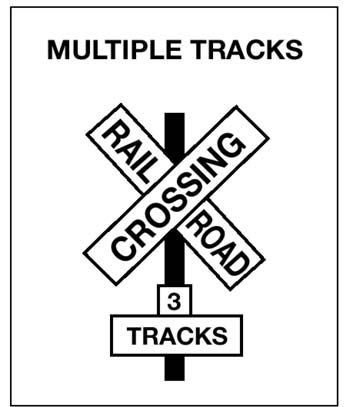
Figure 2.17
Flashing Red Light Signals. At many rail/highway grade crossings, the crossbuck sign has flashing red lights and bells. When the lights begin to flash, stop! A train is approaching. You are required to yield the right-of-way to the train. If there is more than 1 track, make sure all tracks are clear before crossing. See Figure 2.18.
Gates. Many railroad-highway crossings have gates with flashing red lights and bells. Stop when the lights begin to flash and before the gate lowers across the road lane. Remain stopped until the gates go up and the lights have stopped flashing. Proceed when it is safe. See Figure 2.18.

Figure 2.18.
2.15.3 – Driving Procedures
Never Race a Train to a Crossing. Never attempt to race a train to a crossing. It is extremely difficult to judge the speed of an approaching train.
Reduce Speed. Speed must be reduced in accordance with your ability to see approaching trains in any direction, and speed must be held to a point which will permit you to stop short of the tracks in case a stop is necessary.
Do Not Expect to Hear a Train. Trains may not or are prohibited from sounding horns when approaching some crossings. Public crossings where trains do not sound horns should be identified by signs. Noise inside your vehicle may also prevent you from hearing the train horn until the train is dangerously close to the crossing.
Do Not Rely on Signals. You should not rely solely upon the presence of warning signals, gates, or flagmen to warn of the approach of trains. Be especially alert at crossings that do not have gates or flashing red light signals.
Double Tracks Require a Double Check. Remember that a train on 1 track may hide a train on the other track. Look both ways before crossing. After 1 train has cleared a crossing, be sure no other trains are near before starting across the tracks.
Yard Areas and Grade Crossings in Cities and Towns. Yard areas and grade crossings in cities and towns are just as dangerous as rural grade crossings. Approach them with as much caution.
2.15.4 – Stopping Safely at Railroad- Highway Crossings
A full stop is required at grade crossings whenever:
- The nature of the cargo makes a stop mandatory under state or federal regulations.
- Such a stop is otherwise required by law.
When stopping be sure to:
- Check for traffic behind you while stopping gradually. Use a pullout lane, if available.
- Turn on your 4-way emergency flashers.
2.15.5 – Crossing the Tracks
Railroad crossings with steep approaches can cause your unit to hang up on the tracks.
Never permit traffic conditions to trap you in a position where you have to stop on the tracks. Be sure you can get all the way across the tracks before you start across. It takes a typical tractor-trailer unit at least 14 seconds to clear a single track and more than 15 seconds to clear a double track.
Do not shift gears while crossing railroad tracks.
2.15.6 – Special Situations
Be Aware! These trailers can get stuck on raised crossings:
- Low slung units (lowboy, car carrier, moving van, or possum-belly livestock trailer).
- Single-axle tractor pulling a long trailer with its landing gear set to accommodate a tandem axle tractor.
If for any reason you get stuck on the tracks, get out of the vehicle and away from the tracks. Check signposts or signal housing at the crossing for emergency notification information. Call 911 or other emergency number. Give the location of the crossing using all identifiable landmarks, especially the DOT number, if posted.
2.16 – Mountain Driving
In mountain driving, gravity plays a major role. On any upgrade, gravity slows you down. The steeper the grade, the longer the grade, and/or the heavier the load, the more you will have to use lower gears to climb hills or mountains. In coming down long, steep downgrades, gravity causes the speed of your vehicle to increase. You must select an appropriate safe speed, and then use a low gear, and proper braking techniques. You should plan ahead and obtain information about any long, steep grades along your planned route of travel. If possible, talk to other drivers who are familiar with the grades to find out what speeds are safe.
You must go slowly enough so your brakes can hold you back without getting too hot. If the brakes become too hot, they may start to “fade.” This means you have to apply them harder and harder to get the same stopping power. If you continue to use the brakes hard, they can keep fading until you cannot slow down or stop at all.
2.16.1 – Select a “Safe” Speed
Your most important consideration is to select a speed that is not too fast for the:
- Total weight of the vehicle and cargo.
- Length of the grade.
- Steepness of the grade.
- Road conditions.
- Weather.
If a speed limit is posted, or there is a sign indicating “Maximum Safe Speed,” never exceed the speed shown. Also, look for and heed warning signs indicating the length and steepness of the grade.
You must use the braking effect of the engine as the principal way of controlling your speed. The braking effect of the engine is greatest when it is near the governed rpms and the transmission is in the lower gears. Save your brakes so you will be able to slow or stop as required by road and traffic conditions.
2.16.2 – Select the Right Gear Before Starting Down the Grade
Shift the transmission to a low gear before starting down the grade. Do not try to downshift after your speed has already built up. You will not be able to shift into a lower gear. You may not even be able to get back into any gear and all engine braking effect will be lost. Forcing an automatic transmission into a lower gear at high speed could damage the transmission and also lead to loss of all engine braking effect.
With older trucks, a rule for choosing gears is to use the same gear going down a hill that you would need to climb the hill. However, new trucks have low friction parts and streamlined shapes for fuel economy. They may also have more powerful engines. This means they can go up hills in higher gears and have less friction and air drag to hold them back going down hills. For that reason, drivers of modern trucks may have to use lower gears going down a hill than required to go up the hill. You should know what is right for your vehicle.
2.16.3 – Brake Fading or Failure
Brakes are designed so brake shoes or pads rub against the brake drum or disks to slow the vehicle. Braking creates heat, but brakes are designed to take a lot of heat. However, brakes can fade or fail from excessive heat caused by using them too much and not relying on the engine braking effect.
Brake fade is also affected by adjustment. To safely control a vehicle, every brake must do its share of the work. Brakes out of adjustment will stop doing their share before those that are in adjustment. The other brakes can then overheat and fade, and there will not be enough braking available to control the vehicle. Brakes can get out of adjustment quickly, especially when they are used a lot. Also, brake linings wear faster when they are hot. Therefore, brake adjustment must be checked frequently.
2.16.4 – Proper Braking Technique
Remember. The use of brakes on a long and/or steep downgrade is only a supplement to the braking effect of the engine. Once the vehicle is in the proper low gear, the following are the proper braking techniques:
- Apply the brakes just hard enough to feel a definite slowdown.
- When your speed has been reduced to approximately 5 mph below your “safe” speed, release the brakes. (This brake application should last for about 3 seconds.)
When your speed has increased to your “safe” speed, repeat steps 1 and 2.
For example, if your “safe” speed is 40 mph, you would not apply the brakes until your speed reaches 40 mph. You now apply the brakes hard enough to gradually reduce your speed to 35 mph and then release the brakes. Repeat this as often as necessary until you have reached the end of the downgrade.
Escape ramps have been built on many steep mountain downgrades. Escape ramps are made to stop runaway vehicles safely without injuring drivers and passengers. Escape ramps use a long bed of loose, soft material to slow a runaway vehicle, sometimes in combination with an upgrade.
Know escape ramp locations on your route. Signs show drivers where ramps are located. Escape ramps save lives, equipment, and cargo.
SUBSECTIONS 2.15 AND 2.16
Test Your Knowledge
- What factors determine your selection of a “safe” speed when going down a long, steep downgrade?
- Why should you be in the proper gear before starting down a hill?
- Describe the proper braking technique when going down a long, steep downgrade.
- What type of vehicles can get stuck on a railroad-highway crossing?
- How long does it take a typical tractor-trailer unit to clear a double track?
These questions may be on the test. If you cannot answer them all, reread Subsections 2.15 and 2.16.
2.17 – Driving emergencies
Traffic emergencies occur when 2 vehicles are about to collide. Vehicle emergencies occur when tires, brakes, or other critical parts fail. Following the safety practices in this handbook can help prevent emergencies. If an emergency does happen, your chances of avoiding an accident depend upon how well you take action. Actions you can take are discussed below.
2.17.1 – Steering to Avoid an Accident
Stopping is not always the safest thing to do in an emergency. When you do not have enough room to stop, you may have to steer away from what is ahead. Remember, you can almost always turn to miss an obstacle more quickly than you can stop. (However, top-heavy vehicles and tractors with multiple trailers may flip over.)
Keep Both Hands on the Steering Wheel. In order to turn quickly, you must have a firm grip on the steering wheel with both hands. The best way to have both hands on the wheel, if there is an emergency, is to keep them there all the time.
How to Turn Quickly and Safely. A quick turn can be made safely, if it is done the right way. Here are some points that safe drivers use:
- Do not apply the brake while you are turning. It is very easy to lock your wheels while turning. If that happens, you may skid out of control.
- Do not turn any more than needed to clear whatever is in your way. The more sharply you turn, the greater the chances of a skid or rollover.
- Be prepared to countersteer (turn the wheel back in the other direction) once you have passed whatever was in your path. Unless you are prepared to countersteer, you will not be able to do it quickly enough. You should think of emergency steering and countersteering as two parts of one driving action.
Where to Steer. If an oncoming driver has drifted into your lane, a move to your right is best. If that driver realizes what has happened, the natural response will be to return to their own lane.
- If something is blocking your path, the best direction to steer will depend on the situation.
- If you have been using your mirrors, you will know which lane is empty and can be safely used.
- If the shoulder is clear, going right may be best. No one is likely to be driving on the shoulder but someone may be passing you on the left. You will know if you have been using your mirrors.
- If you are blocked on both sides, a move to the right may be best. At least you will not force anyone into an opposing traffic lane and a possible head-on accident.
Leaving the Road. In some emergencies, you may have to drive off the road. It may be less risky than facing an accident with another vehicle.
Most shoulders are strong enough to support the weight of a large vehicle, therefore; they offer an available escape route. Here are some guidelines, if you do leave the road.
- Avoid Braking. If possible, avoid using the brakes until your speed has dropped to about 20 mph. Then brake very gently to avoid skidding on a loose surface.
- Keep One Set of Wheels on the Pavement, if Possible. This helps to maintain control.
- Stay on the Shoulder. If the shoulder is clear, stay on it until your vehicle has come to a stop. Signal and check your mirrors before pulling back onto the road.
Returning to the Road. If you are forced to return to the road before you can stop, use the following procedure:
- Hold the wheel tightly and turn sharply enough to get right back on the road safely. Do not try to edge gradually back on the road. If you do, your tires might grab unexpectedly and you could lose control.
- When both front tires are on the paved surface, countersteer immediately. The 2 turns should be made as a single “steer-countersteer” move.
2.17.2 – How to Stop Quickly and Safely
If somebody suddenly pulls out in front of you, your natural response is to hit the brakes. This is a good response if there is enough distance to stop, and you use the brakes correctly.
You should brake in a way that will keep your vehicle in a straight line and allow you to turn if it becomes necessary. You can use the “controlled braking” or “stab braking” method.
Controlled Braking. With this method, you apply the brakes as hard as you can without locking the wheels. Keep steering wheel movements very small while doing this. If you need to make a larger steering adjustment or the wheels lock, release the brakes. Reapply the brakes as soon as you can.
Stab Braking.
- Apply your brakes all the way.
- Release the brakes when the wheels lock up.
- As soon as the wheels start rolling, apply the brakes fully again. (It can take up to one second for the wheels to start rolling after you release the brakes. If you reapply the brakes before the wheels start rolling, the vehicle will not straighten out.)
Note Stab breaking can only be done in vehicles without anti-lock brake systems (ABS).
Do Not Jam on the Brakes. Emergency braking does not mean pushing down on the brake pedal as hard as you can. That will only keep the wheels locked up and cause a skid. If the wheels skid, you cannot control the vehicle. Emergency braking means, responding to a hazard by slowing the vehicle.
Note If you drive a vehicle with anti-lock brakes, you should read and follow the directions found in the owner’s manual for stopping quickly.
2.17.3 – Brake Failure
Brakes kept in good condition rarely fail. Most hydraulic brake failures occur for one of 2 reasons (air brakes are discussed in Section 5).
- Loss of hydraulic pressure.
- Brake fade on long hills.
Loss of Hydraulic Pressure. When the system will not build up pressure, the brake pedal will feel spongy or go to the floor. Here are some things you can do.
- Downshift. Putting the vehicle into a lower gear will help to slow the vehicle.
- Pump the Brakes. Sometimes pumping the brake pedal will generate enough hydraulic pressure to stop the vehicle.
- Use the Parking Brake. The parking or emergency brake is separate from the hydraulic brake system. Therefore, it can be used to slow the vehicle. However, be sure to press the release button or pull the release lever at the same time you use the emergency brake so you can adjust the brake pressure and keep the wheels from locking up.
- Find an Escape Route. While slowing the vehicle, look for an escape route, such as an open field, side street, or escape ramp. Turning uphill is a good way to slow and stop the vehicle. Make sure the vehicle does not start rolling backward after you stop. Put it in low gear, apply the parking brake, and, if necessary, roll back into an obstacle that will stop the vehicle.
Brake Failure on Downgrades. Going slow enough and braking properly will almost always prevent brake failure on long downgrades. However, once the brakes have failed, you will to have to look outside your vehicle for something to stop it.
Your best hope is an escape ramp. If there is one, there will be signs telling you about it. Use it. Ramps are usually located a few miles from the top of the downgrade. Every year, hundreds of drivers avoid injury to themselves or damage to their vehicles by using escape ramps. Some escape ramps use soft gravel that resists the motion of the vehicle and brings it to a stop. Others turn uphill, using the hill to stop the vehicle and soft gravel to hold it in place.
Any driver who loses brakes going downhill should use an escape ramp if it is available. If you do not use it, your chances of having a serious accident may be much greater.
If no escape ramp is available, take the least hazardous escape route you can—such as an open field or a side road that flattens out or turns uphill. Make the move as soon as you know your brakes do not work. The longer you wait, the faster the vehicle will go, and the harder it will be to stop.
2.17.4 – Tire Failure
Recognize Tire Failure. Quickly knowing you have a tire failure will allow you more time to react. Having just a few extra seconds to remember what you are supposed to do can help. The major signs of tire failure are:
- Sound. The loud “bang” of a blowout is an easily recognized sign. It can take a few seconds for your vehicle to react and you might think it was some other vehicle. Any time you hear a tire blow, you would be safest to assume it is yours.
- Vibration. If the vehicle thumps or vibrates heavily, it may be a sign one of the tires has gone flat. With a rear tire, that may be the only sign you get.
- Feel. If the steering feels “heavy,” it is probably a sign one of the front tires has failed. Sometimes, failure of a rear tire will cause the vehicle to slide back and forth or “fishtail.” However, dual rear tires usually prevent this.
Respond to Tire Failure. When a tire fails, your vehicle is in danger. You must immediately:
- Hold the Steering Wheel Firmly. If a front tire fails, it can twist the steering wheel out of your hands. The only way to prevent this is to keep a firm grip on the steering wheel with both hands at all times.
- Stay off the Brake. It is natural to want to brake in an emergency. However, braking when a tire has failed could cause loss of control. Unless you are about to run into something, stay off the brake until the vehicle has slowed down. Then brake very gently, pull off the road, and stop.
- Check the Tires. After you have come to a stop, get out and check all the tires. Do this even if the vehicle seems to be handling all right. If one of your dual tires goes, the only way you may know is by getting out and looking at it.
2.18 – Anti-lock Braking Systems (ABS)
ABS is a computerized system that keeps your wheels from locking up during hard brake applications.
ABS is an addition to your normal brakes. It does not decrease or increase your normal braking capability. ABS only activates when wheels are about to lock up.
ABS does not necessarily shorten your stopping distance, but it helps you keep the vehicle under control during hard braking.
2.18.1 – How Anti-lock Braking Systems Work
- Sensors detect potential wheel lock up. An electronic control unit (ECU) will then decrease brake pressure to avoid wheel lockup.
- Brake pressure is adjusted to provide the maximum braking without danger of lockup.
- ABS works far faster than the driver can respond to potential wheel lockup. At all other times, the brake system will operate normally.
2.18.2 – Vehicles Required to Have Antilock Braking Systems
The Department of Transportation (DOT) requires that ABS be on:
- Truck tractors with air brakes built on or after March 1, 1997.
- Other air brake vehicles (trucks, buses, trailers, and converter dollies) built on or after March 1, 1998.
- Hydraulically-braked trucks and buses with a GVWR of 10,000 pounds or more built on or after March 1, 1999.
- Many CMVs built before these dates have been voluntarily equipped with ABS.
2.18.3 – How to Know if Your Vehicle Is Equipped With ABS
- Tractors, trucks, and buses will have yellow ABS malfunction lamps on the instrument panel.
- Trailers will have yellow ABS malfunction lamps on the left side, either on the front or rear corner.
- Dollies manufactured on or after March 1, 1998, are required to have a yellow lamp on the left side.
- As a system check on newer vehicles, the malfunction lamp comes on at start-up for a bulb check, and then goes out quickly. On older systems, the lamp could stay on until you are driving over 5 mph.
- If the lamp stays on after the bulb check, or goes on once you are under way, you may have lost ABS control.
- In the case of towed units manufactured before it was required by DOT, it may be difficult to tell if the unit is equipped with ABS. Look under the vehicle for the ECU and wheel speed sensor wires coming from the back of the brakes.
2.18.4 – How ABS Helps You
When you brake hard on slippery surfaces in a vehicle without ABS, your wheels may lock up. When your wheels lock up, you lose steering control. When your other wheels lock up, you may skid, jackknife, or even spin the vehicle.
ABS helps you avoid wheel lock up and maintain control. You may or may not be able to stop faster with ABS, but you should be able to steer around an obstacle while braking, and avoid skids caused by over braking.
2.18.5 – ABS on the Tractor Only or Only on the Trailer
Having ABS on only the tractor, only the trailer, or even on only 1 axle, still gives you more control over the vehicle during braking. Brake normally.
When only the tractor has ABS, you should be able to maintain steering control, and there is less chance of jackknifing. However, keep your eye on the trailer and let up on the brakes (if you can safely do so) if it begins to swing out.
When only the trailer has ABS, the trailer is less likely to swing out, but if you lose steering control or start a tractor jackknife, let up on the brakes (if you can safely do so) until you regain control.
2.18.6 – Braking With ABS
When you drive a vehicle with ABS, you should brake as you always have. In other words:
- Use only the braking force necessary to stop safely and stay in control.
- Brake the same way, regardless of whether you have ABS on the bus, tractor, trailer, or both.
- As you slow down, monitor your tractor and trailer and back off the brakes (if it is safe to do so) to stay in control.
There is only one exception to this procedure. If you drive a straight truck or combination with working ABS on all axles, in an emergency stop, you can fully apply the brakes.
2.18.7 – Braking if ABS Is Not Working
Without ABS, you still have normal brake functions. Drive and brake as you always have.
Vehicles with ABS have yellow malfunction lamps to tell you if something is not working.
As a system check on newer vehicles, the malfunction lamp comes on at start-up for a bulb check and then goes out quickly. On older systems, the lamp could stay on until you are driving over 5 mph.
If the lamp stays on after the bulb check, or goes on once you are under way, you may have lost ABS control on 1 or more wheels.
Remember, if your ABS malfunctions, you still have regular brakes. Drive normally, but get the system serviced soon.
2.18.8 – Safety Reminders
- ABS will not allow you to drive faster, follow more closely, or drive less carefully.
- ABS will not prevent power or turning skids. ABS should prevent brake-induced skids or jackknifes, but not those caused by spinning the drive wheels or going too fast in a turn.
- ABS will not necessarily shorten stopping distance. ABS will help maintain vehicle control, but not always shorten stopping distance.
- ABS will not increase or decrease ultimate stopping power. ABS is an “add-on” to your normal brakes, not a replacement for them.
- ABS will not change the way you normally brake. Under normal brake conditions, your vehicle will stop as it always stopped. ABS only comes into play when a wheel would normally have locked up because of over braking.
- ABS will not compensate for bad brakes or poor brake maintenance.
Remember:
- The best vehicle safety feature is still a safe driver.
- Drive so you never need to use your ABS.
- ABS could help to prevent a serious accident.
2.19 – Skid Control and Recovery
A skid happens whenever the tires lose their grip on the road. This is caused in one of 4 ways:
- Over-Braking. Braking too hard and locking up the wheels. Skids also can occur when using the speed retarder when the road is slippery.
- Over-Steering. Turning the wheels more sharply than the vehicle can turn.
- Over-Acceleration. Supplying too much power to the drive wheels, causing them to spin.
- Driving too Fast. Most serious skids result from driving too fast for road conditions. Drivers who adjust their driving to road conditions, and do not over-accelerate, do not have to over-brake or over-steer from too much speed.
2.19.1 – Drive-Wheel Skids
By far, the most common skid is one in which the rear wheels lose traction through excessive braking or acceleration. Skids caused by acceleration usually happen on ice or snow. Taking your foot off the accelerator can easily stop them. (If it is very slippery, push the clutch in. Otherwise, the engine can keep the wheels from rolling freely and regaining traction.)
Rear wheel braking skids occur when the rear drive wheels lock. Locked wheels have less traction than rolling wheels, the rear wheels usually slide sideways in an attempt to “catch up” with the front wheels. In a bus or straight truck, the vehicle will slide sideways in a “spin out.” With vehicles towing trailers, a drive-wheel skid can let the trailer push the towing vehicle sideways, causing a sudden jackknife. See Figure 2.19.

Figure 2.19
2.19.2 – Correcting a Drive-Wheel Braking Skid
Do the following to correct a drive-wheel braking skid.
- Stop Braking. This will let the rear wheels roll again, and keep the rear wheels from sliding.
- Countersteer. As a vehicle turns back on course, it has a tendency to keep on turning. Unless you turn the steering wheel quickly the other way, you may find yourself skidding in the opposite direction.
Learning to stay off the brake, turn the steering wheel quickly, push in the clutch, and countersteer in a skid takes a lot of practice. The best place to get this practice is on a large driving range or “skid pad.”
2.19.3 – Front-Wheel Skids
Driving too fast for conditions causes most front-wheel skids. Other causes include; lack of tread on the front tires and cargo loaded so not enough weight is on the front axle. In a front-wheel skid, the front end tends to go in a straight line regardless of how much you turn the steering wheel. On a very slippery surface, you may not be able to steer around a curve or turn.
When a front-wheel skid occurs, the only way to stop the skid is to let the vehicle slow down. Stop turning and/or braking so hard. Slow down as quickly as possible without skidding.
SUBSECTIONS 2.17, 2.18 AND 2.19
Test Your Knowledge
- Stopping is not always the safest thing to do in an emergency. True or False?
- What are some advantages of going right instead of left around an obstacle?
- What is an “escape ramp?”
- If a tire blows out, you should put the brakes on hard to stop quickly. True or False?
- How do you know if your vehicle has anti-lock brakes?
- What is the proper braking technique when driving a vehicle with anti-lock brakes?
- How do anti-lock brakes help you?
These questions may be on the test. If you cannot answer them all, reread Subsections 2.17, 2.18, and 2.19.
2.20 – Accident Procedures
When you are in an accident and not seriously hurt, you need to act to prevent further damage or injury. The basic steps to be taken at any accident are to:
- Protect the area.
- Notify authorities.
- Care for the injured.
- Collect required information.
- Report the accident.
2.20.1 – Protect the Area
The first thing to do at an accident scene is to keep another accident from happening in the same spot. To protect the accident area:
- If your vehicle is involved in the accident, try to get it to the side of the road. This will help prevent another accident and allow traffic to move.
- If you are stopping to help, park away from the accident. The area immediately around the accident will be needed for emergency vehicles.
- Put on your 4-way emergency flashers.
- Set out reflective triangles to warn other traffic. Make sure other drivers can see them in time to avoid the accident.
2.20.2 – Notify Authorities
If you have a cell phone or CB radio, call for assistance before you get out of your vehicle. If not, wait until after the accident scene has been properly protected, then phone or send someone to phone the police. Try to determine where you are so you can give the exact location.
2.20.3 – Care for the Injured
If a qualified person is at the accident and helping the injured, stay out of the way unless asked to assist. Otherwise, do the best you can to help any injured parties. Here are some simple steps to follow in giving assistance:
- Do not move a severely injured person unless the danger of fire or passing traffic makes it necessary.
- Stop heavy bleeding by applying direct pressure to the wound.
- Keep the injured person warm.
2.20.4 – Gather Information
If you were involved in the accident, you will have to file an accident report. Collect the following information for the report:
- Names, addresses, and DL numbers of drivers involved in the accident.
- License plate numbers and types of vehicles involved in the accident.
- Names and addresses of the owners of other vehicles (if different from the drivers).
- Description of the damages to other vehicles or to property.
- Name(s) and address(es) of anyone who was injured or involved in the accident.
- Name, badge number, and agency of any peace officer investigating the accident.
- Names and addresses of witnesses.
- Exact location of the accident.
- Direction of travel of the vehicles involved.
2.21 – Fires
Truck fires can cause damage and injury. Learn the causes of fires and how to prevent them. Know what to do to extinguish fires.
2.21.1 – Causes of Fire
The following are some causes of vehicle fires:
- After Accidents. Spilled fuel and improper use of flares.
- Tires. Under-inflated tires and dual tires that touch.
- Electrical System. Short circuits due to damaged insulation and loose connections.
- Fuel. Driver smoking, improper fueling. and loose fuel connections.
- Cargo. Flammable cargo, improperly sealed or loaded cargo, and poor ventilation.
2.21.2 – Fire Prevention
Pay attention to the following:
- Vehicle Inspection. Make a complete inspection of the electrical, fuel, and exhaust systems, tires, and cargo. Be sure to check that the fire extinguisher is charged.
- En Route Inspection. Check the tires, wheels, and truck body for signs of heat whenever you stop during a trip.
- Follow Safe Procedures. Follow correct safety procedures for fueling the vehicle, using brakes, handling flares, and other activities that can cause a fire.
- Monitoring. Check the instruments and gauges often for signs of overheating and use the mirrors to look for signs of smoke from tires or the vehicle.
- Caution. Use caution handling anything flammable.
2.21.3 – Fire Fighting
Knowing how to fight fires is important. Drivers who did not know what to do have made fires worse. Know how the fire extinguisher works. Study the instructions printed on the extinguisher before you need it. Here are some procedures to follow in case of fire.
Pull Off the Road. The first step is to get the vehicle off the road and stop. In doing so:
- Park in an open area, away from buildings, trees, brush, other vehicles, or anything that might catch fire.
- Do not pull into a service station!
- Notify emergency services of your problem and your location.
Keep the Fire From Spreading. Before trying to put out the fire, make sure that it does not spread any further.
- With an engine fire, turn off the engine as soon as you can. Do not open the hood if you can avoid it. Shoot foam through louvers, radiator, or from the vehicle’s underside.
- For a cargo fire in a van or box trailer, keep the doors shut, especially if your cargo contains HazMat. Opening the van doors will supply the fire with oxygen and can cause it to burn very fast.
Extinguish the Fire. Here are some rules to follow in putting out a fire:
- When using the extinguisher, stay as far away from the fire as possible.
- Aim at the source or base of the fire, not up in the flames.
Note Refer to CCR, Title 13 §1242 for additional information.
Use the Correct Fire Extinguisher.
Figures 2.20 and 2.21 detail the type of fire extinguisher to use by class of fire.
- The B:C type fire extinguisher is designed to work on electrical fires and burning liquids.
- The A:B:C type is designed to work on burning wood, paper, and cloth as well.
- Water can be used on wood, paper, or cloth, but do not use water on an electrical fire (can cause shock) or a gasoline fire (will spread the flames).
- A burning tire must be cooled. Lots of water may be required.
- If you are not sure what to use, especially on a HazMat fire, wait for firefighters.
- Position yourself upwind. Let the wind carry the extinguisher to the fire.
- Continue until whatever was burning has been cooled. Absence of smoke or flame does not mean the fire cannot restart.
| CLASS/TYPE OF FIRES | |
|---|---|
| CLASS/TYPE OF FIRESClass | Type |
| CLASS/TYPE OF FIRESA | Wood, Paper, Ordinary Combustibles Extinguish by Cooling and Quenching Using Water or Dry Chemicals |
| CLASS/TYPE OF FIRESB |
Gasoline, Oil, Grease, Other Greasy Liquids
|
| CLASS/TYPE OF FIRESC |
Electrical Equipment Fires
Extinguish with Nonconducting Agents such as Carbon Dioxide or Dry Chemicals. DO NOT USE WATER. |
| CLASS/TYPE OF FIRESD |
Fires In Combustible Metals
Extinguish by Using Specialized Extinguishing Powders |
Figure 2.20
| CLASS OF FIRE/TYPE OF EXTINGUISHER | |
|---|---|
| Class of Fire | CLASS OF FIRE/TYPE OF EXTINGUISHERFire Extinguisher Type |
|
B or C
|
CLASS OF FIRE/TYPE OF EXTINGUISHERRegular Dry Chemical |
|
A, B, C, or D
|
CLASS OF FIRE/TYPE OF EXTINGUISHERMulti-Purpose Dry Chemical |
|
D
|
CLASS OF FIRE/TYPE OF EXTINGUISHERPurple K Dry Chemical |
|
B or C
|
CLASS OF FIRE/TYPE OF EXTINGUISHERKCL Dry Chemical |
|
D
|
CLASS OF FIRE/TYPE OF EXTINGUISHERDry Powder Special Compound |
|
B or C
|
CLASS OF FIRE/TYPE OF EXTINGUISHERCarbon Dioxide (Dry) |
|
B or C
|
CLASS OF FIRE/TYPE OF EXTINGUISHERHalogenated Agent (Gas) |
|
A
|
CLASS OF FIRE/TYPE OF EXTINGUISHERWater |
|
A
|
CLASS OF FIRE/TYPE OF EXTINGUISHERWater With Anti-Freeze |
|
A or B
|
CLASS OF FIRE/TYPE OF EXTINGUISHERWater, Loaded Steam Style |
|
B, on Some A
|
CLASS OF FIRE/TYPE OF EXTINGUISHERFoam |
Figure 2.21
SUBSECTION 2.20 AND 2.21
Test Your Knowledge
- What are some things to do at an accident scene to prevent another accident?
- Name 2 causes of tire fires.
- What kinds of fires is a B:C extinguisher not good for?
- When using your extinguisher, should you get as close as possible to the fire?
- Name some causes of vehicle fires.
These questions may be on the test. If you cannot answer them all, reread Subsections 2.20 and 2.21
2.22 – Alcohol, Other Drugs, and Driving
2.22.1 – Alcohol and Driving
Drinking alcohol and then driving is very dangerous and a serious problem. People who drink alcohol are involved in traffic accidents resulting in over 20,000 deaths every year. Alcohol impairs muscle coordination, reaction time, depth perception, and night vision. It also affects the parts of the brain that control judgment and inhibition. For some people, 1 drink is all it takes to show signs of impairment.
You should know:
- How alcohol works in the human body.
- How alcohol affects driving.
- Laws regarding drinking, drugs, and driving.
- Legal, financial, and safety risks of drinking and driving.
You may NEVER drink while on duty or consume any intoxicating beverage, regardless of its alcohol content, within 4 hours before going on duty.
Remember—it is illegal to drive a commercial motor vehicle with a blood alcohol concentration (BAC) that is 0.04 percent or greater. Doing so will result in an immediate administrative driver licensing sanction (Admin Per Se) in accordance with CVC §13353.2(3). You may also be convicted of driving under the influence of alcohol or drugs (CVC §23152(d)). However, a BAC below 0.04 percent does not mean that it is safe or legal to drive.
How Alcohol Works. Alcohol goes directly into the blood stream and is carried to the brain. After passing through the brain, a small percentage is removed in urine, perspiration, and by breathing, while the rest is carried to the liver. The liver can only process 1/3 an ounce of alcohol per hour, which is considerably less than the alcohol in a standard drink. This is a fixed rate, so only time, not black coffee or a cold shower, will sober you up. If you have drinks faster than your body can get rid of them, you will have more alcohol in your body, and your driving will be more affected. The BAC commonly measures the amount of alcohol in your body. See Figure 2.22.
All of the following drinks contain the same amount of alcohol:
- A 12-ounce glass of 5 percent beer.
- A 5-ounce glass of 12 percent wine.
- A 1-1/2-ounce shot of 80 proof liquor.
| WHAT IS A DRINK? | |||||||||
|---|---|---|---|---|---|---|---|---|---|
| It is the alcohol in drinks that affects human performance. It does not make any difference whether that alcohol comes from “a couple of beers,” or from 2 glasses of wine, or 2 shots of hard liquor. | |||||||||
| Approximate blood alcohol content
|
|||||||||
| Drinks | Body Weight in Pounds | Effects | |||||||
| WHAT IS A DRINK?100 | It is the alcohol in drinks that affects human performance. It does not make any difference whether that alcohol comes from “a couple of beers,” or from 2 glasses of wine, or 2 shots of hard liquor. 120 | Approximate blood alcohol content 140 | Drinks160 | Body Weight in Pounds180 | Effects200 | 220 | 240 | ||
| WHAT IS A DRINK?0 | It is the alcohol in drinks that affects human performance. It does not make any difference whether that alcohol comes from “a couple of beers,” or from 2 glasses of wine, or 2 shots of hard liquor. .00 | Approximate blood alcohol content .00 | Drinks.00 | Body Weight in Pounds.00 | Effects.00 | ta | .00 | .00 | Only Safe Driving Limit |
| WHAT IS A DRINK?1 | It is the alcohol in drinks that affects human performance. It does not make any difference whether that alcohol comes from “a couple of beers,” or from 2 glasses of wine, or 2 shots of hard liquor. .04 | Approximate blood alcohol content .03 | Drinks.03 | Body Weight in Pounds.02 | Effects.02 | .02 | .02 | .02 | Impairment Begins |
| WHAT IS A DRINK?2 | It is the alcohol in drinks that affects human performance. It does not make any difference whether that alcohol comes from “a couple of beers,” or from 2 glasses of wine, or 2 shots of hard liquor. .08 | Approximate blood alcohol content .06 | Drinks.05 | Body Weight in Pounds.05 | Effects.04 | .04 | .03 | .03 | Driving Skills Significantly Affected Criminal Penalties |
| WHAT IS A DRINK?3 | It is the alcohol in drinks that affects human performance. It does not make any difference whether that alcohol comes from “a couple of beers,” or from 2 glasses of wine, or 2 shots of hard liquor. .11 | Approximate blood alcohol content .09 | Drinks.08 | Body Weight in Pounds.07 | Effects.06 | .06 | .05 | .05 | |
| WHAT IS A DRINK?4 | It is the alcohol in drinks that affects human performance. It does not make any difference whether that alcohol comes from “a couple of beers,” or from 2 glasses of wine, or 2 shots of hard liquor. .15 | Approximate blood alcohol content .12 | Drinks.11 | Body Weight in Pounds.09 | Effects.08 | .08 | .07 | .06 | |
| WHAT IS A DRINK?5 | It is the alcohol in drinks that affects human performance. It does not make any difference whether that alcohol comes from “a couple of beers,” or from 2 glasses of wine, or 2 shots of hard liquor. .19 | Approximate blood alcohol content .16 | Drinks.13 | Body Weight in Pounds.12 | Effects.11 | .09 | .09 | .08 | |
| WHAT IS A DRINK?6 | It is the alcohol in drinks that affects human performance. It does not make any difference whether that alcohol comes from “a couple of beers,” or from 2 glasses of wine, or 2 shots of hard liquor. .23 | Approximate blood alcohol content .19 | Drinks.16 | Body Weight in Pounds.14 | Effects.13 | .11 | .10 | .09 | |
| WHAT IS A DRINK?7 | It is the alcohol in drinks that affects human performance. It does not make any difference whether that alcohol comes from “a couple of beers,” or from 2 glasses of wine, or 2 shots of hard liquor. .26 | Approximate blood alcohol content .22 | Drinks.19 | Body Weight in Pounds.16 | Effects.15 | .13 | .12 | .11 | Legally Intoxicated Criminal Penalties |
| WHAT IS A DRINK?8 | It is the alcohol in drinks that affects human performance. It does not make any difference whether that alcohol comes from “a couple of beers,” or from 2 glasses of wine, or 2 shots of hard liquor. .30 | Approximate blood alcohol content .25 | Drinks.21 | Body Weight in Pounds.19 | Effects.17 | .15 | .14 | .13 | |
| WHAT IS A DRINK?9 | It is the alcohol in drinks that affects human performance. It does not make any difference whether that alcohol comes from “a couple of beers,” or from 2 glasses of wine, or 2 shots of hard liquor. .34 | Approximate blood alcohol content .28 | Drinks.24 | Body Weight in Pounds.21 | Effects.19 | .17 | .15 | .14 | |
| WHAT IS A DRINK?10 | It is the alcohol in drinks that affects human performance. It does not make any difference whether that alcohol comes from “a couple of beers,” or from 2 glasses of wine, or 2 shots of hard liquor. .38 | Approximate blood alcohol content .31 | Drinks.27 | Body Weight in Pounds.23 | Effects.21 | .19 | .17 | .16 | |
| WHAT IS A DRINK?Subtract .01% for each 40 minutes of drinking. 1 drink is 1.5 oz. of 80 proof liquor, 12 oz. of beer, or 5 oz. of table wine. | |||||||||
Figure 2.22
What Determines Blood Alcohol Concentration? BAC is determined by the amount of alcohol you drink (more alcohol means higher BAC), how fast you drink (faster drinking means higher BAC), and your weight (a small person does not have to drink as much to reach the same BAC).
Alcohol and the Brain. Alcohol affects more and more of the brain as BAC builds up. The first part of the brain affected controls judgment and self-control. One of the bad things about this is it can keep drinkers from knowing they are getting drunk. Of course, good judgment and self-control are absolutely necessary for safe driving.
As BAC continues to build up, muscle control, vision, and coordination are affected more and more. Effects on driving may include:
- Straddling lanes.
- Quick, jerky starts.
- Not signaling and failure to use lights.
- Running stop signs and red lights.
- Improper passing (See Figure 2.23.)
| EFFECTS OF INCREASING BLOOD ALCOHOL CONTENT | ||||
|---|---|---|---|---|
| Blood Alcohol Content is the amount of alcohol in your blood recorded in milligrams of alcohol per 100 milliliters of blood. Your BAC depends on the amount of blood (which increases with weight) and the amount of alcohol you consume over time (how fast you drink). The faster you drink, the higher your BAC, as the liver can only handle about one drink per hour—the rest builds up in your blood. | ||||
| BAC | Effects on Body | Effects on Driving Condition | ||
| EFFECTS OF INCREASING BLOOD ALCOHOL CONTENT.02 | Blood Alcohol Content is the amount of alcohol in your blood recorded in milligrams of alcohol per 100 milliliters of blood. Your BAC depends on the amount of blood (which increases with weight) and the amount of alcohol you consume over time (how fast you drink). The faster you drink, the higher your BAC, as the liver can only handle about one drink per hour—the rest builds up in your blood.Mellow feeling, slight body warmth. | BAC Less inhibited. | ||
| EFFECTS OF INCREASING BLOOD ALCOHOL CONTENT.05 | Blood Alcohol Content is the amount of alcohol in your blood recorded in milligrams of alcohol per 100 milliliters of blood. Your BAC depends on the amount of blood (which increases with weight) and the amount of alcohol you consume over time (how fast you drink). The faster you drink, the higher your BAC, as the liver can only handle about one drink per hour—the rest builds up in your blood.Noticeable relaxation. | BAC Less alert, less self-focused, coordination impairment begins. | ||
| EFFECTS OF INCREASING BLOOD ALCOHOL CONTENT.08 | Blood Alcohol Content is the amount of alcohol in your blood recorded in milligrams of alcohol per 100 milliliters of blood. Your BAC depends on the amount of blood (which increases with weight) and the amount of alcohol you consume over time (how fast you drink). The faster you drink, the higher your BAC, as the liver can only handle about one drink per hour—the rest builds up in your blood.Definite impairment in coordination & judgment. | BAC Drunk driving limit, impaired coordination & judgment. | ||
| EFFECTS OF INCREASING BLOOD ALCOHOL CONTENT.10* | Blood Alcohol Content is the amount of alcohol in your blood recorded in milligrams of alcohol per 100 milliliters of blood. Your BAC depends on the amount of blood (which increases with weight) and the amount of alcohol you consume over time (how fast you drink). The faster you drink, the higher your BAC, as the liver can only handle about one drink per hour—the rest builds up in your blood.Noisy, possible embarrassing behavior, mood swings. | BAC Reduction in reaction time. | ||
| EFFECTS OF INCREASING BLOOD ALCOHOL CONTENT.15 | Blood Alcohol Content is the amount of alcohol in your blood recorded in milligrams of alcohol per 100 milliliters of blood. Your BAC depends on the amount of blood (which increases with weight) and the amount of alcohol you consume over time (how fast you drink). The faster you drink, the higher your BAC, as the liver can only handle about one drink per hour—the rest builds up in your blood.Impaired balance & movement, clearly drunk. | BAC Unable to drive. | ||
| EFFECTS OF INCREASING BLOOD ALCOHOL CONTENT.30 | Blood Alcohol Content is the amount of alcohol in your blood recorded in milligrams of alcohol per 100 milliliters of blood. Your BAC depends on the amount of blood (which increases with weight) and the amount of alcohol you consume over time (how fast you drink). The faster you drink, the higher your BAC, as the liver can only handle about one drink per hour—the rest builds up in your blood.Many lose consciousness. | BAC | ||
| EFFECTS OF INCREASING BLOOD ALCOHOL CONTENT.40 | Blood Alcohol Content is the amount of alcohol in your blood recorded in milligrams of alcohol per 100 milliliters of blood. Your BAC depends on the amount of blood (which increases with weight) and the amount of alcohol you consume over time (how fast you drink). The faster you drink, the higher your BAC, as the liver can only handle about one drink per hour—the rest builds up in your blood.Most lose consciousness, some die. | BAC | ||
| EFFECTS OF INCREASING BLOOD ALCOHOL CONTENT.50 | Blood Alcohol Content is the amount of alcohol in your blood recorded in milligrams of alcohol per 100 milliliters of blood. Your BAC depends on the amount of blood (which increases with weight) and the amount of alcohol you consume over time (how fast you drink). The faster you drink, the higher your BAC, as the liver can only handle about one drink per hour—the rest builds up in your blood.Breathing stops, many die. | BAC | ||
| EFFECTS OF INCREASING BLOOD ALCOHOL CONTENT*BAC of .10 means that 1/10 of 1 % (or 1/1000) of your total blood content is alcohol. | ||||
Figure 2.23
These effects mean increased chances of an accident and chances of losing your driver license. Accident statistics show that the chance of an accident is much greater for drivers who have been drinking than for drivers who have not.
How Alcohol Affects Driving. All drivers are affected by drinking alcohol. Alcohol affects judgment, vision, coordination, and reaction time. It causes serious driving errors, such as:
- Increased reaction time to hazards.
- Driving too fast or slow.
- Driving in the wrong lane.
- Running over the curb.
- Weaving.
2.22.2 – Other Drugs
Besides alcohol, other legal and illegal drugs are being used more often. Laws prohibit possession or use of many drugs while on duty. They prohibit being under the influence of any “controlled substance,” amphetamines (including “pep pills,” “uppers,” and “bennies”), narcotics, or any other substance, which can make the driver unsafe. This could include a variety of prescription and over-the-counter drugs (cold medicines), which may make the driver drowsy or otherwise affect safe driving ability. However, possession and use of a drug given to a driver by a doctor is permitted if the doctor informs the driver that it will not affect safe driving ability.
Pay attention to warning labels for legitimate drugs and medicines, and to doctor’s orders regarding possible effects. Stay away from illegal drugs.
Do not use any drug that hides fatigue. The only cure for fatigue is rest. Alcohol can make the effects of other drugs much worse. The safest rule is do not mix drugs with driving at all. Use of drugs can lead to traffic accidents resulting in death, injury, and property damage. Furthermore, it can lead to arrest, fines, and jail sentences. It can also mean the end of a person’s driving career.
2.22.3 – Illness
Occasionally, you may become so ill that you cannot operate a motor vehicle safely. If this happens to you, you must not drive. However, in case of an emergency, you may drive to the nearest place where you can safely stop.
2.23 – Hazardous Materials Rules for All Commercial Drivers
All drivers should know something about HazMat. You must be able to recognize hazardous cargo, and know whether or not you can haul it without having an “H” endorsement on your CDL.
If you apply for an original or renewal “H” endorsement, you must undergo a Transportation Security Administration (TSA) federal security threat assessment (background records check). You start the TSA background records check after you apply for your CDL at DMV, successfully complete all appropriate knowledge tests, and submit a valid medical form. You must submit fingerprints, a fee, and any additional required information to one of TSA’s designated agents. You must also provide the TSA agent with a copy of your CLP and one of the following ID documents:
- A California DL/ID card.
- An out-of-state DL.
- Your CLP accompanied by a DMV photo receipt.
For a list of TSA agent sites, visit universalenroll.dhs.gov or call 1-855-347-8371.
2.23.1 – What are Hazardous Materials?
HazMat are products that pose a risk to health, safety, and property during transportation. See Figure 2.24.
| HAZARD CLASS DEFINITIONS | ||
|---|---|---|
| HAZARD CLASS DEFINITIONSClass | Class Name | Example |
| HAZARD CLASS DEFINITIONS1 | Explosives | Ammunition, Dynamite, Fireworks |
| HAZARD CLASS DEFINITIONS2 | Gases | Propane, Oxygen, Helium |
| HAZARD CLASS DEFINITIONS3 | Flammable | Gasoline Fuel, Acetone |
| HAZARD CLASS DEFINITIONS4 | Flammable Solids | Matches, Fuses |
| HAZARD CLASS DEFINITIONS5 | Oxidizers | Ammonium Nitrate, Hydrogen Peroxide |
| HAZARD CLASS DEFINITIONS6 | Poisons | Pesticides, Arsenic |
| HAZARD CLASS DEFINITIONS7 | Radioactive | Uranium, Plutonium |
| HAZARD CLASS DEFINITIONS8 | Corrosives | Hydrochloric Acid, Battery Acid |
| HAZARD CLASS DEFINITIONS9 | Miscellaneous Hazardous Materials | Formaldehyde, Asbestos |
| HAZARD CLASS DEFINITIONSNone | ORM-D (Other Regulated Material-Domestic) | Hair Spray or Charcoal |
| HAZARD CLASS DEFINITIONSNone | Combustible Liquids | Fuel Oils, Lighter Fluid |
Figure 2.24
2.23.2 Why Are There Rules?
You must follow the many rules about transporting HazMat. The intent of the rules is to:
- Contain the product.
- Communicate the risk.
- Ensure safe drivers and equipment.
Contain the Product. Many hazardous products can injure or kill on contact. To protect drivers and others from contact, the rules tell shippers how to package products safely. Similar rules tell drivers how to load, transport, and unload bulk tanks. These are containment rules.
Communicate the Risk. The shipper uses a shipping paper and diamond shaped hazard labels to warn dockworkers and drivers of the risk.
After an accident or HazMat spill or leak, you may be injured and unable to communicate the hazards of the materials you are transporting. Firefighters and police can prevent or reduce the amount of damage or injury at the scene if they know what HazMat is being transported. Your life, and the lives of others, may depend on quickly locating the HazMat shipping papers. For that reason, you must identify shipping papers related to HazMat or keep them on top of other shipping papers. You must also keep shipping papers in or on:
- A pouch on the driver’s door.
- Clear view within reach while driving.
- The driver’s seat when out of the vehicle.
2.23.3 – Lists of Regulated Products
Placards are used to warn others of HazMat. Placards are signs put on the outside of a vehicle that identify the hazard class of the cargo. A placarded vehicle must have at least four identical placards. They are put on the front, rear, and both sides. Placards must be readable from all 4 directions. They must be at least 9.84” (250 mm) inches square, turned upright on a point, and in a diamond shape. Cargo tanks and other bulk packaging display the ID number of their contents on placards or orange panels (CVC §27903).
ID Numbers are a 4-digit code used by first responders to identify HazMat. An ID number may be used to identify more than one chemical on shipping papers. The ID number will be preceded by the letters “NA” or “UN.” The U.S. DOT Emergency Response Guidebook (ERG) lists the chemicals and ID numbers assigned to them.
Not all vehicles carrying HazMat need to have placards. The rules about placards are given in Section 9 of this handbook. You can drive a vehicle that carries HazMat if it does not require placards. If it requires placards, you cannot drive it unless your DL has an “H” endorsement. See Figure 2.25.

Figure 2.25
The rules require all drivers of placarded vehicles to learn how to safely load and transport hazardous products and to have a CDL with the “H” endorsement. To get the required endorsement, you must pass a knowledge test on material found in Section 9 of this handbook. An “X” endorsement is required for CMVs that transport liquid or gaseous materials within a tank or tanks having an individual rated capacity of more than 119 gallons and an aggregate rated capacity of 1,000 gallons or more that is either permanently or temporarily attached to the vehicle or chassis. A CMV transporting an empty storage container tank, not designed for transportation, with a rated capacity of 1,000 gallons or more that is temporarily attached to a flatbed trailer is not considered a tank vehicle (CFR, Title 49 §383.5).
Note An “N” endorsement is not necessary for the operation of vehicles that do not require a CDL.
Drivers who need the “H” endorsement must learn the placard rules. If you do not know if your vehicle needs placards, ask your employer. Never drive a vehicle needing placards unless you have the “H” endorsement. To do so is a crime. When stopped, you will be cited and you will not be allowed to drive your truck. It will cost you time and money. A failure to placard when needed may risk your life and the lives of others if you have an accident. Emergency help will not know of your hazardous cargo.
Drivers who need an “H” endorsement must also know which products they can load together, and which they cannot. These rules are also in Section 9. Before loading a truck with more than one type of product, you must know if it is safe to load them together. If you do not know, ask your employer and consult the regulations.
SUBSECTIONS 2.22 AND 2.23
Test Your Knowledge
- Common medicines for colds can make you sleepy. True or False?
- Coffee and a little fresh air will help a drinker sober up. True or False?
- What is a HazMat placard?
- Why are placards used?
These questions may be on the test. If you cannot answer them all, reread Subsections 2.22 and 2.23.