

Section 7: Laws and Rules of the Road
Traffic Control
When at or approaching traffic signals or signs, yield to pedestrians, bicyclists, and other nearby vehicles that may have the right-of-way. See Right of Way Rules: Who Goes First, in this section.
Traffic Signals
Solid Red Light

A red traffic signal light means STOP. You can turn right at a red light, if:
- There is not a NO TURN ON RED sign posted.
- You stop at the stop or limit line, yield for pedestrians, and turn when it is safe.
Red Arrow

A red arrow means STOP. Do not turn at a red arrow. Remain stopped until a green traffic signal light or green arrow appears.
Flashing Red Light

A flashing red signal light means STOP. After stopping, you may go when it is safe.
Solid Yellow Light

A yellow traffic signal light means CAUTION. The light is about to turn red. When you see a yellow traffic signal light, stop, if you can do so safely. If you cannot stop safely, cautiously cross the intersection.
Yellow Arrow

A yellow arrow means the protected turning time is ending. The signal will change soon. If you cannot stop safely or you are already in the intersection, cautiously complete your turn. Pay attention to the next signal. It could be a:
- Green or red traffic signal light.
- Red Arrow.
Flashing Yellow Light

A flashing yellow traffic signal light is a warning to PROCEED WITH CAUTION. Slow down and be alert. You do not need to stop.
Flashing Yellow Arrow

You can turn, but your turn is not protected from other traffic. Proceed to turn left after yielding to oncoming traffic and proceed with caution.
Solid Green Light

A green traffic signal light means GO. You should still stop for any vehicle, bicyclist, or pedestrian in the intersection. Only proceed if you have enough space without creating a danger to any oncoming vehicle, bicyclist, or pedestrian. Do not enter the intersection if you cannot get completely across before the traffic signal light turns red.
Green Arrow

A green arrow means GO in the direction the arrow is pointing. The green arrow allows you to make a protected turn. Oncoming vehicles are stopped by a red traffic signal light.
Traffic Light Not Working
When a traffic light is not working, stop as if the intersection is controlled by STOP signs in all directions. Then proceed cautiously when it is safe to do so.
Pedestrian Signals and Signs
WALK or Walking Person

You may cross the street.
Don’t Walk or Raised Hand

You may not cross the street.
Flashing Don’t Walk or Flashing Raised Hand
Do not start crossing the street. The traffic signal light is about to change. Drivers must yield to pedestrians, even if the Don’t Walk light is flashing.
Numbers
The numbers count down the seconds left for crossing the street.
Diagonal Crossing

These are crisscross and diagonal crosswalks that allow pedestrians to cross the intersection in any direction at the same time. Cross only when the walk signal allows it.
Sounds
Sounds such as beeping, chirping, or verbal messages help blind or visually impaired pedestrians cross the street.
Pedestrian Push Button
This is used to activate the WALK or Walking Person signal.
No Pedestrian Signals
If there are no pedestrian signals, obey the vehicle traffic signals.
Signs
Obey all warning signs regardless of their shape or color.
STOP Sign

Make a full stop before entering the crosswalk or at the limit line. If there is no limit line or crosswalk, stop before entering the intersection. Check traffic in all directions before proceeding.
Red YIELD Sign

Slow down and be ready to stop to let any vehicle, bicyclist, or pedestrian pass before you proceed.
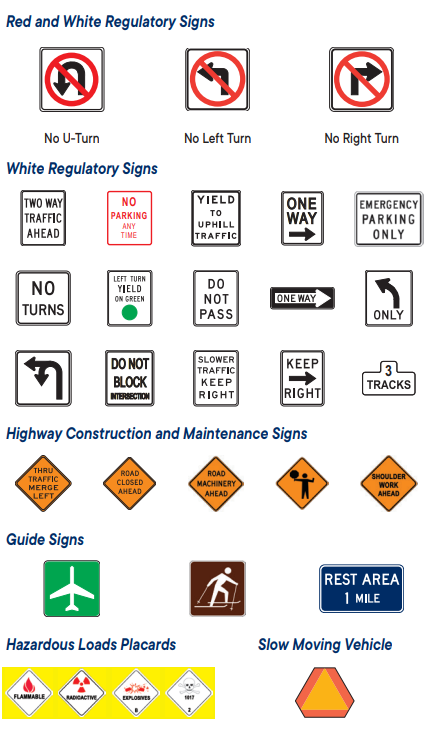
Red and White Regulatory Sign

Follow the sign’s instruction. For example, DO NOT ENTER means do not enter the road or ramp where the sign is posted.
WRONG WAY Sign

If you enter a roadway against traffic, DO NOT ENTER and WRONG WAY signs may be posted. When it is safe, back out or turn around. If you are driving at night, you will know you are going the wrong way if the road reflectors shine red in your headlights.
Red Circle with a Red Line Through It

The picture inside the circle shows what you cannot do and may be shown with words.
Yellow and Black Circular Sign or X-shaped Sign
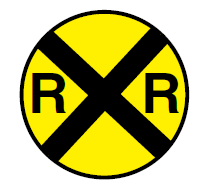
You are approaching a railroad crossing. Look, listen, slow down, and prepare to stop. Let any trains pass before you proceed.

Many railroad crossings also have a blue and white sign to tell you what to do if there is an emergency on or near the tracks or if your vehicle has stalled on the tracks.
5-sided Sign

You are near a school. Drive slowly and stop for children in the crosswalk.
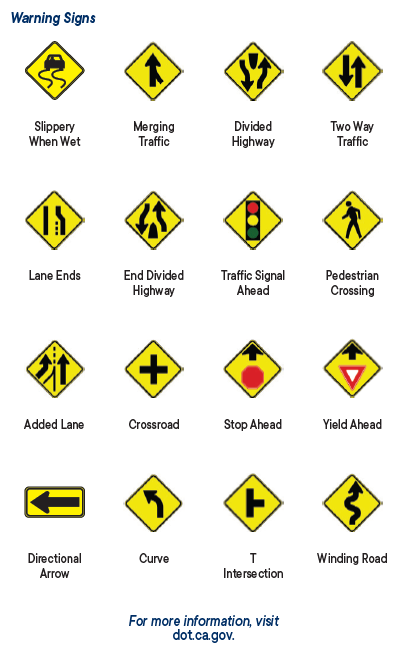
Diamond-shaped Sign
Warns you of specific road conditions and dangers ahead.
White Rectangular Sign
Communicates many important rules you must obey.
Warning Signs
Warns of conditions related to pedestrians, bicyclists, schools, playgrounds, school buses, and school passenger loading zones.
For more information about signs, visit dot.ca.gov/programs/safety-programs/sign-charts.
Right-of-Way Rules: Who Goes First?
Right-of-way rules help you understand who goes first when vehicles, pedestrians, and bicyclists meet on the road. The vehicle that arrives to the intersection first has the right-of-way. Other vehicles, bicyclists, and pedestrians must wait for the person who has the right-of-way. Never assume that other drivers will give you the right-of-way. Give up your right-of-way when it will help prevent collisions.
Intersections
An intersection is any place where one road meets another road. Controlled intersections have signs or traffic signal lights. Uncontrolled and blind intersections do not. Before entering an intersection, look left, right, and ahead to check for vehicles, bicyclists, and pedestrians. Be prepared to slow down and stop if necessary. Pedestrians always have the right-of-way. Here are some right-of-way rules at intersections:
- Without STOP or YIELD signs: The vehicle that arrives to the intersection first has the right-of-way. However, if a vehicle, pedestrian, or bicyclist gets to the intersection at the same time as you, give the right-of-way to the vehicle, pedestrian, or bicyclist on your right. If you approach a stop sign and there is a stop sign on all four corners, stop first and proceed as above.
- T intersections without STOP or YIELD signs: Vehicles, bicyclists, and pedestrians on the through road (continuing to go straight) have the right-of-way.
- Turning left: Check for pedestrians. Give the right-of-way to any pedestrian or approaching vehicle that is close enough to be dangerous.
- Turning right: Always check for pedestrians crossing the street, and motorcycles and bicycles riding next to you.
- Green traffic signal light: Proceed with caution. Pedestrians have the right-of-way.
- Entering traffic: When entering traffic, you must proceed with caution and yield to the traffic already occupying the lanes. It is against the law to stop or block an intersection where there is not enough space to completely cross before the traffic signal light turns red.
Roundabouts
In a roundabout, traffic travels in one direction around a central island.
How to use a roundabout:
- Slow down as you approach.
- Yield to all traffic already in the roundabout.
- Enter heading to the right when there is a big enough gap in traffic to merge safely.
- Watch for signs and lane markings that guide you.
- Travel in a counter-clockwise direction. Do not stop or pass.
- Signal when you change lanes or exit.
- If you miss your exit, continue around until you return to your exit.
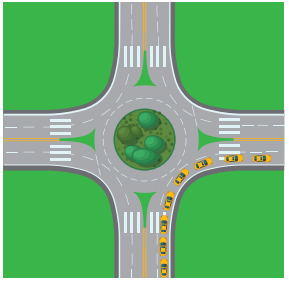
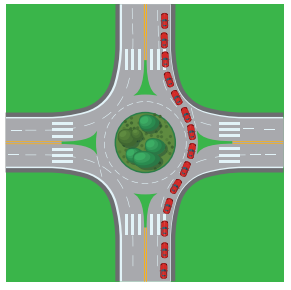
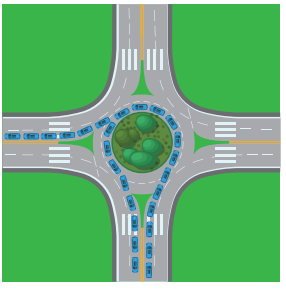
If the roundabout has multiple lanes, choose your entry or exit lane based on your destination. This is shown in the image below. To:
- Turn right (yellow car): Choose the right lane and exit in the right lane.
- Go straight (red car): Choose either lane. Exit in the lane you entered.
- Turn left: Enter and continue driving until you reach the exit in the direction you choose (blue car).
Pedestrians
These are considered pedestrians or vulnerable road users:
- A person walking.
- A person traveling on something other than a vehicle or bicycle. This includes roller skates, a skateboard, etc.
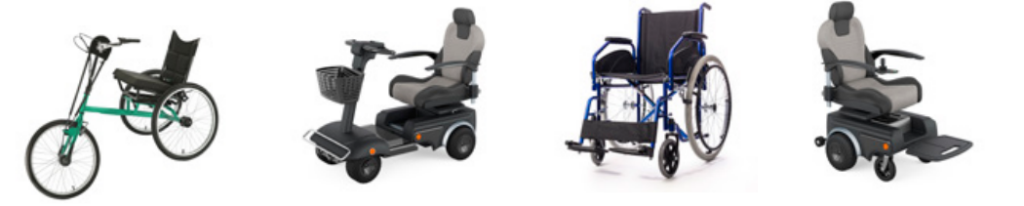
- A person with a disability using a tricycle, quadricycle, or wheelchair for transportation.
Although pedestrians have the right-of-way, they also must follow the rules of the road.
When there is a pedestrian crossing a roadway with or without a crosswalk, you must use caution, reduce your speed, or stop to allow the pedestrian to safely finish crossing.
Other things to keep in mind:
- Do not pass a vehicle stopped at a crosswalk. You may not be able to see a pedestrian crossing the street.
- If a pedestrian makes eye contact with you, they are ready to cross the street. Yield to the pedestrian.
- Always allow pedestrians enough time to safely cross a street as some groups such as seniors, people with small children, and people with disabilities may require extra time.
Crosswalks
A crosswalk is the part of the road set aside for pedestrians to safely cross the road. They are often marked with white lines. School crossings may have yellow crosswalk lines. Not all crosswalks are marked.
Pedestrians have the right-of-way in marked or unmarked crosswalks. If there is a limit line before the crosswalk, stop at the limit line and allow pedestrians to cross the street.
Some crosswalks have flashing lights. Whether or not the lights are flashing, look for pedestrians and be prepared to stop.
Pedestrians who are Blind
Pedestrians using guide dogs or white canes have the right-of-way at all times. These pedestrians are partially or totally blind. Be careful when you are turning or backing up. This is particularly important if you are driving a hybrid or electric vehicle because blind pedestrians rely on sound to know there is a vehicle nearby.
- Do not stop in the middle of a crosswalk. This could force a blind pedestrian to walk into traffic outside of the crosswalk.
- Do not honk your horn at a blind person.
- When a blind person pulls in their cane and steps away from the intersection, this gesture usually means you may go.
Mountain Roads
If two vehicles meet on a steep narrow road and neither vehicle can pass, the vehicle facing uphill has the right-of-way. The vehicle facing downhill has more control when backing up the hill. The vehicle facing downhill should back up until the vehicle going uphill can pass.
Section 7: Laws and Rules of the Road (Continued)
Other Important Roadway Information
You must:
- Not smoke when a minor is in the vehicle. You can be fined.
- Not dump or abandon animals on a highway. This crime is punishable by a fine of up to $1,000, six months in jail, or both.
- Not drive a vehicle so overloaded that you cannot control it, see ahead, or see to the sides of your vehicle.
- Not drive a vehicle with an unsecured load that is a safety hazard.
- Not carry anything in or on a passenger vehicle which extends beyond the fenders on the left side or more than 6-inches beyond the fenders on the right side.
- Cargo that extends more than 4 feet from the back-rear bumper of the vehicle must display a 12-inch red or fluorescent orange square flag.
- At night, this cargo must be marked with two red lights.
- Not allow a person to ride in the back of a pickup or other truck unless the vehicle has secure seats and seat (safety) belts.
- Not transport animals in the back of a pickup or other truck unless the animal is properly secured. This prevents the animal from falling, jumping, or being thrown from the vehicle.
- Not drive a vehicle equipped with a video monitor visible to the driver, unless it only displays vehicle information, navigation system, media player, or radio.
- Not throw a cigarette, cigar, or other flaming or glowing substance from your vehicle.
- Not put signs or other objects on the front windshield or side rear windows that block your view. Do not hang objects on the mirror. Objects may only be affixed in these locations:
- A 7-inch square on the lower corner of the passenger’s side windshield or the lower corner of the rear window.
- A 5-inch square on the lower corner of the driver’s side window.
- A 5-inch square located in the center uppermost portion of your windshield for an electronic toll payment device.
- On the side windows behind the driver.
- Not interfere with a funeral procession. A funeral procession is led by a traffic officer and has the right-of-way. All vehicles taking part in the procession have windshield markers to identify them and have their headlights on. You can be ticketed if you interrupt a funeral procession.
- Not operate a vehicle with an illegible license plate.
- Not alter a license plate in any way.
Evading Law Enforcement
It is a misdemeanor to use a motor vehicle to flee or attempt to evade law enforcement performing their duties. This is punishable by imprisonment in a county jail for one year or less.
A person convicted of causing serious bodily injury during a law enforcement pursuit is subject to imprisonment in a state prison for up to seven years, or a county jail for one year or less.
A person convicted of manslaughter resulting from evading law enforcement during a pursuit is subject to imprisonment in a state prison for a minimum of 4 to 10 years.
If an unlicensed person is caught driving your vehicle, it may be impounded for 30 days.
Speed Contests and Reckless Driving
A person convicted of reckless driving or engaging in a speed contest that causes injury to another person is subject to imprisonment, a fine, or both.
Points on Your Driver’s Record
DMV monitors your driver’s record. If you are stopped by a law enforcement officer and cited (ticketed) for a traffic violation, you sign the ticket as a promise to appear in traffic court. As an adult or minor, if you get a traffic ticket and fail to appear (FTA) in court, DMV may suspend your driving privilege until you appear. If you do not keep your promise to appear in court, the FTA goes on your driver’s record.
Each time you are convicted of a moving traffic violation, the court notifies DMV. The conviction is placed on your driver’s record. Convictions reported by other states and juvenile court are also added to your driver’s record. Traffic convictions and collisions stay on your record for 36 months or longer, depending on the type of conviction. As an adult, your license may be suspended if your driver’s record shows one of the following point totals:
- 4 points in 12 months.
- 6 points in 24 months.
- 8 points in 36 months.
Traffic Violator School
If you are given a one-point traffic violation, the judge may offer you the choice to attend a traffic violator school to have the citation not reported to your insurance company but remain on your driving record. You can do this once in any 18-month period. The school will report your course completion to the court. You will also get a completion receipt.
If you are a commercial driver cited in a noncommercial vehicle, see the California Commercial Driver’s Handbook.
Suspension or Revocation
If you have too many points on your driver’s record, you will be considered a negligent driver. DMV will place you on probation, suspend, or revoke your driving privilege. When this happens, you have the right to a hearing. DMV will notify you in writing of any action taken against your driving privilege and inform you of your legal rights, including your right to a hearing.
DMV will revoke your driving privilege if you are convicted of a hit-and-run or reckless driving that resulted in injury. Courts also have the authority to suspend a person’s driving privilege.
At the end of your suspension or revocation, you may apply for a replacement driver’s license. You must show proof of financial responsibility (such as SR 22/SR 1P).
Maintaining Your Minor’s (Provisional) Driver’s License
If you get into collisions or commit traffic violations within the first 12 months of obtaining your minor’s driver’s license, DMV may restrict or suspend your driving privilege. You cannot drive if your driving privilege is suspended or revoked.
As a minor, DMV may take action against your license if you have:
- One at fault collision or traffic violation conviction: An at fault collision means you were found responsible.
- Two at fault collisions, two traffic violation convictions, or one of each: You cannot drive for 30 days unless a licensed adult, at least 25 years old, rides with you.
- Three at fault collisions, three traffic violation convictions, or a combination: Your driving privilege will be suspended for six months. You will be on probation for one year.
- If you have more at fault collisions or traffic violation convictions while on probation, your license will be suspended again.
- A conviction of using alcohol or a controlled substance, or both and are 15-20 years old: The court will order DMV to suspend your driving privilege for one year or delay your eligibility to apply for a driver’s license.
Note Turning 18 years old does not erase or end existing restrictions, suspensions, or probation sentences.
Administrative Hearing
Administrative hearings are conducted by DMV. If you received notification that a proposed action is being taken against your driving privilege, you must request a hearing within 10 days of being served or 14 days from the date the notice is mailed. If you do not make a timely request, your right to a hearing will be lost.
This hearing provides you with an opportunity to be heard before an action is taken against your driving privilege. You may also have to appear in court for the same reason. Any action taken by the court is independent of the action taken by DMV.
Your Hearing Rights
You have the right to:
- Present relevant evidence and witnesses on your behalf.
- Testify on your behalf or be represented by an attorney or other representative at your expense. Representation by an attorney is not required.
- Review the evidence and cross examine the testimony of any witness. DMV bases its case only on written documents. If you wish to question someone who prepared a document or is listed on a document used as evidence, it is your responsibility to acquire a subpoena.
For more information regarding Administrative Hearings, visit dmv.ca.gov/driversafety.
Unsafe Driver
If you know someone who no longer drives safely, you may submit a Request for Driver Reexamination (DS 699) to DMV to review their driving qualifications. To obtain a form, visit dmv.ca.gov/reexamination.
Record Confidentiality
Most information in your driver’s record is available to the public, except physical or mental conditions, address, and social security number.
You can get a copy of your driver’s record online or at a kiosk. For more information on record requests, visit dmv.ca.gov/record-requests.
Section 13: Seniors and Driving
Senior drivers often have unique needs and concerns about driving. Driving requires certain physical, visual, and mental abilities. We all want to continue driving as long as we can. However, the time may come when we must limit or stop driving temporarily or permanently. Here are some warning signs of an unsafe driver:
- Getting lost in familiar places.
- Dents and scrapes on the car, fences, mailbox, garage doors, etc.
- Frequent close calls or collisions.
Senior drivers may consider:
- Limiting or not driving at night.
- If night driving is necessary, choose a well-lit route.
- Driving during the time of day when traffic is light.
- Avoiding difficult intersections.
- Driving for short distances or limiting driving to essential places.
- No freeway driving.
- Installing an additional right-side mirror.
To get the Driver Skills Self-Assessment Questionnaire, visit dmv.ca.gov/driver-skills.
Driver’s License Renewal
If you are 70 years old or older at the time your driver’s license expires, you are required to renew your driver’s license in person and pass a vision test. In some cases, other exams may be required. If a knowledge test is required, you may be eligible to select “eLearning” when completing your application online. DMV sends a renewal notice to your address of record about 90 days before your driver’s license expires. If you do not receive a renewal notice, complete a Driver License or Identification Card Application at dmv.ca.gov/dlservices or at a DMV office. Visit dmv.ca.gov/driver-ed for more information and sample tests.
DMV’s Community Liaison and Outreach
The Community Liaison’s primary function is to represent public safety interests for all Californians, with a focus in addressing the concerns of senior drivers and teens. The liaison can assist as a go-between to ensure drivers are treated fairly, consistently with laws and regulations, and with dignity and respect. While the Community Liaison cannot represent you in a DMV hearing or reexamination, they can provide you with useful tools and information.
For information about outreach services in your area or to speak to a liaison, contact Community Liaison and Outreach at (833) 493-0675.
Cognitive Impairment
Seniors suffering from dementia present a significant challenge to safe driving. Individuals with progressive dementia ultimately lose their ability to drive safely. It is often up to caregivers, physicians, and law enforcement, to stop these seniors from driving and arrange alternative transportation. For more information about the reexamination process, visit dmv.ca.gov/reexamination.
Mature Driver Program
The Mature Driver Improvement Program is an eight-hour course for drivers 55 years old and older. It covers a range of topics that are of special interest to mature drivers.
Your insurance company may offer discounts if you complete the program. Contact your insurance provider with a copy of your completion certificate. Your certificate is valid for three years. You can renew it by completing another four-hour course.
You can take the course through DMV-approved providers. Visit dmv.ca.gov/seniors for more information, including locations near you.
Senior ID Cards
If you are 62 years old or older, you are eligible for a no-fee Senior ID card. Drivers of any age who are unable to continue driving safely due to a physical or mental condition may be eligible to exchange their driver’s license for a no-fee ID card. The ID card serves as identification only. Details may be found at dmv.ca.gov/id-cards.
Disclaimer
Disclaimer
This handbook is a summary of the laws and regulations in the Vehicle Code available at leginfo.legislature.ca.gov. DMV, law enforcement, and the courts follow the full, exact language.
Contact Us
Send comments or suggestions for this driver’s handbook to dmv.ca.gov/customerservice.
Section 14: Glossary
| Term | Definition |
|---|---|
| TermBehind-the-wheel drive test | DefinitionA drive test where you have control of the vehicle and are accompanied by a DMV examiner who is evaluating your driving skills. |
| TermBlood alcohol concentration (BAC) | DefinitionYour BAC is the amount of alcohol in your blood. For example, if your BAC is 0.10%, that means you have 0.10 grams of alcohol in 100 milliliters of blood. |
| TermDriving performance evaluation (DPE) | DefinitionDPE is the portion of the behind-the-wheel drive test when you drive your car with a DMV examiner who evaluates your driving skills. |
| TermPedestrian | DefinitionA pedestrian is a person walking and can also be a person with a disability using a tricycle, quadricycle, or wheelchair for transportation. |
| TermRight-of-way | DefinitionHelps determine who is allowed to go first in situations where vehicles, pedestrians, and cyclists meet on the road. |
| TermThree-second rule | DefinitionA driving rule that helps you estimate how closely you should follow other vehicles. When the vehicle in front of you passes a certain point, such as a sign, count three seconds. If you pass the same point before you finish counting, you are following too closely. |
| TermTraffic citation | DefinitionAlso known as a ticket, a traffic citation is an official summons issued by law enforcement for violating a traffic law. |
| TermVulnerable road users (VRU) | DefinitionVRUs are non-motorized road users, such as cyclists, pedestrians, and persons with disabilities or reduced mobility and orientation using a wheelchair, tricycle, or quadricycle. |
| TermYield | DefinitionYield means to wait for, slow down, and be ready to stop (if necessary) to allow other vehicles or pedestrians who have right-of-way to proceed. |
DMV Services
Have your driver’s license or identification (ID) card number, vehicle license plate number, or vehicle identification number (VIN) available.
Online Services
Vehicle Registration Renewal at dmv.ca.gov/vrservices.
Driver’s License Renewal at dmv.ca.gov/dlservices.
Office Appointments at dmv.ca.gov/make-an-appointment.
Visit dmv.ca.gov/online to find many other online services.
Kiosk Services
Visit dmv.ca.gov/kiosks to find kiosk services and locations.
Phone Services
Call 1-800-777-0133:
During normal business hours:
- Talk to a DMV representative.
Automated 24/7 Phone Services:
- Renew your vehicle registration.
- Make a DMV office appointment.
Individuals who are deaf, hard of hearing, or speech impaired may call 1-800-368-4327 for assistance.
Section 12: Driver Safety
Eventually, every driver will need to evaluate and assess their driving skills and abilities. If you are concerned about your driving, ask a trusted driver with a valid driver’s license to sit in the passenger seat and observe your driving. Your observer should note any dangerous driving behaviors and give suggestions for improvement. Listen carefully and apply what you have learned. Consider professional driving lessons or driving classes as an alternative.
Reexamination
The Vehicle Code allows DMV to investigate and reexamine every driver’s ability to operate a motor vehicle safely. A physical or mental condition or poor driver’s record can be the basis for a reexamination, not a driver’s age. Drivers with a physical or mental condition can be referred to DMV by a physician, law enforcement, or family member by submitting a completed Request for Driver Reexamination (DS 699) form.
Cognitive disorders, such as dementia, seizure disorder, brain tumor, Parkinson’s disease, stroke, or vertigo, present a significant challenge to safe driving. Individuals suffering from these conditions may lose their ability to drive safely.
Note When a referral or diagnosis for a driver with a mild cognitive impairment is received by DMV, the Driver Safety team will schedule a reexamination. For more information regarding the reexamination process, visit dmv.ca.gov/reexamination.
DMV may do the following:
- Request medical information from you or your physician.
- Conduct an in-person or over the telephone reexamination.
- Require you to take a knowledge, vision, or driving test(s).
- Issue you a limited term driver’s license.
- Immediately suspend or revoke your driving privilege if your physical or mental condition presents an immediate threat to public safety.
- Take no action against your driving privilege.
Priority Reexamination
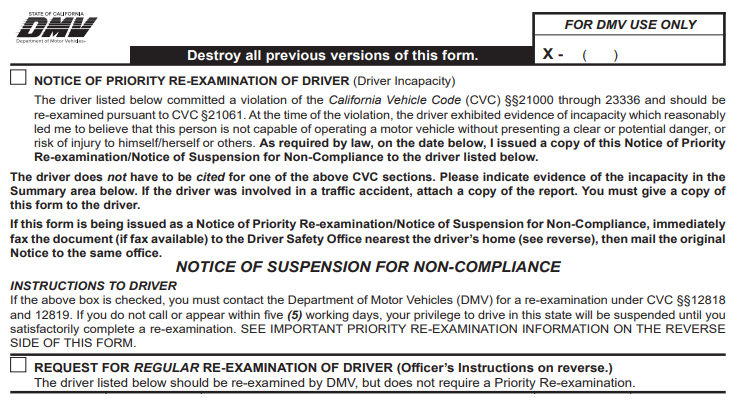
If you come in contact with law enforcement and receive a Notice of Priority Reexamination of Driver with a check mark in the top box, carefully read the form. You have five working days to contact DMV to initiate the process or your driving privilege will be automatically suspended.
Driver’s License Restrictions
DMV places restrictions on a driver’s license to ensure a driver is operating a vehicle within their ability. Restrictions may be imposed by DMV or required by law. Restrictions placed on your driving privilege will be reasonable and necessary for your safety and the safety of others. Restrictions and conditions may include:
- Requiring a driver to place special mechanical devices on their vehicle, such as hand controls.
- Limiting when and where a person may drive, such as no night or freeway driving.
- Requiring eyeglasses or corrective contact lenses.
- Requiring additional devices, such as outside mirrors.
Note There are no specific restrictions for seniors. All restrictions are based on conditions, not age.
Any restriction placed on your driver’s license is based on the examiner’s findings and recommendations.
IRP Glossary
The following vehicle illustrations are the types of power units that should be listed in Column 11 of the Schedule C:
| TYPE VEHICLE | DEFINITION | PICTURE DESCRIPTION |
|---|---|---|
| TYPE VEHICLETractor (TR)1 Plate Issued | DEFINITIONA motor vehicle designed and used primarily for drawing other vehicles, but not so constructed as to carry a load other than a part of the weight of the vehicles and load so drawn. | PICTURE DESCRIPTION |
| TYPE VEHICLETruck (Single) (TK)2 Plates Issued | DEFINITIONEvery motor vehicle designed, used or maintained primarily for the transportation of property. | PICTURE DESCRIPTION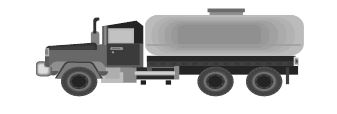 |
| TYPE VEHICLETruck Tractor (TT)1 Plate Issued | DEFINITIONA motor vehicle designed and used primarily for drawing other vehicles but constructed as to carry a load other than a part of the weight of the vehicle and the load drawn. | PICTURE DESCRIPTION |
| TYPE VEHICLERoad Tractor (RT)1 Plate Issued | DEFINITIONA motor vehicle designed and used for drawing other vehicles and not so constructed as to carry any load thereon either independently or any part of the weight of a vehicle or load so drawn. | PICTURE DESCRIPTION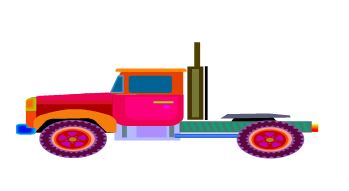 |
| TYPE VEHICLEBus (BS)2 Plates Issued | DEFINITIONDesigned and used for transporting passengers | PICTURE DESCRIPTION |
| TYPE VEHICLEWrecker (WK)(Tow Truck)2 Plates Issued | DEFINITIONA motor vehicle which has been altered or designed and equipped for, and primarily used in the business of, transporting vehicles by means of a crane, hoist, tow bar, tow line, or dolly or is otherwise primarily used to render assistance to other vehicles. | PICTURE DESCRIPTION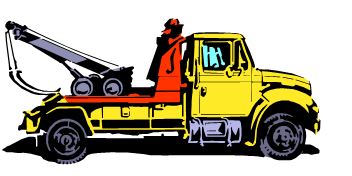 |
| TYPE VEHICLEPick-Up Truck (PU)2 Plates Issued | DEFINITIONA motor truck with a manufacturer’s gross vehicle weight rating of less than 11,500 pounds, and unladen weight of less than 8,001 pounds, and which is equipped with an open box-type bed not exceeding 9 feet in length. Pick-up truck does not include a motor vehicle otherwise meeting the above definition that is equipped with a bed-mounted storage compartment unit commonly called a “utility body.” | PICTURE DESCRIPTION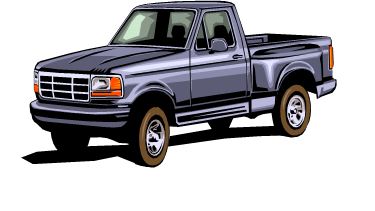 |
| TYPE VEHICLEUnladen Weight (CVC. 660) | DEFINITIONThe “unladen weight” of a vehicle is the weight equipped and ready for operation on the road including the body, fenders, oil in motor, radiator full of water, with five gallons of gasoline or equivalent weight of other motor fuel; also equipment required by law, and unless exempted under CVC Section 661, any special cabinets, boxes or body parts permanently attached to the vehicle, and any machinery, equipment or attachment which is attendant to the efficient operation of the body or vehicle. Unladen weight shall not include any load or any machinery or mechanical apparatus, such as, but not limited to, wood saws, well-drilling machines, spray apparatus, tow truck cranes, and grinding equipment. The unladen weight of a vehicle shall have no application in determining any fee under this code or the RTC other than Section 9400.” | PICTURE DESCRIPTION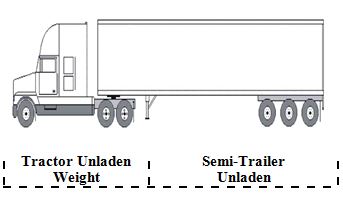 |
| TYPE VEHICLEDeclared Gross WeightOrGross Vehicle Weight | DEFINITIONThe weight that equals the total unladen weight of the vehicle plus the weight of the heaviest load that will be transported on the vehicle. | PICTURE DESCRIPTION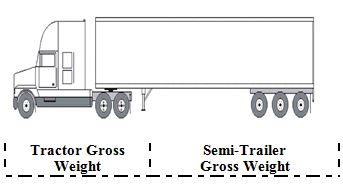 |
| TYPE VEHICLEDeclared Combined Gross WeightOrCombined Gross Vehicle Weight | DEFINITIONThe total unladen weight of the combination of vehicles (motor truck and trailer) plus the weight of the heaviest load that will be transported by the combination. | PICTURE DESCRIPTION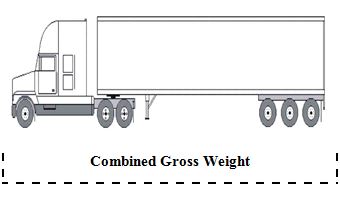 |
Chapter 9: Audits
9.000 – AUTHORITY AND FREQUENCY OF AUDITS
California Vehicle Code (CVC) Section 8057(b) authorizes the Department to audit fleet records of apportioned registrants to ensure the accuracy of the reported distance (mileage), vehicle cost, and weight information.
The Plan Section 1020 authorizes the base jurisdiction to audit the apportioned registration applications and supporting documents of registrants based in that jurisdiction. The audit shall be to assess the accuracy of distances reported in the application for apportioned registration, and where inaccuracies are found, to adjust the fees accordingly. An audit conducted by the base jurisdiction shall be conducted on behalf of all Member Jurisdictions, and the base jurisdiction may assess and collect fees based on its audit.
Per Section 1025 of the Plan, Member Jurisdictions shall conduct a number of audits equivalent to an average of three percent per year of the number of fleets whose registration it renews annually. Nothing in this section precludes a base jurisdiction from conducting more audits than required or from auditing a registrant more than once.
9.005 – JOINT AUDITS
IRP Section 1030, “Joint Audits,” allows audits of any registrant by multiple jurisdictions. Upon completion of the joint audit, the base jurisdiction is responsible for issuing the audit report, collecting and distributing the resulting fee adjustments, and resolving any disagreement with the audit findings.
9.010 – PURPOSE OF AUDITS
Audits are necessary to ensure: (1) The accuracy and integrity of information reported on the apportioned registration applications;
(2) Compliance with provisions of the IRP and jurisdictional statutes; and (3) Proper payment of apportionable fees to all affected Member Jurisdictions.
9.015 – AUDIT STANDARDS
Audits are conducted in a professional manner with the results clearly documented, following the Plan, the IRP Audit Procedures Manual, and Generally Accepted Government Auditing Standards.
9.020 – AUDIT LOCATION
Audits are performed at DMV Headquarters in Sacramento (in-house audits) or at the registrants’ or the designated agents’ business locations where operational records are maintained and made available for examination (field audits), as determined by the Department.
9.025 – AUDIT NOTIFICATION
In accordance with IRP Audit Procedures Manual Section 401(a) and CVC Section 8057(b), the Department will provide a 30-day notice to the registrant prior to conducting the audit. For just cause, notification requirements may be waived, as provided in IRP Audit Procedures Manual Section 401(c).
For field audits, the auditor will contact the registrant or the registrant’s authorized agent by telephone to arrange an audit. An audit notification letter is sent to the registrant to confirm the audit commencement date, the registration year(s) to be audited, the location where the audit will take place, the types of records to be examined, and the person(s) conducting the audit.
For in-house audits, the auditor will notify the registrant by telephone. An audit notification letter is also sent to the registrant regarding the registration year(s) to be audited, the types of records to be examined, the due date for the submission of records, the address to where records should be sent, and other information regarding the audit.
Audit notification letters are sent by certified mail to the last known mailing address on record with the Department, and are considered received, when delivered. It is the responsibility of the registrant to ensure that the telephone numbers as well as business and mailing addresses are correct and current, and to promptly notify the IRP Operations Section whenever there is an address change.
9.030 – ENTRANCE (OPENING) CONFERENCE
The auditor will hold an entrance conference with the registrant or agent to discuss the registrant’s operations, distance accounting and reporting system, records to be examined, sampling procedures, and the extent and timing of the audit. For in-house audits, the entrance conference will be held over the telephone.
9.035 – TRAVEL EXPENSES
Pursuant to CVC Section 8057(b), the registrant may be required to reimburse the Department for the auditor’s per diem and actual travel expenses incurred under certain conditions as determined by the Department.
In-house audits involve no travel expenses. Under the Department’s current administrative policy, the registrant will not be charged for the travel cost for a field audit conducted in California, except when:
- A return trip is required to complete the fieldwork because the required records were unavailable or unauditable.
- The registrant requests the audit to take place at its place of business or another location in lieu of sending the records to the Department’s Headquarters in Sacramento, when it is deemed reasonable and cost effective for the Department to conduct an in-house audit due to the small size of the fleet or other reasons.
California-based registrants shall reimburse the Department for the auditor’s per diem and actual travel expenses for audits conducted outside California.
9.040 – EXIT (CLOSING) CONFERENCE
At the conclusion of the audit, the auditor will hold an exit conference with the registrant to review audit issues and preliminary findings; an overview of the post-audit process, including to whom the final audit report should be addressed; reporting procedures, rights of appeal, and any recommendations for improvement of the registrant’s distance record keeping and reporting system.
9.045 – NOTIFICATION OF AUDIT RESULTS TO REGISTRANTS
Upon completion of an audit, an audit report is issued to the registrant (and the designated agent, if any). When mailed to the last known mailing address of the registrant as it appears on the Department’s records, the audit report is considered sufficient notification of the audit results whether it is received or not.
9.050 – REGISTRANT’S OPTIONS UPON RECEIPT OF AUDIT REPORT
The registrant shall have 30 days from the issuance of the audit report to:
- Pay the netted assessment in full to the Department.
- Request a reevaluation (reexamination) of the audit results and provide additional documents not previously made available.
- File an appeal to contest the audit results.
Non-receipt of or refusal to accept the audit report will not extend the deadline allowed for payment of the assessment or for requesting a reevaluation or hearing.
Requests to modify the audit findings must be made within the 30-day statutory deadline, with supporting documentation. Records received after the 30-day period will not be accepted for reevaluation.
If the registrant submits a timely request for reevaluation of the audit results, and provides additional records to the Department, the Department will notify the registrant of the result of its reevaluation upon completion, including any modifications to the original findings and/or assessment.
The registrant will have 30 days from the date of notice to pay any audit assessment due or to request a hearing.
Audit appeals must be made to the Audits Branch within the time period specified in the audit report or notification of the reevaluation result, and shall include the areas of disagreement and specific reasons for a hearing.
If the audit resulted in a net assessment, the registrant shall pay the uncontested portion of the audit assessment.
In the appeal, California as the base jurisdiction, shall act on behalf of all affected jurisdictions. Upon the resolution of an appeal, California will notify all affected Member Jurisdictions of the results.
9.055 – INTEREST AND PENALTIES ON UNDERPAID CALIFORNIA FEES
In accordance with CVC Section 8058, interest is assessed at the rate of 1 percent per month of the underpaid portion of the California fees, commencing on the date the underpaid portion of the fees were originally due and accruing monthly until paid. This interest will continue to accrue despite any dispute or hearing regarding the underpaid fees. If the audit is under appeal or reevaluation, the registrant may pay the underpaid portion of the California fees, as determined in the audit, to avoid accumulation of additional interest.
In addition, a penalty of $50 or 10 percent of the underpaid portion, whichever is greater, is assessed on any underpaid California fees.
California does not calculate, bill, or collect penalties, interest, or any other charges for other Member Jurisdictions. As such, the registrant may receive billings from other Member Jurisdictions for such charges.
9.060 – FAILURE TO MAINTAIN OR PROVIDE ADEQUATE RECORDS FOR AUDIT
In accordance with the Plan Section 1015 “Inadequate Records; Assessment” if the records produced, for the fleet as a whole, for audit are determined to be inadequate to perform an audit, or if, within 30 calendar days of the issuance of a written request by the base jurisdiction, the registrant produces no records, the base jurisdiction shall impose on the registrant an assessment in the amount of 20 percent of the apportionable fees paid by the registrant for the registration of its fleet in the registration year to which the records pertain, including apportionable fees based on estimated distance.
In an instance where the base jurisdiction knows that it is the registrant’s second such offense, the base jurisdiction shall impose an assessment of 50 percent of the apportionable fees paid by the registrant for the registration of its fleet in the registration year to which the records pertain.
When the base jurisdiction knows it is the registrant’s third offense, and on any subsequent offenses of the registrant known to the base jurisdiction, the base jurisdiction shall impose an assessment of 100 percent of the apportionable fees paid by the registrant for the registration of its fleet in the registration year to which the records pertain.
The base jurisdiction shall distribute the amounts of assessment it collects under this Section on a pro rata basis to the other jurisdictions in which the fleet was registered.
9.065 – NETTING OF AUDIT FEE ADJUSTMENTS
In accordance with IRP Section 1050, “Netting Audit Adjustments,” all underpayments and overpayments of fees to affected jurisdictions resulting from the audit are netted. California will collect the net underpayment from the registrant or refund the net overpayment to the registrant.
All affected Member Jurisdictions will be notified of the results of the audit and will have 45 days from the date of the report to appeal or notify California and the registrant of their intent to reexamine records. As a result, the net fee adjustment may change pending acceptance of the audit findings by other Member Jurisdictions.
9.070 – LIEN, SUSPENSION OF OPERATING AUTHORITY, AND SEIZURE OF VEHICLES
Pursuant to CVC Section 8201(a), unpaid fees constitute a lien on all vehicles operated as part of the fleet and on any other fleet vehicles operated by the registrant. The lien will follow the vehicles regardless of their removal or separation from the fleet. Liens arising as the result of an audit expire four years from the date the registration fees first become due unless the lien is perfected. Perfected liens shall expire five years from the date of the perfection.
The audit report also serves as a lien notice to the registrant if the audit results in net underpaid fees. The lien is perfected upon: (1) the mailing of a lien perfection notice; and (2) the recording of the lien on the Department’s electronic vehicle registration records. Such liens may be perfected in the form of a Vehicle License and Titling (VLT) stop on the vehicle identification number.
Pursuant to CVC Section 8203(a), when a lien is perfected and the opportunity to submit additional documentation or request a hearing has passed, the Department may suspend or cancel the operating privileges of the fleet. When the suspension takes effect, the Department may seize a sufficient number of vehicles to satisfy the lien without further notice to the registrant. Upon full payment of the delinquent fees, interest, and penalties, the recorded lien will be removed from the Department’s vehicle registration database.
If you have any questions regarding liens, payments, collections, suspension, and seizure and sale of vehicles, please contact:
Department of Motor Vehicles
Registration Operations Division
IRP Operations Section
Audit Collections M/S H179
P. O. Box 932320
Sacramento, CA 94232-3200
Telephone Number: (916) 657-8092
If you have any questions regarding the audit, reevaluation, or appeal, please contact:
Department of Motor Vehicles
Audits Branch
IRP Audit Section M/S F157
P. O. Box 932328
Sacramento, CA 94232-3280
Telephone Number: (916) 657-7576
Chapter 8: New Fleet Registration Requirements
8.000 – NEW FLEET APPLICATIONS
The documents and requirements for registration of a new fleet is the same as for a new carrier, except for the established place of business and base jurisdiction residency requirements.
If the new fleet has the same business address (physical address) as the address shown on the IRP account, new basing documents are not required.
New fleets with a different business address (physical address) that differs from the address on the IRP account must provide a lease, rental agreement, or mortgage document as proof of established place of business.